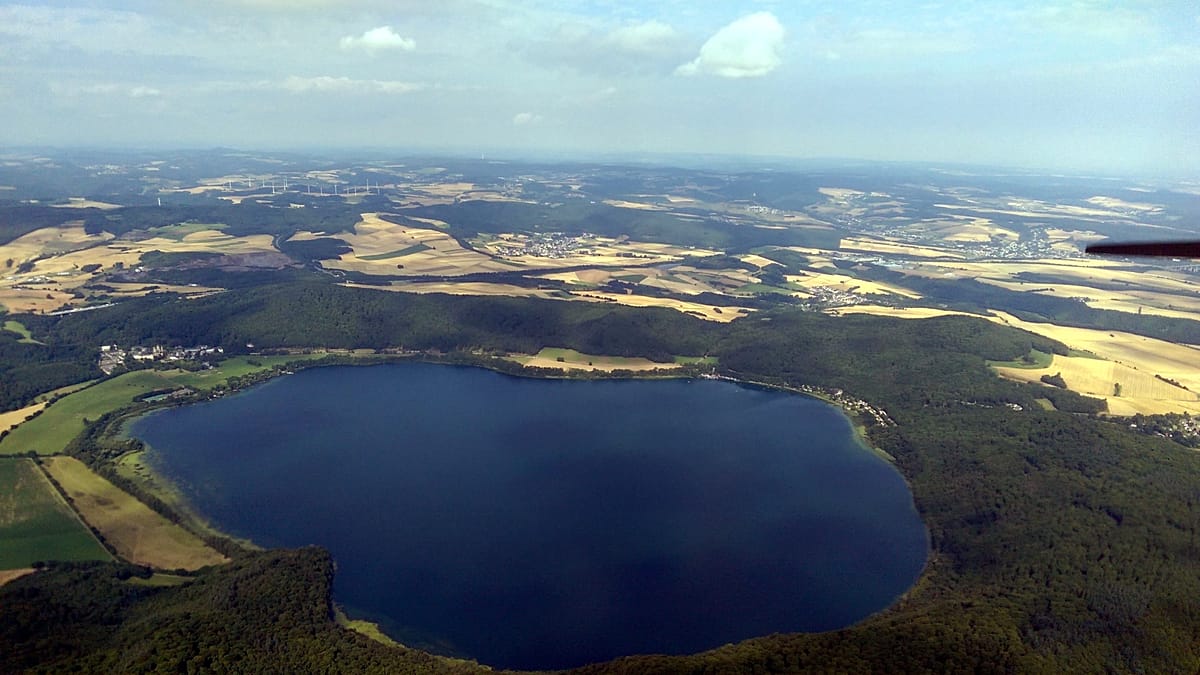
Deep beneath the tranquil surface of Lake Laach in western Germany's Eifel region, the earth is not entirely at rest. Over a 12-month period from September 2022 to August 2023, seismologists recorded more than 500 micro-earthquakes beneath the lake, which occupies the crater of a volcano that last erupted around 13,000 years ago. The findings, published in a 2026 study, add to a growing body of evidence that the volcanic system is still active.
A sleeping giant with a violent past
The Laacher See volcano produced one of the most powerful eruptions in Europe's recent geological history. Its last outburst, now dated to 13,084 years ago, sent ash as far north as Sweden and as far south as northern Italy. The explosion is estimated to have been equivalent to roughly 500 Hiroshima bombs, leaving a layer of pumice and ash up to 60 metres thick near the vent and seven metres in the Rhine valley.
Given that history, scientists have long urged continuous monitoring. The new seismic data, collected by a network of stations around the lake, reveals a pattern of deep low-frequency (DLF) earthquakes. These are distinct from ordinary tremors: they occur at depths of 12 to 14 kilometres and are widely regarded as indicators of magmatic fluid movement. Torsten Dahm, head of the Earthquake and Volcano Physics section at the GFZ German Research Centre for Geosciences, explains: "DLF earthquakes are regarded worldwide as an indication of the movement of magmatic fluids at great depth. Under active volcanoes, for example in Iceland, Japan or Kamchatka, such earthquakes can be observed regularly."
The fluids in question—water, oxygen, sulphur compounds, and halogens—are released from molten rock and play a crucial role in determining how explosively a volcano erupts. Their movement can also trigger earthquakes in the subsurface. According to the GFZ, these fluids may be rising from the upper mantle along the Ochtendung fault zone, suggesting that magma chambers beneath Lake Laach could be slowly filling.
Recent swarm and other signs of life
On the night of 10 October 2025, an unusual earthquake swarm shook the region: about 92 small micro-quakes within twelve hours, the strongest with a magnitude of just 0.9. This swarm is part of a broader pattern. Martin Hensch, lead author of a 2019 study, noted that "four spatially confined clusters of such DLF earthquakes have been detected in the Eastern Eifel over the past five years."
Beyond the seismic activity, there are other telltale signs. Bubbles of carbon dioxide of magmatic origin rise to the surface of the lake, and in 2024 the GFZ confirmed CO2 emissions at two sites around the lake. The researchers describe the process as a natural example of hydraulic fracking, where fluids fracture the rock under pressure.
Despite these stirrings, experts are clear that an eruption is not on the horizon. The magma that fuelled the last eruption took an estimated 30,000 years to accumulate in the upper chamber. Joachim Ritter from the Geophysical Institute at KIT points out that "the ascent of magma into the shallow crust is almost always accompanied by high-frequency earthquake swarms. Such activity has not yet been observed in the Eastern Eifel." Dahm adds that there is no evidence of surface uplift, which would be expected if a large magma body were moving upward.
The Laacher See system is one of several volcanic fields in the Eifel, a region that owes its name to its fiery past. While the immediate threat is low, the research underscores the importance of continued vigilance. As Dahm puts it, the underground processes are active, and understanding them is key to assessing future risks.
For those interested in Germany's broader geological and energy landscape, the country is also making headlines with record-breaking wind turbines and a growing role in Europe's gaming industry. But beneath the surface, the Eifel remains a reminder that Europe's geology is far from static.