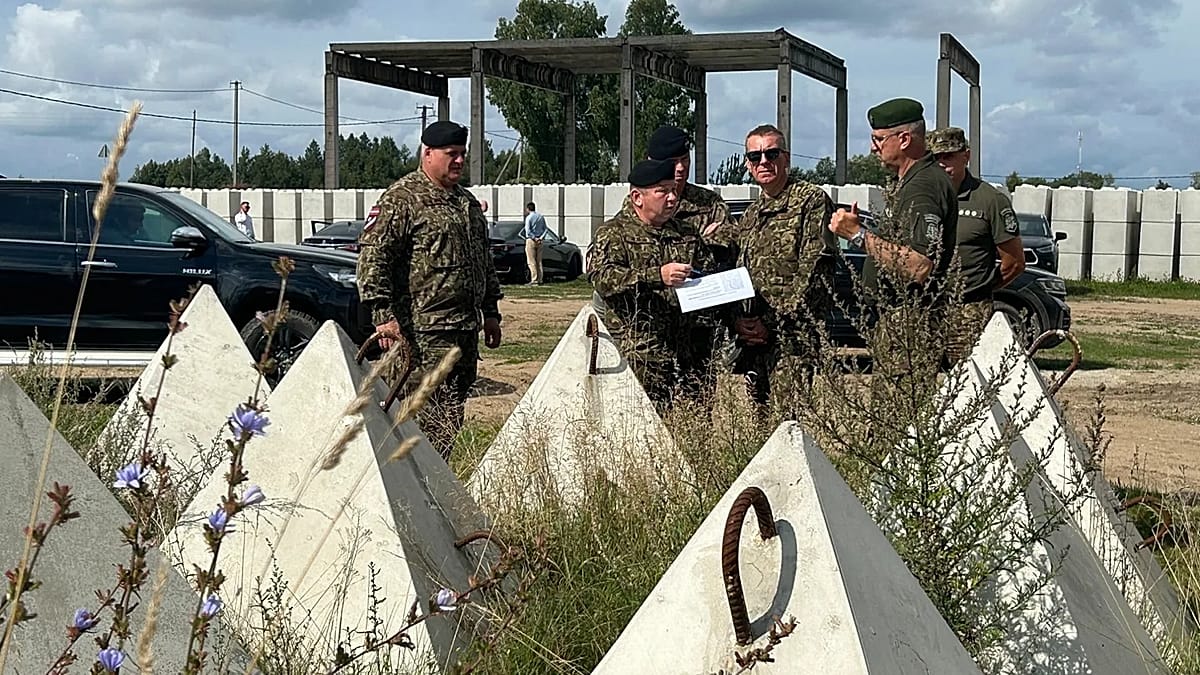
On the eastern edge of the European Union and NATO, Latvia is hardening its frontier against a convergence of threats that its officials say can no longer be treated as separate issues. Along the 173-kilometre border with Belarus, a newly completed fence is now backed by expanding surveillance systems and the construction of defensive positions designed to slow any potential ground assault.
For Riga, the challenges of irregular migration, drone intrusions, and the risk of military confrontation are now viewed as parts of a single, broader security problem facing NATO's eastern flank. “We have, unfortunately, very aggressive neighbours: Russia and Belarus,” Guntis Pujāts, Chief of the State Border Guard, told Euronews.
This summer has seen a sharp rise in attempted crossings. Latvian border guards have stopped nearly 10,000 attempts this year, with more than 100 recorded on some days, including 16 August. Officials accuse the regime of Belarusian President Alexander Lukashenka of orchestrating the flows as a hybrid attack designed to pressure the EU.
Migration as a political weapon
Since 2021, Latvia, Lithuania, and Poland have all experienced increased attempts to cross from Belarus, but the scale varies. Latvian President Edgars Rinkēvičs, during a visit to the border, suggested the timing is deliberate. “Partly this is because we have elections in October,” he said, adding that for Minsk, “it's very important somehow to show that we are not able to cope with the pressure. To somehow indirectly influence the electoral process.”
Latvia's vulnerability has been compounded by delays in completing its border infrastructure. The fence was only fully erected this year, and technological surveillance systems are not expected to be finished until the end of 2024. The border guard also needs up to 200 additional personnel. In the meantime, neighbouring countries have stepped in. “We are supported by Lithuanian, Estonian and Finnish border guards. And I plan to sign this agreement next month with Poland,” Pujāts said, underscoring regional solidarity.
Yet Pujāts laments a lack of understanding among some EU member states about the scale of the situation. “Unfortunately, there is not enough understanding about the current situation,” he said, noting that most migrants intend to move further west. “Latvia is not a target country. We are guarding, you know, Germans, Belgians, Netherlands here in Latvia,” he explained, adding that migrants see the country as a transit route. “But we do not allow them to do this.”
Preparing for a wider conflict
Beyond migration, Latvia is deepening its military preparedness. Together with Lithuania and Estonia, it is developing the Baltic Defence Line—a network of anti-tank obstacles, ditches, and other defensive positions, along with drone and minefield plans. However, military leaders caution that a conventional invasion is not the most immediate threat. “If you look at the threat perception, what we are seeing now, of course, most likely…is potential hybrid activities,” said Lieutenant General Kaspars Pudāns, commander of Latvia's National Armed Forces.
“Currently, it doesn't require much of resources to recruit some local population, even not knowing what they're conducting, somehow creating some diversion activities, sabotage activities,” Pudāns continued. “And it's not only physical ones. It could also be in the cyber domain, in the information domain.”
Still, Latvia is not neglecting conventional defense. “We understand that we have a very credible alliance, our allies already here in the Baltic states and Latvia, also particularly a very multinational force which is present here. They are part of our daily lives. They are not only training in our bases, they are part of our defence planning, rehearsing our defence plans,” he said.
Drone incursions and NATO response
NATO's commitment was tested on 14 August when a drone entered Latvian airspace from Belarus near the village of Rugāji in the northeast. Jets from NATO's Baltic Air Policing mission intercepted and shot it down. President Rinkēvičs acknowledged that while Latvia is better prepared than before, escalation cannot be ruled out. “We are much better prepared, but we never can rule out anything. We see that NATO has now updated its procedures, NATO air policing is working,” he said.
The incident echoes a similar episode over Romania, where NATO jets intercepted a drone near the Moldova border, highlighting the alliance's heightened vigilance across the eastern flank. For Latvia, the message is clear: the border is not just a line on a map but a frontline in a hybrid war that blends migration, drones, and the spectre of conflict.