The International Judo Federation's World Tour made its debut in Lausanne, Switzerland, this weekend, and the opening day at the Vaudoise Arena carried a symbolic weight beyond the usual medal ceremonies. For the first time, adaptive judo athletes competed on the same tatami as the world's elite, a move that underscores the sport's commitment to inclusivity at the highest level.
Before the competition began, the Olympic capital set the tone. At the IOC headquarters, judo legends signed a commemorative wall, and IJF President Marius Vizer took time to meet young hopefuls at a local masterclass, a reminder that the sport's future is as much about grassroots participation as it is about podium finishes.
Adaptive judo takes centre stage
The inclusion of adaptive judo in a Grand Slam event is a significant step for the sport. Athletes with intellectual or physical impairments competed side by side with Olympic and world champions, a format that organisers hope will become a regular feature of the World Tour. The sight of these athletes sharing the same mats, under the same lights, sent a clear message about the universality of judo's values.
Once the adaptive competition concluded, attention turned to the main draw, where five gold medals were decided on day one.
Vorobeva and Fukuda shine in the early sessions
In the women's -48kg category, Marina Vorobeva of Russia claimed the title, securing victory with an arm lock in the final. Sergey Soloveychik, president of the Russian Judo Federation, presented the medals.
Japan's Yamato Fukuda delivered one of the day's standout performances in the -60kg final. With IJF President Vizer and IOC Honorary President Thomas Bach watching from the stands, Fukuda executed a massive ura-nage counter to earn his first-ever Grand Slam gold. IOC member Aïcha Garad Ali presented his medal.
Primo, Kentoku, and Liparteliani complete the podium
In the -52kg final, Israel's Gefen Primo was judged the more active fighter in a closely contested bout, earning her fourth Grand Slam gold. Thomas Bach was on hand to award her medal.
The -66kg final was an all-Japanese affair, with Kairi Kentoku facing Shinsei Hattori. Kentoku's spectacular uchi-mata sealed his first Grand Slam victory, with IOC member Petra Sörling presenting the medals.
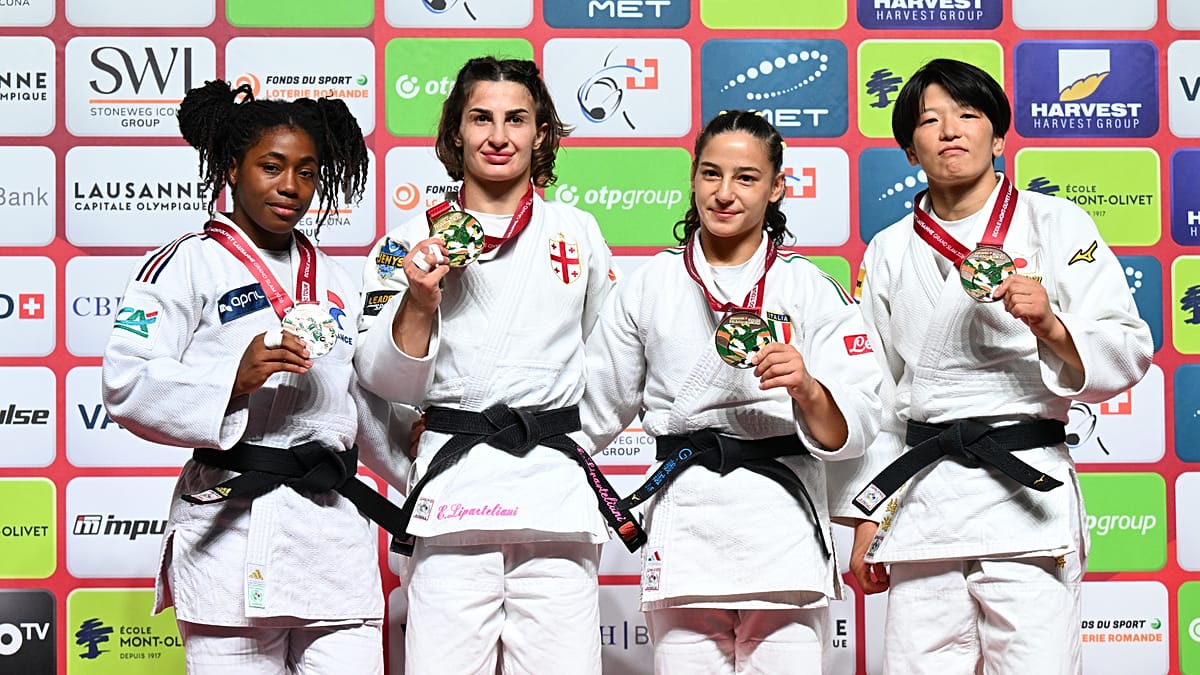
Finally, in the -57kg category, Georgia's Eteri Liparteliani, the reigning world champion, overcame France's Sarah Léonie Cysique with a signature hip throw. Klaus Glahn, a multiple Olympic medallist, awarded her the gold.
The Lausanne Grand Slam marks a new chapter for the IJF World Tour, and the integration of adaptive judo is a development that many in the sport hope will inspire other events to follow suit. As the competition continues, the focus will remain on the athletes, but the message from the Vaudoise Arena is already clear: judo is a sport for everyone.