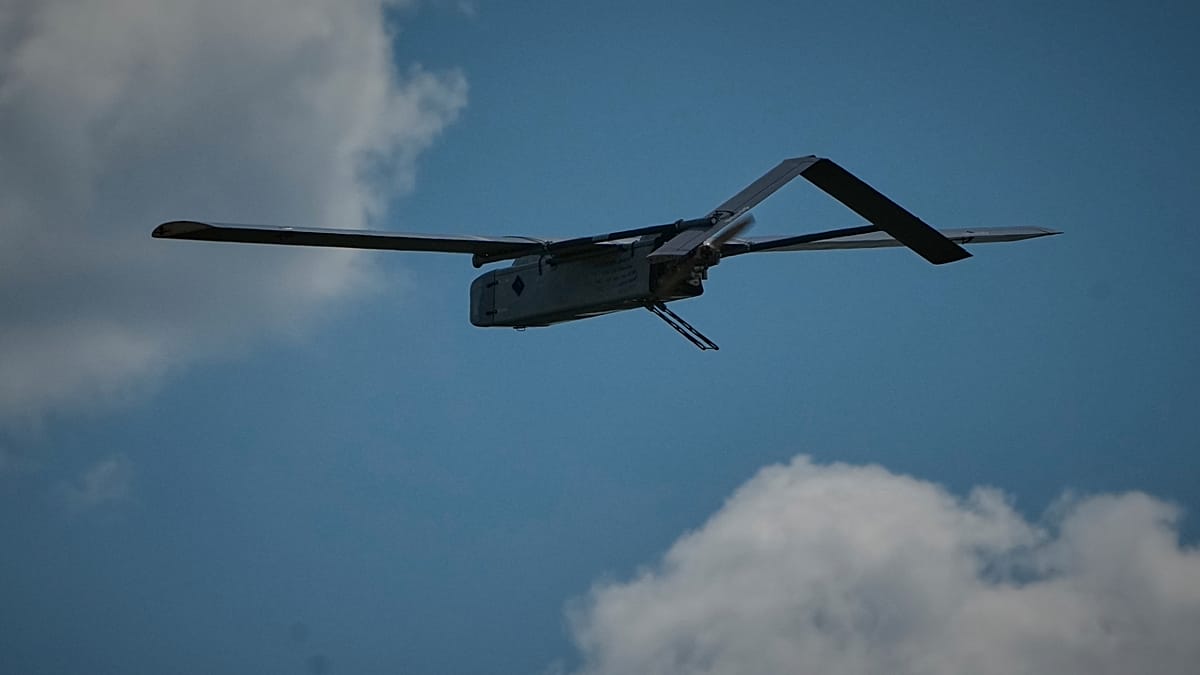
Leonardo, the Italian defence and aerospace group, has established a new subsidiary in Kyiv as part of a strategic push to absorb the operational lessons of drone warfare and apply them to European defence production. The company, named Leonardo Ukraine, was registered in the Ukrainian corporate registry in May and is wholly owned by the Italian state-controlled group, according to Italian financial daily Milano Finanza.
The move underscores a broader shift among European arms manufacturers, who increasingly view Ukraine not merely as a recipient of military aid but as a vital source of real-world combat data and innovation. At the Farnborough Airshow in July, Leonardo's chief executive, Lorenzo Mariani, said Ukraine had "acquired an operational experience without equal during the conflict" and that it was essential to "envisage forms of cooperation with the Ukrainian drone industry."
Why Kyiv matters for European defence
Elio Calcagno, senior fellow for defence and space at the Istituto Affari Internazionali (IAI) in Rome, told European Pulse that Ukraine has developed a level of expertise in systems that "in Europe would initially be considered simple, but which are obviously not simple either to design or to manufacture on a large scale." He described this as an "enormous asset for European industry, including defence ministries, which may be trying to do planning in procurement and in medium- to long-term programming."
The new company is registered with the declared purpose of conducting research and development in optical and navigation systems. Leonardo's half-year report, published at the end of June, lists the subsidiary with a share capital of just under €100,000, as reported by Il Fatto Quotidiano.
Beyond absorbing know-how, Leonardo has long signalled its intention to test its new integrated air-defence system, the Michelangelo Dome, in real combat conditions. The system is designed to complement existing US Patriot batteries and the European Samp/T system, and the company projects a business volume of some €20 billion over the next decade.
Ukraine as a laboratory for future war
Since Russia's full-scale invasion, Ukraine has become a vast military experiment. The conflict, which began with trench warfare reminiscent of the early 20th century, has evolved into a series of operations dominated by unmanned systems. Ukrainian industry has not only produced drones at low cost but has turned them into cutting-edge products, refined through continuous field testing and iterative improvements.
Calcagno highlighted the remarkable ability of Ukrainian engineers to maintain a constant flow of information between the front line and the companies that design and build the drones. "From the perspective of countries at peace such as ours, or France, Germany, the United Kingdom, what has become evident and remarkable is the ability of Ukrainians to create a continuous flow of information between the front line, that is those who are fighting, those who in the case of drones use them every day, and the engineers in the various companies," he said.
Among the innovations emerging from Ukraine are GPS-independent navigation, resistance to electronic interference, and automatic target recognition. The government in Kyiv has supported these efforts through Brave1, a state innovation hub that brings together around 2,500 companies specialising in drones, electronic warfare, and artificial intelligence. The hub also uses the Brave1 Dataroom, developed with US firm Palantir, which provides visual and thermal data collected in real conditions to train algorithms for detecting and intercepting airborne threats.
Germany and the European Union have already recognised the strategic advantage of cooperating with Ukraine's defence industry. Brussels has made up to €60 billion available for cooperation with Kyiv's defence sector, according to Il Fatto Quotidiano. Ukraine has also published tenders for long-range attack drones, surveillance aircraft using fibre optics, and an unmanned cargo vehicle.
Data as the new currency of warfare
In the age of artificial intelligence, real-time data from the battlefield has become as valuable as the weapons themselves. The ability to collect and analyse data from actual combat conditions is crucial for refining defence systems and making them more effective. This is why Leonardo's presence in Kyiv is so significant.
The strategic importance of this cooperation was underscored by a meeting in the spring between Italian Defence Minister Guido Crosetto and his then-Ukrainian counterpart Mykhailo Fedorov, who was later removed from office by President Volodymyr Zelenskyy. Fedorov had been a key architect of Ukraine's hybrid warfare approach.
Also part of this picture is the British licence, disclosed during a recent visit to Kyiv by UK Prime Minister Andy Burnham, for the production in Ukraine of the Storm Shadow-Scalp cruise missile, which has a range of 250–500 kilometres. The missile is produced by MBDA, a company owned 37.5% each by BAE Systems and Airbus, and 25% by Leonardo. As with drones, the use of missiles in a real-world context provides manufacturers with invaluable data and operational feedback.
Leonardo's move into Ukraine is part of a wider European trend. The UK has already shared missile technology with Ukraine, and the EU is grappling with how to fund Kyiv's defence needs, as highlighted by Ukraine's €23 billion funding gap. The war has also accelerated the adoption of robotic systems, as seen in Ukraine's robot parade, which signals a new era in warfare.
For European defence companies, Ukraine offers a unique opportunity to test and refine their products in real combat conditions. As Calcagno noted, the expertise developed in Ukraine is a strategic asset that European industry cannot afford to ignore. Leonardo's new subsidiary is a concrete step towards integrating that expertise into the broader European defence ecosystem.