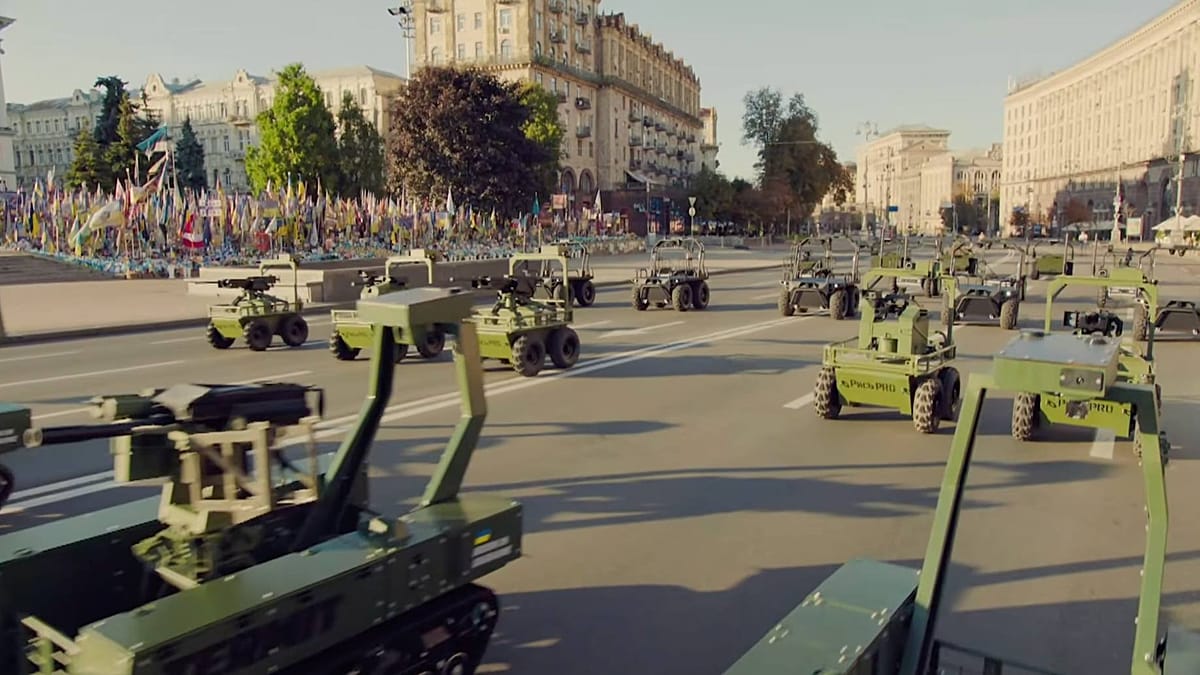
On Monday, Kyiv marked Ukraine's 35th Independence Day with a military display unlike any before: no columns of tanks, no marching infantry, no heavy armour. Instead, robots rolled down Khreshchatyk, the capital's main boulevard, while naval drones glided along the Dnipro and reconnaissance and strike UAVs circled overhead. The parade was a deliberate statement about how war has changed.
Since Russia launched its full-scale invasion in February 2022, Ukraine has been forced to innovate at extraordinary speed. The result is a military that now leans heavily on unmanned systems—on land, at sea, and in the air. Monday's display brought that transformation into the heart of Kyiv, offering a glimpse of what future conflicts may look like.
Robots on the ground, drones in the sky
Dozens of multi-role unmanned ground vehicles took part in the parade, including systems designed for combat, reconnaissance, logistics, and medical evacuation. These robots are not experimental prototypes; they are operational tools that have become routine on the front lines, performing tasks that once fell to soldiers.
On the Dnipro river, Ukraine showcased its naval drone fleet, including variants of the Magura and Sea Baby vessels. These unmanned boats have been instrumental in challenging Russia's Black Sea Fleet, which once dominated the region. Despite lacking a conventional navy of comparable size, Ukraine has used these drones to strike Russian warships and military infrastructure, shifting the balance of power in the Black Sea.
Above the capital flew the latest generation of aerial drones: reconnaissance and strike UAVs, as well as interceptor drones developed to counter Russian attacks on Ukrainian cities. These systems have become indispensable, providing real-time intelligence and precision strike capabilities while reducing the risk to Ukrainian pilots and soldiers.
A military transformed by necessity
The parade was a snapshot of a broader military transformation that has unfolded over four and a half years of war. Unmanned systems have moved from the periphery to the centre of Ukrainian operations, taking on roles once dominated by manned aircraft, ships, and armoured vehicles.
In 2024, President Volodymyr Zelenskyy signed legislation creating the Unmanned Systems Forces, a separate branch of the military dedicated to drone warfare. This made Ukraine the first country in the world to establish an independent military branch built around unmanned systems—a move that reflects both technological ambition and the brutal realities of the battlefield.
Ukraine is defending itself against a much larger adversary with greater reserves of soldiers and conventional weapons. Unmanned systems have allowed Kyiv to strike Russian forces while minimising exposure of its own troops, extend the reach of relatively inexpensive weapons, and compensate for shortages in everything from artillery ammunition to naval power.
Monday's display brought these strands together in the centre of Kyiv, a city that has endured relentless Russian drone and missile attacks. The parade was also a signal to international partners, many of whom have pledged support. As the EU approves billions for air defences, Ukraine's focus on unmanned systems is reshaping how European allies think about their own defence postures.
The shift to drones is not without controversy. Some military analysts question the long-term effectiveness of unmanned systems in contested environments, where electronic warfare and counter-drone measures are evolving rapidly. But for Ukraine, the calculus is clear: drones save lives and stretch limited resources.
Ukraine has not held a conventional military parade since the invasion began in 2022. Monday's event was a deliberate departure, reflecting a military that has adapted to survive. As the war enters its fifth year, the robots on display in Kyiv are not just a symbol of resilience—they are a preview of the future of warfare, where machines increasingly take the front line.