Air pollution remains one of the most serious environmental health threats across Europe, and London is no exception. Yet the British capital has made measurable progress in recent years, thanks in large part to stricter transport policies. An independent analysis by researchers at Imperial College London found that the Ultra Low Emission Zone (ULEZ) — which restricts the most polluting vehicles from entering the city — has reduced fine particulate matter (PM2.5) by 31 per cent in outer London and nitrogen dioxide, a traffic-linked gas that irritates the lungs, by 27 per cent across the city.
But air quality is not static. Levels of ozone, pollen, and other pollutants can shift dramatically throughout the day, depending on traffic, weather, and even seasonal factors. Keeping pace with these fluctuations has traditionally required bulky, expensive monitoring equipment, often limited to a few fixed locations. That is now changing with a new generation of compact, connected sensors that are small enough to be carried in a pocket or mounted on a lamppost.
From Tube platforms to school playgrounds
Dr Kayla Schulte, a researcher in social and environmental technology at Imperial College London, uses a handheld black carbon monitor in her fieldwork — a device that logs particle pollution from burning materials like wood or coal. While black carbon levels in the UK are relatively low compared to other parts of the world, Schulte notes that globally it remains a major contributor to premature deaths.
These small sensors, now part of London's 'Breathe London' monitoring network, can be deployed in places where traditional reference equipment could never fit. "Having small compact equipment like these sensors really changes where and how we're able to monitor pollution," Schulte explains. Her colleagues have already used them to measure air quality inside the London Underground, and similar devices are being placed in school playgrounds and near busy roads.
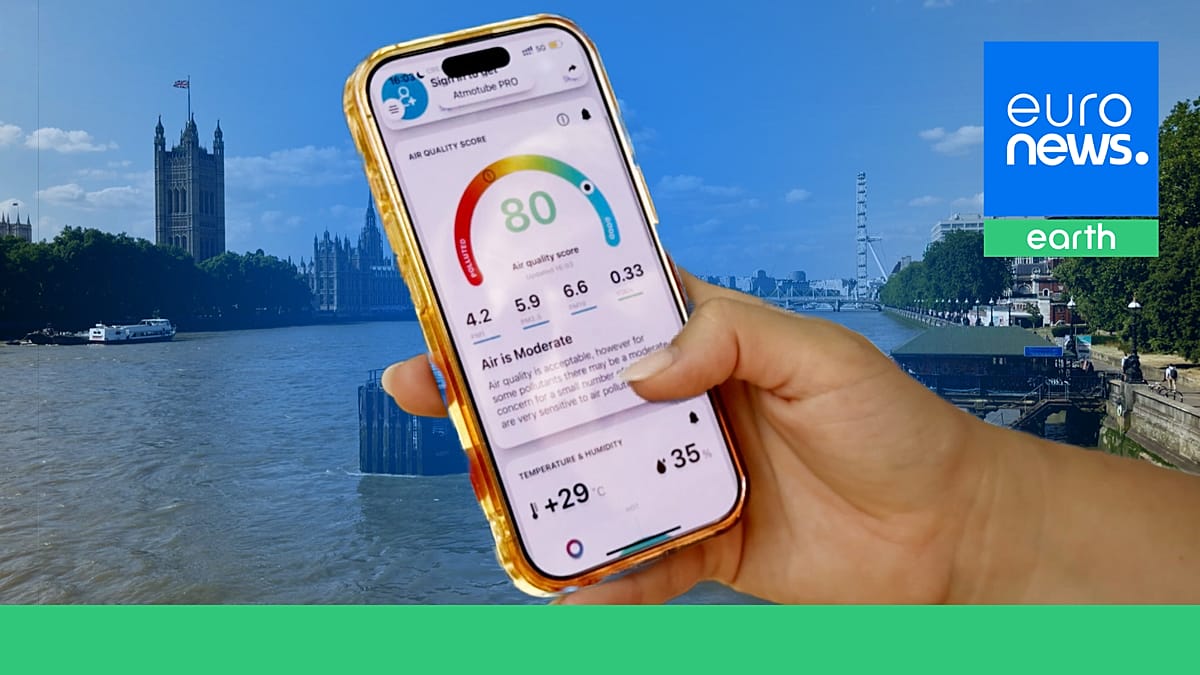
The affordability of these sensors — though still priced in the tens of thousands of euros — makes it feasible to install them in communities that bear the heaviest pollution burden. Software developers can integrate the readings into mobile apps, allowing Londoners to check real-time air quality on their phones wherever they are.
Making data understandable
For Schulte, the technology is only half the battle. "Certain groups in society are more likely to interact with information about pollution when they're caring for an individual that might have a health issue," she says. But many people who could benefit from real-time data never encounter it, partly because the information is often presented in a highly technical way. "The way that air pollution information is presented can be very, very complex," she adds.
To address this, her team works directly with affected communities. They run school activities where pupils design their own pollution displays, and collaborate with residents on the AWAIR project — a set of solar-powered public air quality displays installed across several London neighbourhoods. The displays show local pollution levels in a simple, visual format that anyone can understand.
More rollouts are planned as researchers try to close the gap between what sensors can measure and what the public can actually grasp. The goal is not just to collect data, but to empower residents with the knowledge they need to protect their health.
This shift toward hyper-local, accessible air quality monitoring is part of a broader European trend. Cities like Paris, Berlin, and Amsterdam are experimenting with similar sensor networks, and the European Environment Agency has called for more granular data to inform policy. As Europe braces for more frequent heatwaves, which can exacerbate ozone pollution, the need for real-time, community-level monitoring becomes even more urgent.
While London's ULEZ has been a success story, the city still faces challenges from other sources of pollution, including wood burning and construction dust. The new sensors can help identify these hotspots and guide targeted interventions. As Schulte puts it, "We're moving from a world where air quality was a city-wide average to one where we can pinpoint the exact street corner where pollution spikes."
For now, the focus is on making sure that the data reaches the people who need it most. With continued investment in sensor technology and community engagement, London is setting an example for other European cities on how to turn raw data into meaningful action.