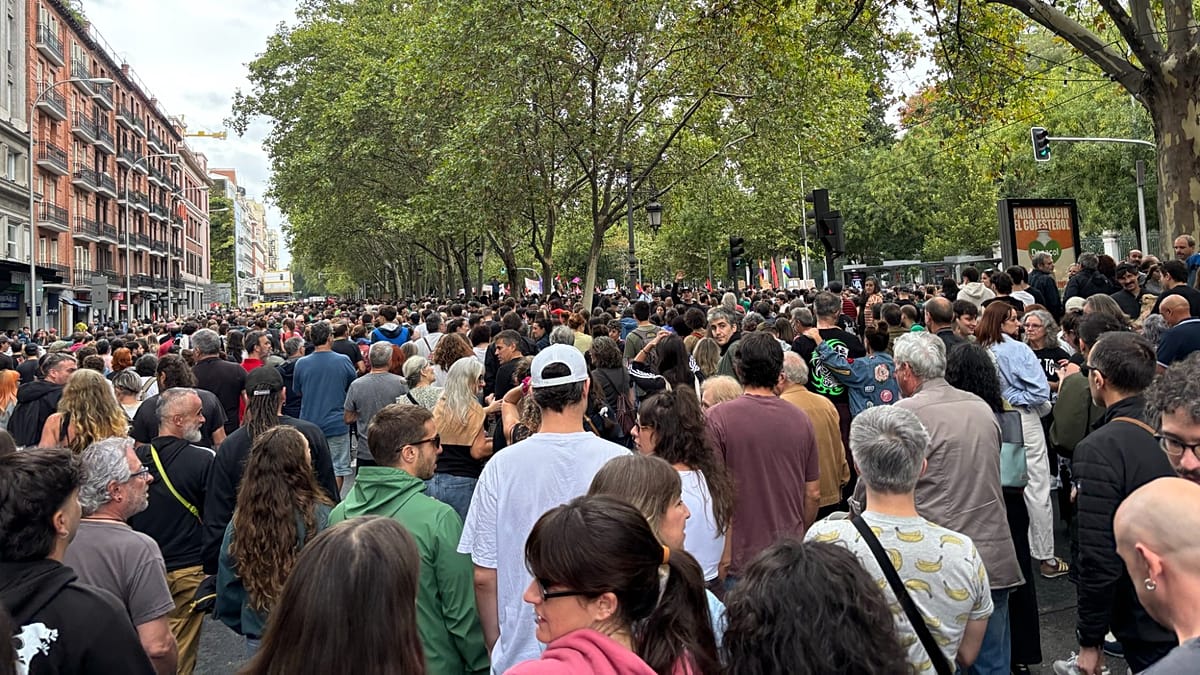
MADRID — Nearly half a million demonstrators filled the streets of the Spanish capital on Saturday, in one of the largest protests in recent memory, as the country's housing crisis moved to the center of political life. The march, called by the Tenants' Union and backed by dozens of civic groups, came a day after Congress voted down two government decrees designed to strengthen tenant protections.
Organizers put turnout at around 500,000 in Madrid alone; police estimated 70,000. The discrepancy reflects the emotional charge of an issue that has become a national flashpoint. Protesters, many carrying placards reading "General strike" and chanting "Down with rentierism," converged on Puerta del Sol, where activists have camped for a week. The demonstration remained peaceful under a visible police presence.
Renters demand radical change
The Tenants' Union, which coordinates the protests, issued a stark statement: "There is an irreparable disconnect between what the people want and what the parties vote for." The group is demanding a 50% cut in rents, open-ended contracts, and the expropriation of homes owned by vulture funds. Spokesperson Valeria Racu said a general strike is still being negotiated with other organizations and that they want it to be "historic."
The protest movement has been fueled by cases like that of Maricarmen Abascal, an 87-year-old woman evicted from her Madrid home after an investment company bought the building where she had lived for seven decades and sought to raise her rent by 275%. The backlash forced the new owners to offer her a low-rent return, but the episode has become a symbol of what campaigners call a predatory market.
In Valencia, tensions escalated when protesters marched toward the Palau de les Arts Reina Sofía, where the Valencia Real Estate Summit 2026 was taking place. Some demonstrators removed barriers, threw objects at police, and reached the upper part of the building. Officers responded with rubber bullets and tear gas. The march was called by four organizations, including the Tenants' Union and the Housing Union.
Protests also took place in Donostia, Cádiz, Las Palmas de Gran Canaria, Lanzarote, Fuerteventura, Tenerife, and Barcelona, where camp member Luana Rocha told TVE they intend to stay indefinitely: "We are heading towards a general strike." Teruel will hold its own demonstration on Sunday.
Political fallout in Congress
On Friday, the Spanish Congress rejected the government's two housing decrees, with votes against from the conservative PP, Vox, UPN, and Junts refusing to support them. The first decree fell 172–178, the second 166–184. Prime Minister Pedro Sánchez, visibly frustrated, warned: "History will judge you sooner than you think and more harshly than you imagine." He has since opened a period of reflection on calling early elections, a decision that rests solely with him.
The opposition is again demanding elections, and some PSOE leaders and ministers now share that view, according to reports. Junts, the Catalan party that holds a key parliamentary bloc, urges the PSOE to negotiate. Its spokesperson Míriam Nogueras called the decrees "a poorly drafted law," while secretary general Jordi Turull argued they would have "discouraged" property sales. The PSOE counters that the texts already included Junts' proposals: "What more do they want?"
Vice-president Yolanda Díaz, who leads the left-wing Sumar platform, insisted that evictions "have three names": Feijóo, Abascal, and Nogueras. PP leader Alberto Núñez Feijóo, for his part, pledged to find a legal formula to ensure no further term passes without a budget.
The camp in Sol entered its seventh night with around 2,000 people, keeping the original cause in full view. The housing crisis has become a defining issue for Spain, and the protests show no sign of abating. As the political class trades blame, the streets are making their own demands heard.
For more on the broader European housing picture, see the divide across the continent. And for the latest on the political fallout, follow Sánchez's next move.