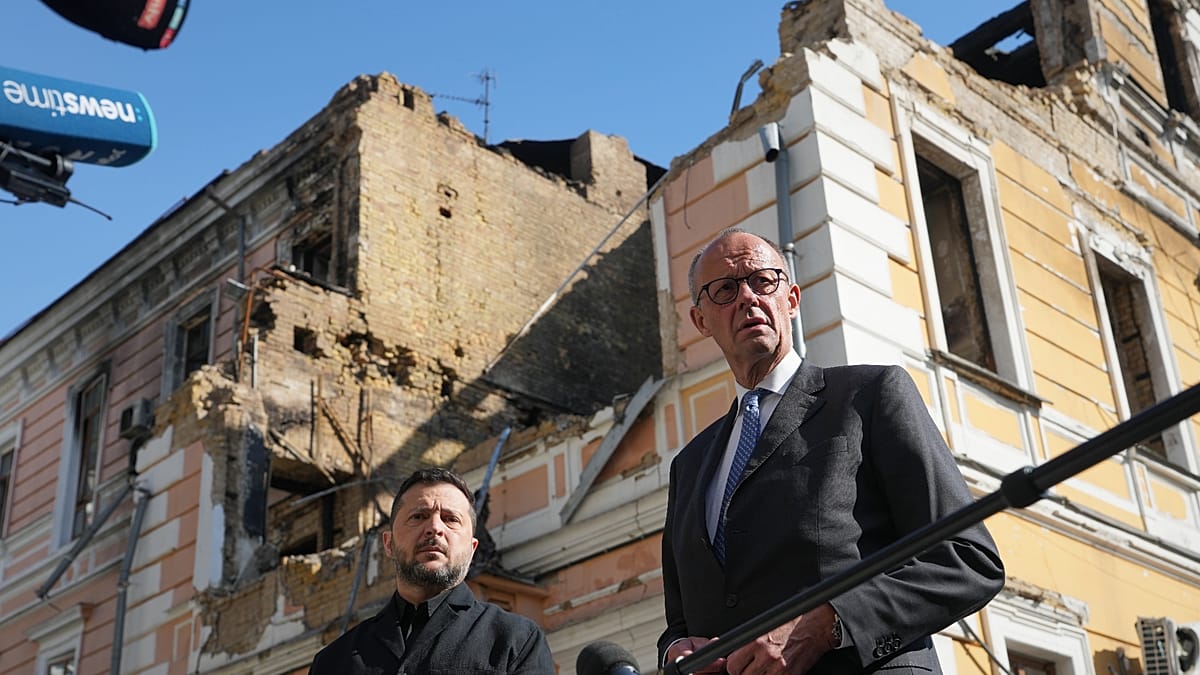
German Chancellor Friedrich Merz arrived in Kyiv on Sunday morning by special train, in a visit that had not been publicly announced. He was accompanied by Economy Minister Katherina Reiche and roughly ten representatives from German defence and energy companies. The trip underscores Berlin's continued commitment to Ukraine as the war enters what is expected to be a difficult winter.
According to German government sources, the coming months will see the delivery of thousands of interceptor drones to the Ukrainian armed forces. These systems are designed to counter Russian jet-powered drones, which are notoriously hard to shoot down due to their high speed. In addition, Berlin and Kyiv plan to expand joint production of long-range weapons, with around €1 billion from already approved budget funds earmarked for this purpose. A further €350 million is set aside for repairing and rebuilding damaged Ukrainian power plants.
Merz: 'Ukraine needs all our support'
Speaking on arrival, Merz justified the trip by pointing to the current situation. "Ukraine needs all our support for the coming weeks," he said, referring to the approaching fifth winter of the war and Russia's ongoing attacks on cities, homes, and energy infrastructure. He was welcomed by Ukrainian President Volodymyr Zelenskyy, and their talks were expected to cover military aid, energy supplies, and broader bilateral cooperation.
The visit took place under heightened security conditions. On Saturday, Russia warned foreign nationals and diplomats to leave Kyiv, citing the risk of airstrikes. On Sunday morning, Kyiv Mayor Vitali Klitschko reported that a road on the northern bridge over the Dnipro River had been hit by at least one Russian drone.
Merz addressed Russian President Vladimir Putin directly: "Mr Putin, stop this senseless war! We are ready for talks, we are ready to discuss how to end this war. But these barbaric attacks on Ukraine's civilian population must stop." He added that Russia only understands the "language of strength", signalling a continued reliance on military pressure.
Defence cooperation deepens
Beyond immediate aid, the visit focused on closer ties between the German and Ukrainian defence industries. According to Reuters, the two sides are working toward an agreement on the joint development and production of drones, particularly systems capable of intercepting fast Russian models. The German government is increasingly linking military support to industrial cooperation, and the delegation is also preparing economic agreements and declarations of intent.
This is Merz's second trip to Ukraine since becoming chancellor. His first came in May 2025, just days after taking office, alongside then-British Prime Minister Keir Starmer, French President Emmanuel Macron, and Polish Prime Minister Donald Tusk. The latest visit signals that Germany remains a key backer of Ukraine, even as domestic political pressures mount.
Domestic headwinds
Back home, Merz's CDU/CSU alliance is facing a difficult political landscape. The latest INSA Sunday poll shows the CDU/CSU falling another point to 18%, its lowest level ever recorded by INSA, while the far-right AfD has risen to 30%, a new high. The gap between the two parties now stands at 12 percentage points. The SPD and Greens are at 14% each, the Left Party at 10%, and both the FDP and BSW sit at 4%, below the 5% threshold needed for parliamentary representation.
Approval of Merz has also sunk to a new low: only 15% of respondents are satisfied with his performance, while 79% are dissatisfied. The federal government's approval rating is even lower, at 14%. The INSA poll surveyed 1,202 people between September 28 and October 2, with separate figures on leadership approval based on 1,001 respondents on October 1-2.
Public support for Ukraine is eroding, particularly in eastern Germany. An ARD-Deutschlandtrend poll from early September showed that more than half of respondents in the east believe German support for Ukraine has gone too far. Nationwide, over four in ten now share that view, the highest level since Russia's full-scale invasion began in February 2022. This scepticism has been reflected in recent state elections, where parties critical of continued aid have gained ground. The east-west divide remains a defining feature of German politics, and the AfD's recent success has raised questions about how the EU will respond.
Despite these domestic challenges, Merz's government is pressing ahead with substantial aid packages. The announced billions and deeper defence cooperation signal that Berlin intends to remain a steadfast ally to Ukraine, even as the political cost at home grows. The EU's recent agreement on Ukraine's 2026 funding provides some relief, but the long-term sustainability of Western support remains uncertain.