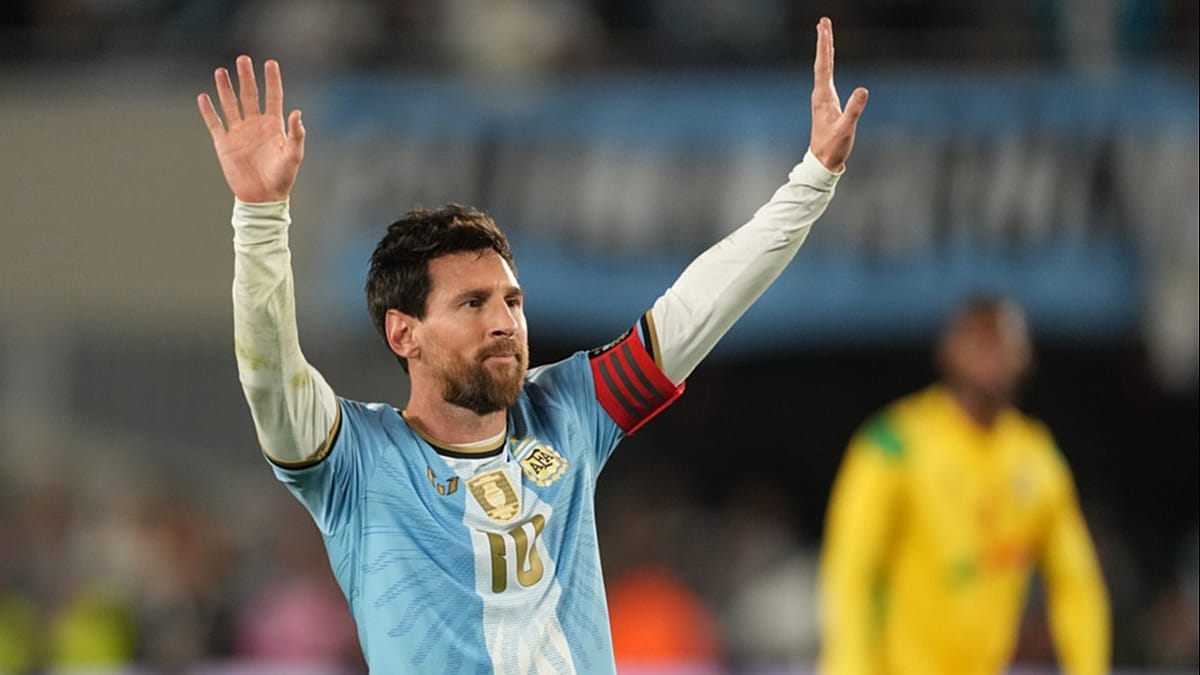
Buenos Aires said goodbye to its most beloved son on Tuesday night. Lionel Messi, the 39-year-old who has defined Argentine football for over two decades, played his final match for the national team, guiding a 3-0 friendly victory over Benin at the Monumental stadium. The result was almost incidental; the occasion was everything.
Messi, who announced his retirement from international duty in late August, delivered one last vintage performance. He converted a penalty and provided assists for the other two goals, bringing his international tally to 126 in 208 appearances. The crowd of more than 85,000, which had snapped up tickets within 90 minutes, rose to him at every touch.
For a country that has weathered decades of economic and political turbulence, Messi's career has been a rare constant source of collective joy. “It feels like an era is ending, knowing he won’t play for the national team anymore,” said Valentino Ruso, a 17-year-old fan watching in Buenos Aires. “I’m sad. I think everyone is upset today. He will be missed.”
From Rosario to the world
Messi left his hometown of Rosario at 13 to join Barcelona's youth academy, and for years his relationship with Argentina was complicated. Fans adored his genius but sometimes questioned his commitment, especially when he underperformed in early international tournaments. The criticism peaked after Argentina lost three consecutive major finals between 2014 and 2016, prompting a brief retirement that he soon reversed.
The turning point came in 2021, when Argentina beat Brazil to win the Copa América for the first time in 28 years. Messi, long accused of emotional detachment, broke down in tears. The following year, he led Argentina to World Cup glory in Qatar, sealing his transformation from prodigy to national hero.
“I don’t know if there has ever been a love story between a player and a nation as great as the one you built,” wrote teammate Rodrigo De Paul on Instagram.
A night of tributes
The Argentine football federation turned the match into a grand farewell, billing it as “the last tango.” Players from the 1978, 1986, and 2022 World Cup-winning squads were in attendance. A drone display lit up the sky, and a banner at midfield proclaimed Messi the “Eternal Captain.”
After the final whistle, Messi's eyes glistened as his teammates encircled him. The stadium roared with a chorus of “Olé, olé, olé, olé, Messi, Messi.” In a rare public speech, he told the crowd: “The truth is, I'm talking more than I ever have. I don't want to leave here, I don't want to leave this field. I just want to tell you that I love you, I'm going to miss you, and I'm grateful to God to be Argentine.”
Messi will continue playing for Inter Miami in Major League Soccer, but his international chapter is closed. For Argentina, the post-Messi era begins now. As Andrés Rabinovich, a University of Chicago scholar who studies football and Argentine culture, put it: “Argentines often say, ‘Thank God I was born at a time when I could experience the miracle of watching Messi play.’”
The farewell also resonated beyond Argentina's borders. In Europe, where Messi spent his entire club career until 2021, tributes poured in from Barcelona, Paris, and beyond. His legacy, like his game, was global.
As the crowd lingered long after the final whistle, Messi took a slow lap around the pitch, a small figure under the floodlights. At the tunnel, he paused, raised his arms to the fans one last time, and disappeared into the night.