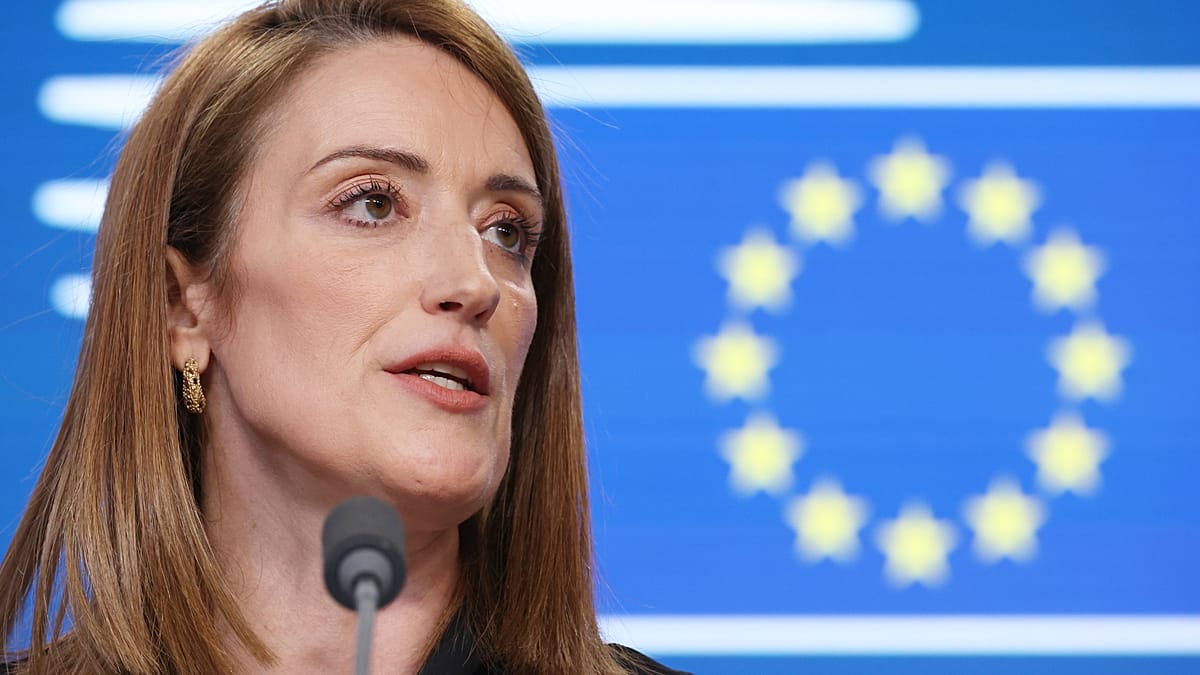
The European Political Community summit in Yerevan, Armenia, saw an unexpected confrontation on Monday between Azerbaijani President Ilham Aliyev and European Parliament President Roberta Metsola. Aliyev used the platform to accuse the European Parliament of an “obsession” with his country, announcing a suspension of cooperation, while Metsola delivered a forceful defence of the parliament’s democratic role.
Addressing leaders from nearly 50 European countries gathered in the Armenian capital, Aliyev claimed the European Parliament had adopted 14 resolutions critical of Azerbaijan, describing the pattern as “a kind of obsession.” He accused the institution of “spreading slander and lies” and said its members appeared intent on sabotaging the US-brokered peace process with Armenia that followed the Nagorno-Karabakh conflict. That accord, reached last year, ended nearly four decades of armed tensions and set a framework for diplomatic and economic normalisation.
Aliyev also announced that Azerbaijan’s parliament would suspend cooperation with the European Parliament across all areas. However, he distinguished between the parliament and the European Commission, welcoming the latter’s efforts to expand bilateral ties with Baku, a key exporter of oil and gas to Europe. The EU has been deepening engagement with the South Caucasus region, and Azerbaijan remains a strategic partner in energy diversification.
Metsola’s Unscripted Rebuttal
According to European Parliament sources, Aliyev’s remarks were not on the official agenda. Metsola requested the floor for an impromptu intervention to defend her institution. “The European Parliament is a directly elected democratic body, with resolutions adopted by a majority,” she told the chamber. “We understand that outcomes may be uncomfortable for some, but we will never change the way we work.”
Her response was sharp and unequivocal: “We will never change the way we work, even if it is uncomfortable.” The exchange highlighted the growing friction between Baku and the European Parliament, even as the European Commission pursues closer energy and diplomatic ties.
The summit, the eighth gathering of the European Political Community, was hosted by Armenian Prime Minister Nikol Pashinyan and brought together leaders from EU member states, candidate countries, and neighbours such as the United Kingdom, Switzerland, and Norway. The meeting was seen as an opportunity to advance the fragile peace process between Armenia and Azerbaijan. The next EPC summit is scheduled to take place in Azerbaijan in May 2028.
Aliyev’s criticism came days after the European Parliament adopted its most recent resolution on Azerbaijan, focusing on democratic resilience in Armenia while raising concerns about Baku’s actions. The resolution called for the right of return for Armenians who fled the region in 2023 after renewed armed conflict, described the detention of Armenian prisoners of war as “unjust,” and urged their “immediate and unconditional release.” It also demanded protection for Armenian identity, property, and cultural heritage in the disputed region.
In response, Azerbaijan’s parliament approved a resolution on Friday establishing a special commission to address what it called “hostile activities” by the European Parliament. Hikmet Hajiyev, a senior aide to President Aliyev, described the European Parliament’s resolution as “a diplomatic disgrace and diplomatic failure” and accused its members of “creating obstacles to a peace process.”
Following the summit, Aliyev was scheduled to meet Italian Prime Minister Giorgia Meloni in Baku later on Monday and EU foreign policy chief Kaja Kallas on Tuesday. The meetings underscore the dual track of Azerbaijan’s relations with Europe: cooperation with the European Commission and key member states on energy and trade, alongside deepening tensions with the European Parliament over human rights and regional conflicts.
The clash in Yerevan reflects broader challenges in EU-Azerbaijan relations. While Brussels values Baku as a reliable energy partner—particularly after Russia’s invasion of Ukraine disrupted gas supplies—the European Parliament has consistently raised concerns about democratic backsliding, human rights, and the treatment of ethnic Armenians. The parliament’s resolutions, though non-binding, carry political weight and have become a recurring irritant in bilateral ties.
For Metsola, the confrontation was a defence of the parliament’s institutional role. “We are a directly elected body,” she reiterated, “and we will not be silenced by threats or accusations.” The episode underscores the delicate balance the EU must strike between strategic interests and its stated values, as it navigates relations with a key energy supplier in a volatile region.