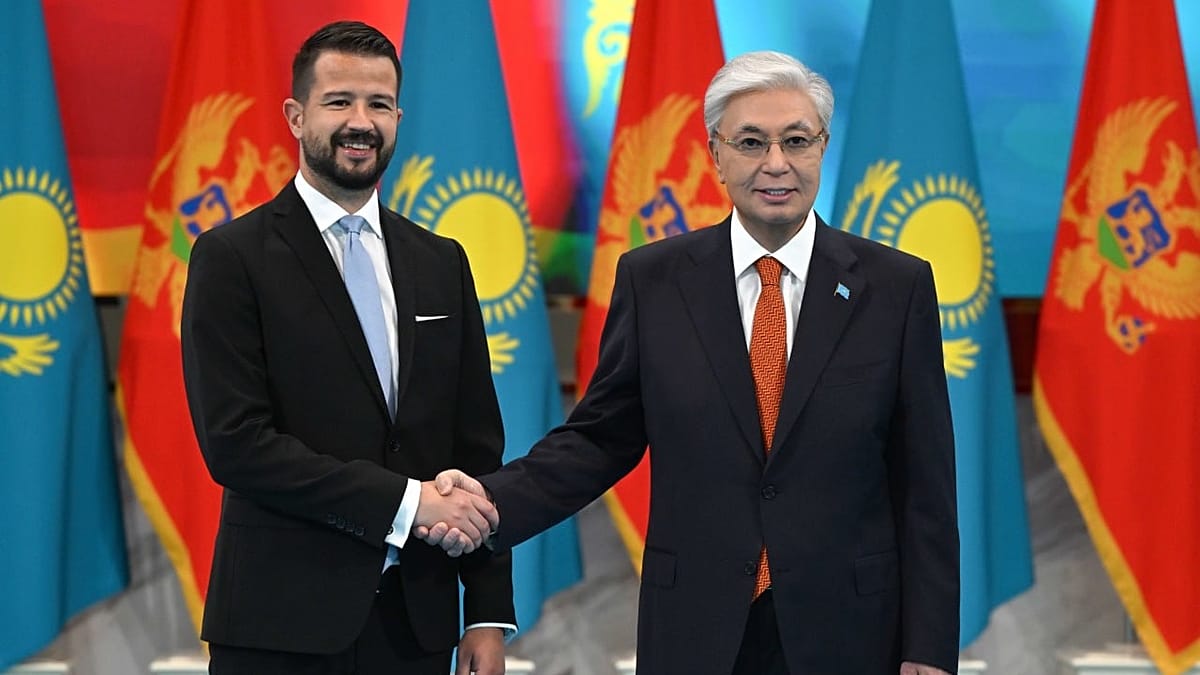
Montenegrin President Jakov Milatović travelled to Astana over the weekend for the first official state visit by a Montenegrin head of state to Kazakhstan. The trip marked a strategic push to deepen ties between the Adriatic nation and Central Asia, with the Port of Bar emerging as a potential new link in the Trans-Caspian International Transport Route (TITR), also known as the Middle Corridor.
At a meeting with Kazakh Prime Minister Olzhas Bektenov, Milatović highlighted Kazakhstan's role as a logistical hub bridging Europe and Asia. The TITR, which bypasses Russia by crossing the Caspian Sea, has seen cargo volumes rise by more than 36% over the past year, reaching 77,000 twenty-foot equivalent units (TEUs). Discussions centred on whether Montenegro's Adriatic port could serve as a multimodal gateway for goods moving between Central Asia and southern and central Europe.
"Kazakhstan is an important partner in an area that increasingly connects Europe and Asia," Milatović said. "That's why we see this visit as an opportunity to open new doors for the Montenegrin economy, tourism, investments and development."
No formal agreement was signed, but officials indicated that further talks could lead to integrating Bar into the TITR network. This would complement existing efforts to expand the route, which already connects China, Kazakhstan, and the Caucasus to European markets. Kazakhstan's Tokayev in Brussels to Advance Middle Corridor Trade Route earlier this year underscored the EU's interest in reducing reliance on traditional northern corridors.
Historic Context and EU Aspirations
The visit coincided with the 20th anniversary of Montenegro's independence and two decades of diplomatic relations between the two countries. Kazakh President Kassym-Jomart Tokayev praised Montenegro's progress toward European Union membership, a goal Milatović has set for 2028. "You have played a vital role in advancing reforms in Montenegro and strengthening its position as a leading candidate for EU accession," Tokayev said. "We wish you success in achieving this strategic national goal."
Both leaders noted that Montenegro's eventual EU accession could unlock new opportunities for bilateral cooperation, particularly in trade and investment. Milatović also stressed Central Asia's growing geopolitical weight, calling it "an important region with a population of more than 100 million people" that deserves Montenegro's attention. He announced plans to open a Montenegrin diplomatic mission in Astana to represent the country's interests across Central Asia.
Kazakhstan has maintained a Consulate General in Podgorica since 2024, reflecting a steady but underdeveloped relationship. Bilateral trade remains minimal: between January and April, it totalled just €226,700, an 81% drop from the same period last year. To jumpstart commerce, Milatović brought a business delegation to the Kazakhstan-Montenegro Business Forum, where the two countries' Chambers of Commerce signed a memorandum of understanding.
Digital Transformation and Tourism
Beyond transport, the talks explored cooperation in digitalisation. Kazakhstan boasts one of the most advanced e-government systems globally, with around 90% of public services available online. Astana is also investing heavily in artificial intelligence. "We highly value Kazakhstan's achievements in digital transformation and believe we can learn from your country's valuable experience in this area," Milatović noted.
Tourism is another growing link. Since direct flights between Kazakhstan and Montenegro launched in 2021, the number of Kazakh visitors has risen steadily. Montenegro offers visa-free entry for Kazakh citizens for up to 30 days between May and October each year, further encouraging travel. The Adriatic coast, with its historic towns like Kotor and Budva, remains a draw for Central Asian tourists seeking Mediterranean escapes.
The visit signals Montenegro's ambition to position itself as a southern European hub for the Middle Corridor, a route that has gained urgency amid shifting global trade patterns. BMW Slashes 2026 Profit Forecast as China Slump and Middle East Tensions Bite highlights the broader economic pressures that make diversifying trade routes attractive for European businesses. For now, the Port of Bar remains a potential rather than a certainty, but the political will on both sides is clear.