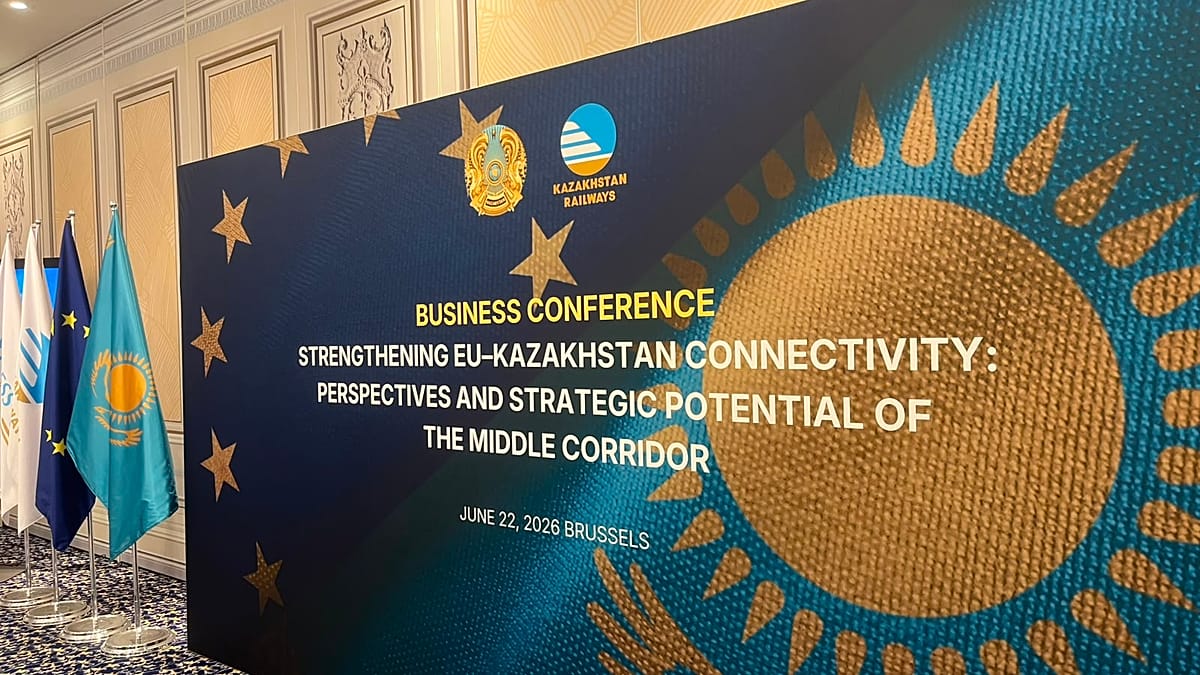
Kazakhstan's President Kassym-Jomart Tokayev arrived in Brussels this week for high-level meetings with European Union officials, focusing on the development of the Middle Corridor — a trade route connecting China to Europe through Central Asia that has gained strategic importance since the disruption of Russian corridors.
The visit follows the April 2025 EU-Central Asia summit in Samarkand, Uzbekistan, where the bloc and the five Central Asian republics — Kazakhstan, Uzbekistan, Kyrgyzstan, Tajikistan, and Turkmenistan — agreed to deepen cooperation on connectivity, investment, and joint projects. Tokayev is scheduled to meet European Commission President Ursula von der Leyen and European Council President António Costa to assess progress on those pledges.
What Is the Middle Corridor?
The Middle Corridor is envisioned as a modern version of the ancient Silk Road: a multimodal network of railways, roads, and maritime routes that starts at the Chinese port of Lianyungang, passes through Xi'an, crosses Kazakhstan, and branches toward Uzbekistan and the Caspian Sea. From there, cargo moves by ship to Azerbaijan and Georgia before reaching European hubs in Romania, Hungary, and Poland.
Under current geopolitical conditions, the corridor offers a vital alternative to the Northern Corridor through Russia. It is roughly 3,000 kilometres shorter and avoids Russian territory entirely. Kazakhstan operates 13 international transit corridors and boasts one of the world's ten largest railway systems, with 100,000 employees.
Ahead of Tokayev's visit, Kazakh ministers held a series of "days of business opportunities" events in Brussels, culminating in a presentation of the corridor's achievements and remaining bottlenecks. Attendees included representatives from global shipping companies, freight forwarders, the European Investment Bank, the European Bank for Reconstruction and Development, and EU institutions.
Kazakhstan's Transport Minister Nurlan Sauranbayev and Talgat Aldybergenov, CEO of Kazakhstan Railways, outlined the country's progress. Kazakhstan has committed $50 billion to corridor infrastructure by 2030, with nearly $40 billion already spent. More than 5,000 kilometres of rail have been modernised or newly built, slashing transit time from Xi'an to Georgia from 55 days three years ago to just 18 days today.
"It is an ambitious task to provide speedy, safe transport with maximum transparency in tariffs and easy procedures," Aldybergenov told the Brussels audience. "It should help both our exporters and importers and enhance trade between Europe and Asia."
He added: "Kazakhstan has already invested billions of dollars into infrastructure. We shall provide infrastructure, secure the digitalisation of all processes, including the capacity of transportation. We claim that this route is the most reliable and transparent for our European partners."
Kazakhstan's railway company recently signed a major deal with China's CGCT railroad administration to oversee goods shipments from China. To address maritime bottlenecks on the Caspian Sea — limited port capacity and vessel numbers — Kazakhstan has purchased two additional ships for the Caspian section, with four more expected by the end of next year. The port of Aktau has undergone major dredging to deepen its waters.
"We also work on air transport, and it is our three-year plan to reconstruct and modernise all runways of all airports in the country," Sauranbayev said. "We have 27 airports, and all are under reconstruction. We shall provide a green corridor for all companies interested in developing cargo air traffic."
European Commission representatives welcomed the progress. Charlotte Adriaen, Head of the Unit for Central Asia in the Directorate-General for International Partnerships, said: "The Middle Corridor has gone from a concept to something that is more than a concept — it is reality, it is moving forward and is the central pillar of our shared connectivity agenda. It has become, for us in the EU, what we call the 'global gateway flagship'. Considering the geopolitical and geostrategic situation, it is more important than ever."
The corridor's development also touches on broader European interests. As EU leaders grapple with supply chain resilience and diversification — topics that have featured in discussions on unified strategies against illicit trade and budget negotiations — the Middle Corridor offers a tangible alternative to routes through Russia. The project's success could reshape trade patterns across the continent, linking Central Asia more closely to European markets.
Tokayev's visit underscores Kazakhstan's ambition to position itself as a key transit hub. With billions already invested and concrete results on the ground, the Middle Corridor is no longer a distant vision but an operational reality — one that European policymakers are increasingly counting on.