International Joke Day, observed on 1 July, invites people to start the second half of the year with a smile. In an era where headlines often dampen spirits, the day encourages sharing a joke or watching comedy. The earliest known joke, according to Guinness World Records, is a Sumerian proverb from 1900 BC: 'Something which has never occurred since time immemorial; a young woman did not fart in her husband's lap.' Toilet humour, it seems, is timeless.
For many Europeans, the art of the joke is inseparable from Monty Python's Flying Circus, the British comedy troupe that debuted on BBC on 5 October 1969. In their very first episode, they introduced the 'Killer Joke' sketch—a gag so potent that anyone who hears or reads it dies from laughter.
The Sketch That Never Reveals Its Punchline
The sketch, shot in a quasi-documentary style, begins with Ernest Scribbler (Michael Palin) writing the joke on a piece of paper. He reads it to himself and promptly dies laughing. His mother (Eric Idle) finds him, mistakes the note for a suicide letter, reads it, and also dies. The British army then weaponises the joke, translating it into German under 'joke-proof conditions': each translator works on only one word. One translator who saw two words was hospitalised for weeks.
The army deploys the joke against German forces during World War II. We see its devastating effect: a British soldier test subject dies, and bandaged German soldiers convulse with laughter in a field hospital. The Germans attempt a counter-joke, shown via real footage of Adolf Hitler from Leni Riefenstahl's Triumph of the Will, with subtitles: 'My dog has no nose' / 'How does he smell?' (said by the crowd) / 'Awful.' Another Nazi attempt over the radio: 'Zher were zwie peanuts walking down der strasse, und one was assaulted... peanut. Ho ho ho.' Neither works.
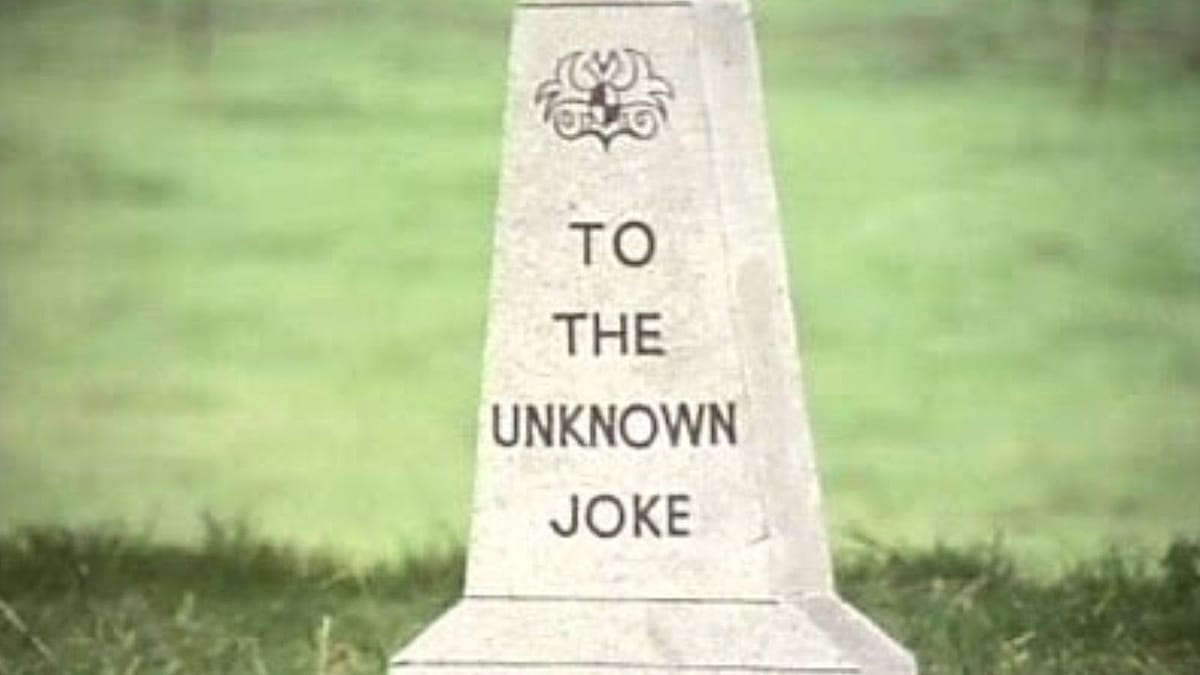
The sketch ends in 1950, with countries agreeing to a joke warfare ban at the Geneva Convention. The last copy of the killer joke is sealed under a monument inscribed 'To the unknown joke.'
The Unspoken Punchline
The ultimate absurdity: the joke is never revealed to the audience—at least, not in English. The German translation, heard in the sketch, is gibberish: 'Wenn ist das Nunstück git und Slotermeyer? Ja! Beiherhund das Oder die Flipperwaldt gersput!' Any attempt to parse it is futile; translation software breaks down. It roughly reduces to: 'When is the ??? and ??? Yes! Something about a dog and the ???'
In 2023, at the Festival Lumière in Lyon, ex-Python Terry Gilliam told Euronews Culture that Monty Python's brand of comedy might not survive today. 'People are losing their sense of humour, and that, to me, is probably the most important sense,' he said. 'Sense of touch is very important, sense of taste also – but sense of humour is more important. You get to the point where people are frightened to laugh. “Oh, no, you’re making fun of somebody!” No, I’m making fun of humanity, and we are an absurd species of creatures.' He added: 'We are funny because we've got such pretentions, and we fall on our faces so constantly. Make jokes about it! It keeps life interesting.'
On International Joke Day, perhaps the best tribute is to share a laugh—even if that salted peanut joke might find a chuckling audience. For those seeking more cultural insights, the International Booker Prize 2026 shortlist offers a different kind of storytelling, while the Edinburgh International Festival 2026 will enforce phone-free performances, ensuring audiences stay present. And for a truly unique travel experience, the new overnight ferry from Boulogne-sur-Mer to Cork revives historic maritime links.