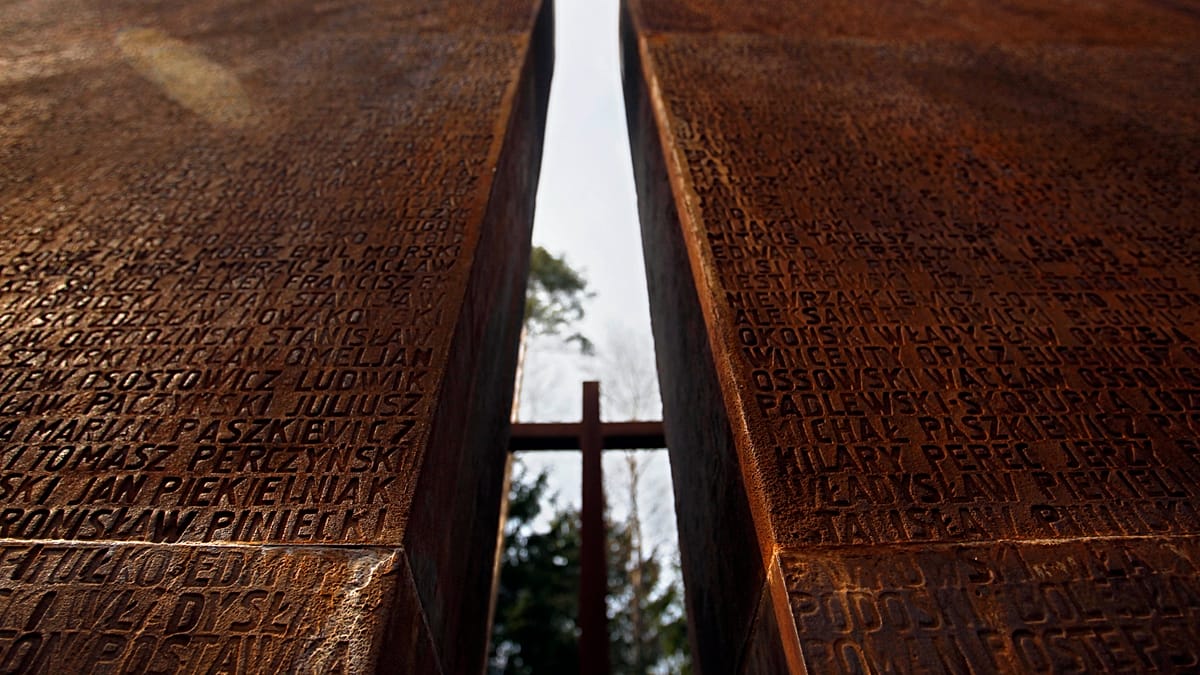
On 10 April, the Russian Military-Historical Society, chaired by Vladimir Putin's adviser Vladimir Medinsky, inaugurated an exhibition titled "10 Centuries of Polish Russophobia" at the Katyn memorial complex in western Russia. The choice of date and location has drawn sharp condemnation from Polish officials, historians, and families of the victims of the 1940 Katyn massacre, who describe it as a calculated act of provocation.
The exhibition opened on the 16th anniversary of the Smolensk air disaster, which killed 96 people, including Polish President Lech Kaczyński and his wife Maria, as they travelled to commemorate the Katyn massacre. It also precedes Poland's Day of Remembrance of the Victims of the Katyn Massacre on 13 April.
Exhibition Content and Accusations
According to the organisers' website, the exhibition alleges a centuries-long pattern of "hatred of the Polish elite towards Russia and the Russian people," focusing heavily on the 20th century and World War II. It accuses Warsaw of pursuing an "aggressive anti-Russian policy," citing the removal of Soviet-era monuments and Poland's military support for Ukraine. The display also claims to give "special attention" to what it describes as contemporary Polish Russophobia.
Dr Rafał Kościński, spokesperson for Poland's Institute of National Remembrance, said the exhibition marks a return to Soviet-era narratives that blamed Nazi Germany for the Katyn massacre. "For years we have been observing a turn in the historical policy of the Russian Federation, in which there has been a return to the narrative that the Germans are responsible for the Katyn Massacre," Kościński told Euronews. "This is a return to 1943, when, after the Third Reich announced the discovery of the graves of Polish officers in the Katyn forest, the Soviets tried to put the responsibility for their deaths on the German occupiers." He added that the exhibition is part of broader Russian attempts to assign co-responsibility for the outbreak of World War II to Poland and to reinterpret the Molotov-Ribbentrop Pact.
Timing and Location Condemned
Izabella Saryusz-Skąpska, president of the Federation of Katyn Families, condemned the exhibition's placement and timing. "The choice of the place and time of this exhibition is a disgusting malice, calculated to hurt us – the Katyn Families, who have suffered a lot from Russia," she told Euronews. She noted that Polish historians mock the exhibition's title, pointing out that Moscow did not exist in anything like its current form 10 centuries ago. Saryusz-Skąpska said families of victims spent years building war cemeteries at Katyn, Mednoye, and Kharkiv as symbols of reconciliation. "Had it not been for Russia's attack on Ukraine and a full-scale war, the Katyn Families would have been heading for the necropolises in Kyiv, Kharkiv, Mednoye and Kyiv-Bykivnia at that time," she said.
The Katyn massacre was carried out in April and May 1940 by the NKVD on the orders of Stalin and the Soviet Politburo. The victims included officers captured during the 1939 Soviet invasion of Poland, police officers, and members of the intelligentsia. Moscow denied responsibility for decades, blaming Nazi Germany, until the Soviet Union officially admitted NKVD responsibility in 1990, calling it "one of the grave crimes of Stalinism." In 2010, Russia's State Duma confirmed the crime was carried out "on the direct orders of Stalin and other Soviet leaders."
Broader Pattern of Historical Revisionism
This exhibition is not an isolated incident. In June 2022, the mayor of Smolensk ordered the removal of Polish flags from the Katyn memorial complex, citing "blatantly anti-Russian statements by Polish politicians." In spring 2025, bas-reliefs depicting Polish military decorations were removed from the Mednoye memorial complex at the prosecutor's office's request. In 2023, busts of Stalin, Lenin, Felix Dzerzhinsky, and Yakov Sverdlov were installed at Mednoye, which officials said reflected "the era" of mass repression.
Nikolai Rybakov, a Russian opposition politician from the Yabloko party, called for the exhibition's removal on 17 April, arguing it violates Russia's international obligations under its 1994 agreement with Poland and the 1992 Treaty on Friendly Cooperation, which require maintaining memorial sites in a dignified condition. The exhibition initially opened in Moscow in October 2025 before being moved to Katyn in April 2026.
The controversy comes amid broader tensions between Warsaw and Moscow, including Poland's role as a key supporter of Ukraine in its war against Russia. For more on how disinformation campaigns exploit historical grievances, see our report on Pro-Russian Networks Deploy AI-Generated Soldier Deepfakes to Sap Ukrainian Morale.



