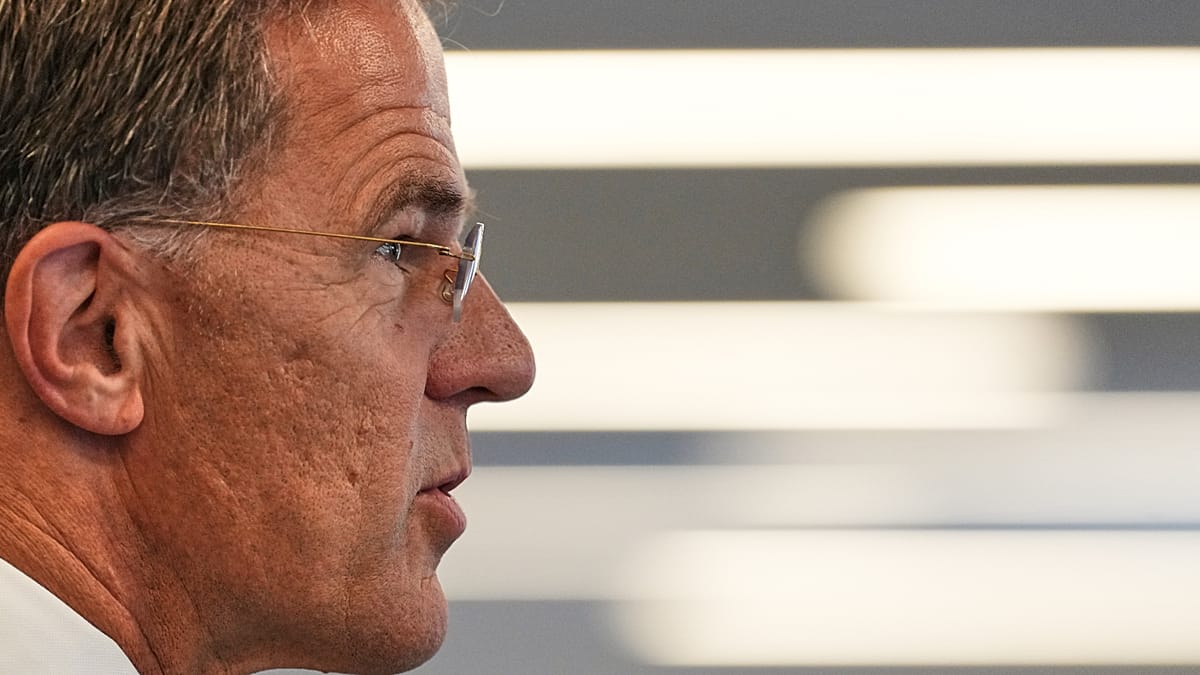
In the green room before Euronews' first defence summit, Mark Rutte recalled a chaotic doorstep outside his Brussels hotel during the 2020 pandemic recovery fund negotiations. Shaky cameras, jostling journalists, technicians tripping over cables – he remembered it all in detail, and reminded me that his hotel was the cheapest of any EU leader. No official car, no police escort: the 'cheapest and fastest' option, he said with a shrug.
That is the essence of Rutte, the Dutchman who served four terms as prime minister of the Netherlands before taking over as NATO Secretary-General. He has earned the nickname 'Teflon Mark' for his ability to emerge unscathed from political storms. Most politicians have egos; Rutte is remarkably effective at pretending he doesn't. He leans into self-deprecation, knows exactly when to switch on the charm, and presents himself as a man simply there to serve.
But behind the affable facade is a serious mission: keeping NATO together in an era of renewed Russian aggression and a volatile US presidency. Rutte's approach is to cosy up to Donald Trump, even at the expense of his own image, while ensuring that Russia's war does not spill into allied territory. If, by the end of his tenure, NATO is better funded and Washington remains on board, his 'daddy' diplomacy – an unfortunate remark that still haunts him – will have been worth it.
Nuclear threats and the Baltic front
On stage, Rutte confirmed that NATO had responded to a provocative Russian letter threatening to use its full arsenal, including nuclear weapons, if Russian territory came under threat. Moscow specifically mentioned Kaliningrad, the enclave bordering Lithuania, where experts warn of a real risk of false-flag attacks. Playing the nuclear card is nothing new for the Kremlin, which often reaches for it when the battlefield situation deteriorates. But that does not mean it can be ignored.
Rutte was clear: Russia should simply end the war in Ukraine and stop the nuclear threats. He was on a mission to calm nerves after weeks of speculation about a deteriorating security picture on NATO's eastern flank, particularly in the Baltic states, which have remained on high alert as hybrid attacks linked to Russia multiply. He insisted – and that is part of his job – that there is 'no imminent threat' to NATO territory.
This was a secretary-general determined to project an alliance that is strong and united. 'So much stronger than Russia. It could never beat us,' he said. The Kremlin knows it too, hence the sabre-rattling. The war is not going well for Russia; the battlefield is largely stuck. A Russia incapable of defeating Ukraine cannot take on NATO. Conventionally, this is not a fight Russia can win.
That does not mean Moscow cannot inflict enormous damage. It has created a climate of paranoia across Europe while pounding Ukraine in a sharp escalation of the air war. My colleague Sasha Vakulina, on assignment in Kyiv, was routinely woken by attacks. During one security check-in, she said it felt worse than at any point this year. Winter is approaching, and Ukraine clearly needs more air defence.
When I pressed Rutte on licensing Patriot systems for Kyiv, he did not give me an answer. The US and Ukraine have been negotiating a deal that would allow Kyiv to produce the system and reduce its dependence on external deliveries. It would not be a game changer in the short term – Rutte is right about that – but this should have been ironed out at the NATO summit in Turkey over the summer.
Europe's responsibility
Rutte is careful not to criticise Trump and is prepared to defend the president's intervention in Iran at great length – even if the war against the regime in Tehran has also inflicted pain on Ukraine. Energy prices are surging around the world, and the Strait of Hormuz remains shut, despite an agreement three months ago that was supposed to restore freedom of navigation. That promise has yet to materialise.
Trump is also cautioning Ukraine against hitting Russian energy facilities, which are instrumental in financing the war. He has a point: cutting refinery capacity at a time of acute market stress does not help. But Zelenskyy is not the root cause of the energy squeeze. The blockade of the Strait of Hormuz is.
Rutte is remarkably measured in his words. He won't utter the smallest criticism of Trump. Instead, he calls on Europeans to do more to help unblock the situation. Europe, he argues, should have been capable of dealing with Iran's nuclear threat rather than leaving the US to do the heavy lifting. When I asked Rutte, a European, whether he really believed Europe could have done it, his answer was emphatic.
'It should be us doing it. It should be us taking care of the Houthis and the Red Sea, not the Americans.'
Under his watch, NATO allies have committed to spend 5% of gross domestic product on defence, of which 3.5% will go to hard military capabilities. It is an accomplishment, and let's be honest, it's in large part due to Trump's return to the White House. But as Europeans put real money on the table, another question is becoming unavoidable: what should they buy? Should Europe favour European-made equipment or US systems? The debate is already simmering in capitals from Berlin to Paris, and it will define the alliance's future as much as any external threat.
Rutte's mission is to keep NATO together, and so far, his Teflon skin has served him well. But the cracks are visible, and the pressure is mounting. Whether he can hold the line remains to be seen.