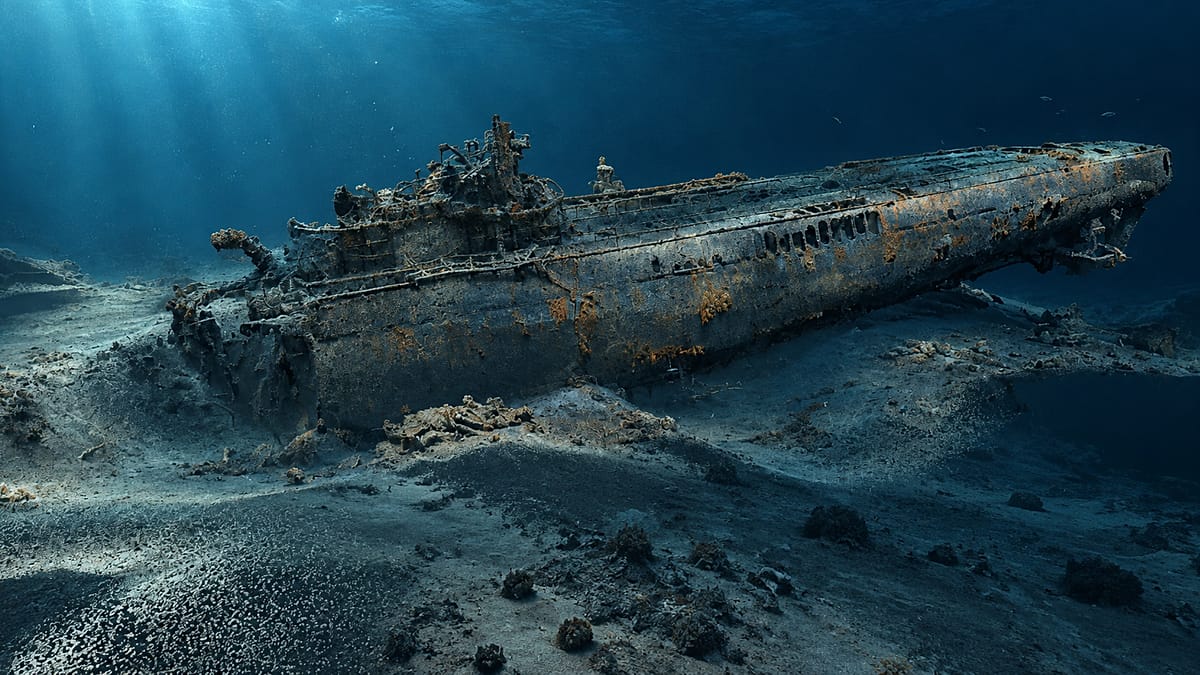
Off the rugged coast of Fedje, a small island in western Norway, a dark relic of the Second World War lies 150 metres beneath the waves. The German submarine U-864, split into two sections and half-buried in sediment, has been there since February 1945. But this is not just a historical curiosity – it is an environmental hazard that Norwegian authorities have been wrestling with for decades.
A lethal cargo from a desperate mission
U-864 was on a secret mission to Japan, carrying military technology, specialists, and a substantial quantity of mercury – a substance vital for the Japanese arms industry. Historical records mention an order for 1,867 containers of mercury, which would equate to roughly 65 to 67 tonnes. The exact loading manifests have never been found, so the precise amount remains uncertain. What is certain is that mercury is still inside the wreck, and it is not going away.
Mercury is a persistent pollutant. Unlike many organic compounds, it does not break down in the environment. It can remain in sediments for decades, even centuries, according to the US Environmental Protection Agency. Worse, micro-organisms can convert it into methylmercury, a highly toxic form that accumulates in the food chain, particularly in fish. For a coastal community like Fedje, whose economy depends on fishing and aquaculture, this is a direct threat.
The submarine was sunk by the British submarine HMS Venturer on 9 February 1945, in what remains the only known case of one submerged submarine sinking another. All 73 crew members perished. The wreck was forgotten until 2003, when the Norwegian naval vessel KNM Tyr located it after investigations prompted by the suspected cargo.
New images, old dilemma
In May 2025, the Norwegian Coastal Administration (Kystverket) conducted a detailed survey of the wreck using remotely operated vehicles equipped with 4K cameras, photogrammetry, and acoustic sensors. The resulting images and a 3D model show the submarine lying in two parts, partly embedded in the seabed. The footage, released by Kystverket, offers a stark view of the vessel's condition.
The state of the wreck is critical. Many of the mercury containers are likely to have been damaged during the sinking. A recovery operation could remove some of the mercury, but it also risks stirring up contaminated sediments and releasing pollutants into the water column. This is exactly what happened during a 2026 salvage attempt, when 22 containers were brought to the surface. Around 80% of those containers were found to be damaged and leaking. About half a tonne of mercury was recovered, but mercury was also released into the sea during the operation.
That experience has led Kystverket to recommend a different approach: covering the wreck and the contaminated seabed with a protective layer. The authority argues that a large-scale recovery could ultimately release more pollutants than it removes. However, a cover would require long-term monitoring to ensure its integrity.
The people of Fedje live with the knowledge that a few kilometres offshore lies a ticking environmental time bomb. The debate over what to do – recover the mercury or seal it in place – has been ongoing for years, and the new images have only sharpened the urgency. As technology allows a closer look at the wreck, the fundamental question remains unresolved: how to neutralise a threat that has been building for over eight decades.
Norway is not alone in facing such legacy pollution from the world wars. Across Europe, old munitions dumps and sunken ships pose similar risks. The challenge is to balance the need to protect the environment with the practical and financial constraints of operating at depth. For Fedje, the answer may determine the future of its waters and its community.