Oil prices edged higher on Thursday, holding near their highest levels in weeks, as the unresolved standoff between the United States and Iran continued to keep supply worries at the forefront for Middle East markets. Brent crude, the international benchmark, rose 0.3% to $91.90 a barrel, while US benchmark crude gained 0.2% to $84.57.
Since the start of August, when Brent was trading around $87.38, prices have climbed steadily. The tension over the Strait of Hormuz—a critical chokepoint for global oil shipments—has kept the market on edge, even without a single new escalation. Both benchmarks remain well above their pre-war levels, reflecting the persistent risk premium.
Markets rebound on Treasury move
Global equities reversed Wednesday's sharp sell-off in technology stocks after the US Treasury Department announced it would at least double the size of its buyback operations for longer-dated government debt, to $4 billion (€3.4bn) or more per operation, starting in September. The move eased pressure on bond markets that had pushed yields to multi-decade highs in recent months, lifting risk appetite across Asia.
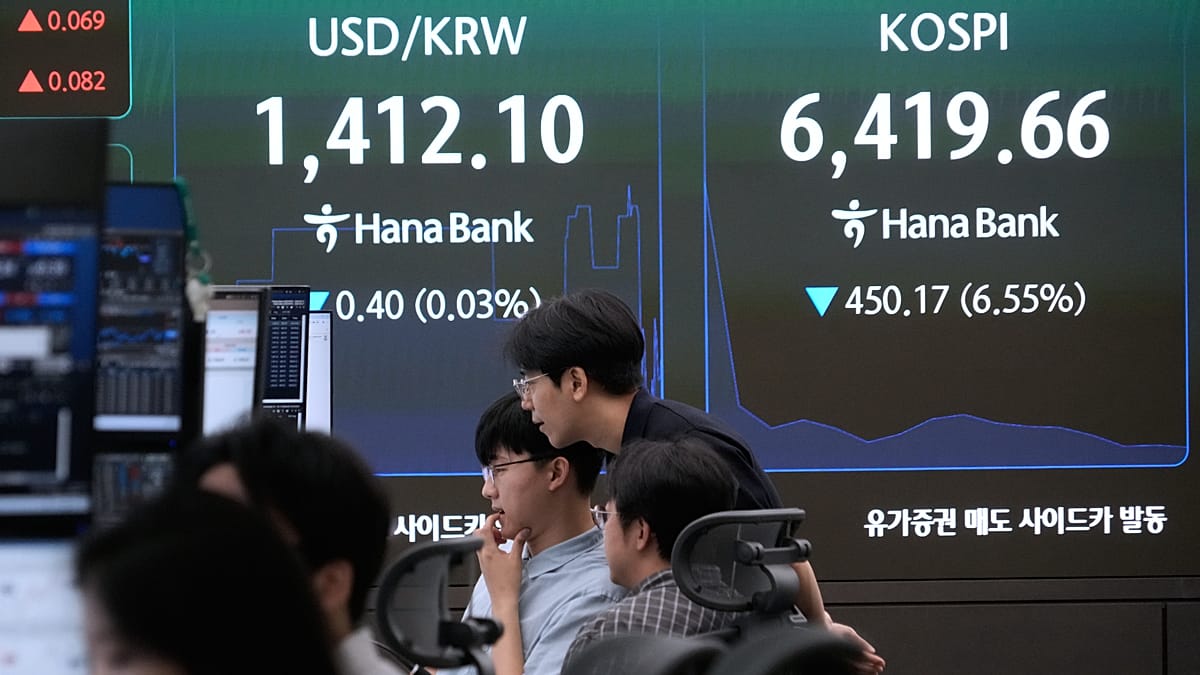
South Korea's Kospi surged 6.1% to 6,858.91, rebounding sharply after sinking 5.8% the previous day. Samsung Electronics jumped 9.7%, while SK Hynix soared 14.1% after the memory chipmaker unveiled its own share buyback plan. Japan's Nikkei 225 added roughly 0.9%, and the Topix rose 0.8%, recovering some of Wednesday's losses. Hong Kong's Hang Seng gained 1.1% to 25,786.32, and the Shanghai Composite rose 0.3% to 3,905.23. Australia's S&P/ASX 200 was up 0.3% to 9,066.40.
In Europe, the positive sentiment was mirrored in early trading, with major indices like the DAX in Frankfurt and the CAC 40 in Paris opening higher, though gains were more muted than in Asia. The euro slipped slightly to $1.1676, while the US dollar strengthened to 158.60 yen.
Bond yields ease from multi-decade highs
The yield on the 10-year US Treasury fell to around 4.64%, down from 4.71% on Tuesday, while the 30-year yield dropped to 5.18% from 5.28%—pulling back from its highest level since 2007. Yields had climbed in recent months on concerns over inflation stemming from the conflict in Iran and rising government debt.
Japan's 10-year government bond yield, which had been trading near a three-decade high, fell to around 2.83% from more than 2.89% on Wednesday. On Wall Street, the S&P 500 climbed 0.2% for its first gain in four sessions, snapping a three-day losing streak. The Dow Jones Industrial Average and the Nasdaq composite each added 0.2%.
The Treasury's buyback plan is seen as a way to improve liquidity in the bond market, which has been strained by heavy issuance and reduced dealer capacity. Analysts say the move could help stabilize yields, though the underlying fiscal concerns remain.
For European investors, the development is a welcome respite after a turbulent summer. The midday briefing on August 14 noted that markets were already jittery over inflation and geopolitical risks. The easing in yields may provide some breathing room for European governments as they plan their autumn borrowing.
Meanwhile, the oil market's resilience is a reminder of the fragile balance in the Middle East. The summer retreats of European leaders have done little to ease the underlying tensions, and the previous day's briefing highlighted the continued volatility in energy prices.
As the standoff over the Strait of Hormuz drags on, European consumers and businesses will be watching closely. Higher oil prices feed directly into inflation, which the European Central Bank has been battling with interest rate hikes. The recent easing in bond yields, if sustained, could offer some relief, but the path ahead remains uncertain.