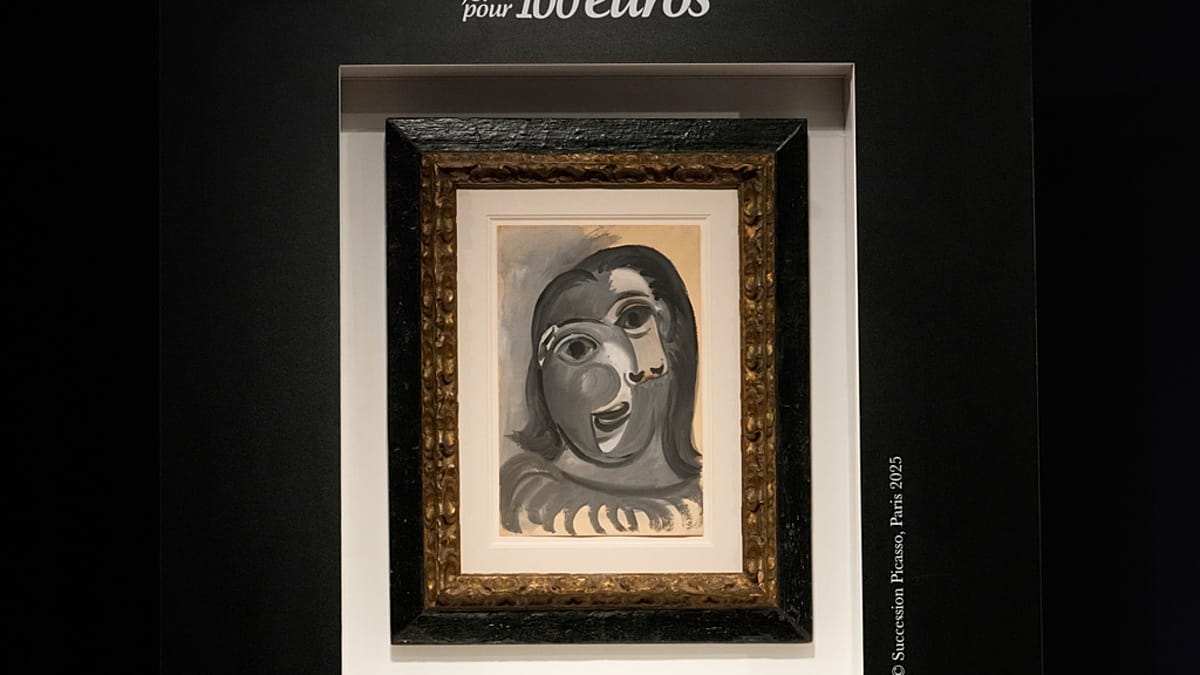
A Parisian sales engineer has become the owner of a major work by Pablo Picasso after his €100 ticket was drawn in a high-stakes charity raffle. Ari Hodara, 58, was declared the winner of the portrait "Tête de femme" ("Head of a Woman") during a live ceremony broadcast by Christie's auction house. The 1941 gouache, depicting Picasso's muse Dora Maar, was provided by the Opera gallery at a preferential price of €1 million.
The event, organised by French journalist Peri Cochin with support from the Picasso family and foundation, is the third of its kind. It sold 120,000 tickets at €100 each to participants from 52 countries, generating a total of €12 million. The primary beneficiary is the Alzheimer's Research Foundation, based at Paris's Pitié-Salpêtrière Hospital, which will receive €11 million. The remaining €1 million covers the cost of the artwork.
A Personal Win for a Public Cause
"How do I know this isn't a joke?" Hodara recalled asking when Christie's informed him of his win. A self-described art lover with a passion for Picasso, he purchased his ticket over the weekend after discovering the raffle online while dining out. "I'm going to break the news to my wife first, who isn't back from work yet," he said. "And in the first instance, I think I'm going to enjoy it and keep it."
The organisers emphasised that the core mission is funding critical medical research. "Funding for research is derisory," said Olivier de Ladoucette, director of the Alzheimer's Research Foundation. "In our developed societies, we still haven't understood that this is a major public health problem and that everyone needs to get involved." He added that the initiative is "one more stone in the edifice that will one day make Alzheimer's disease a thing of the past."
The foundation, created in 2004, claims to be France's leading private funder of Alzheimer's research. This significant injection of funds comes as public health systems across Europe face mounting pressures from ageing populations. The success of such philanthropic models highlights alternative avenues for supporting research where public funding may fall short, a relevant consideration as broader economic pressures strain national budgets.
A History of Artistic Philanthropy
This is not the first time a Picasso work has been raffled for charity. In 2013, a 25-year-old American fire-systems worker won "Man with an Opera Hat," a 1914 Cubist piece. In 2020, "Still Life," a 1921 oil painting acquired from billionaire collector David Nahmad, was won by Italian accountant Claudia Borgogno after her son gifted her a ticket. Those earlier draws raised over €10 million for cultural projects in Lebanon and water programmes in Africa.
Gilles Dyan, founder of the Opera gallery, stated he offered the "Tête de femme" at below its public market value of €1.45 million to maximise the charitable contribution. The painting was sourced from a private dealer, illustrating the mobilisation of the high-value art market for public good. Such collaborations between cultural institutions and medical foundations represent a unique cross-sector approach to philanthropy.
The story underscores how European cultural assets can be leveraged to address societal challenges. While the win is a life-changing event for one Parisian, its greater impact lies in the multimillion-euro boost for a foundation tackling a disease that affects millions across the continent. The model also demonstrates public engagement on a global scale, with ticket buyers from across the world participating.
As Europe continues to navigate complex health and funding landscapes, initiatives like this offer a creative template. The convergence of art, charity, and public health research in Paris serves as a notable example of civic innovation, standing in contrast to other regions where cultural patronage may follow different paths, such as the economic diplomacy seen in the Gulf.