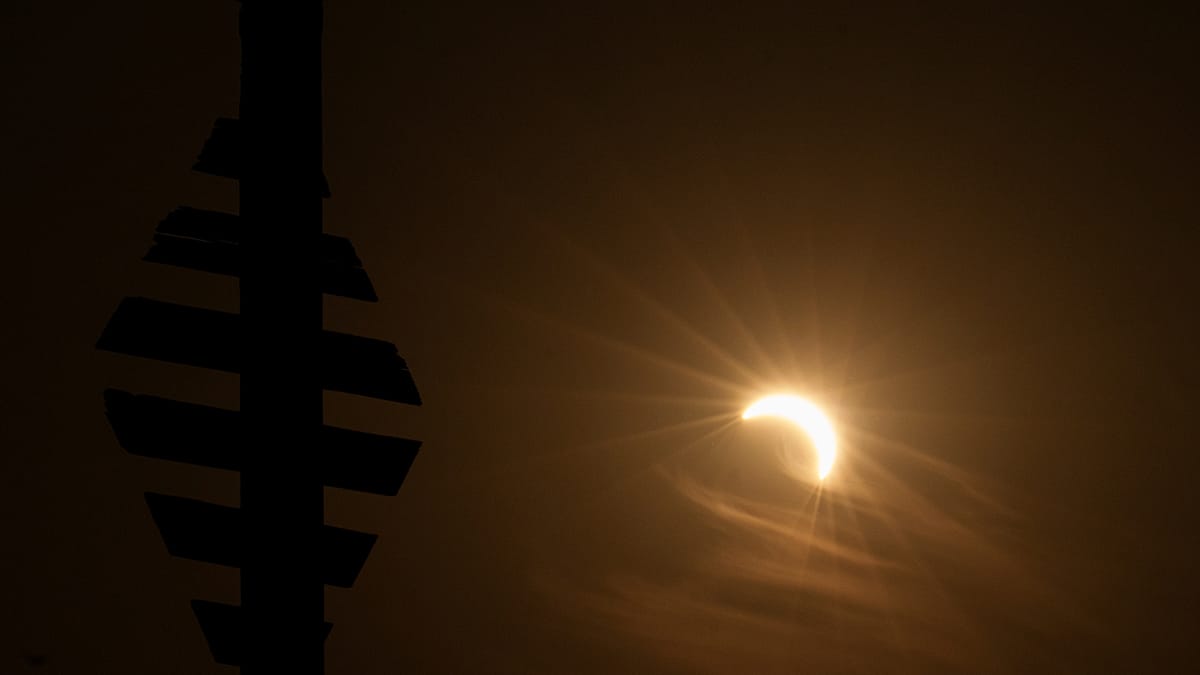
On a crisp morning, the Royal Observatory Greenwich became a focal point for sky-watchers as a partial solar eclipse swept across Britain. The event, the most substantial since 1999, drew crowds to parks, observatories, and open spaces across the country, all eager to witness the Moon's slow passage across the Sun.
At Greenwich, the historic site of the prime meridian, the atmosphere was electric. Amateur astronomers and curious families alike set up telescopes and solar filters, while others simply looked up through protective glasses. The sky, normally a clear blue, took on a strange, muted quality as the eclipse reached its peak, with more than 90% of the Sun obscured in parts of the nation.
The timelapse captured from the Royal Observatory offers a condensed view of the event, showing the Moon's shadow creeping across the solar disc, then retreating. In London, the light dimmed to an eerie grey, a phenomenon that prompted many to pause in their daily routines and look upward.
A rare celestial alignment
Partial solar eclipses occur when the Moon passes between Earth and the Sun, but not in perfect alignment, leaving a crescent of sunlight visible. The last time Britain witnessed such a significant eclipse was in 1999, when a total eclipse crossed the south of England. This year's event, while not total, still offered a dramatic spectacle for millions.
For many, the eclipse was a reminder of the vastness of the cosmos and our place within it. "It's humbling to see the mechanics of our solar system in action," said Dr. Emily Carter, an astronomer at the Royal Observatory. "Events like this connect us to the universe in a way that few other experiences can."
The eclipse also sparked conversations about the upcoming total solar eclipse on 12 August, which will be visible from northern Spain. That event, expected to draw half a million spectators, promises to be an even more dramatic display. For those who missed the British eclipse, it offers another chance to witness the celestial ballet.
As the eclipse concluded, the sky gradually brightened, and normalcy returned. But the memories of the event, and the images captured from Greenwich and elsewhere, will linger. For those who took part, it was a moment of shared wonder, a brief pause in the rush of modern life to appreciate the natural world.
For those who missed the event or wish to relive it, the timelapse from the Royal Observatory provides a lasting record. It also serves as a reminder of the importance of safe viewing practices; looking directly at the Sun can cause permanent eye damage. Experts recommend using certified solar filters or indirect viewing methods.
As Europe looks ahead to the next major eclipse, the enthusiasm shown today suggests that the continent's fascination with the skies remains as strong as ever. Whether from a historic observatory or a city park, the experience of watching the Moon obscure the Sun is one that unites people across borders and generations.