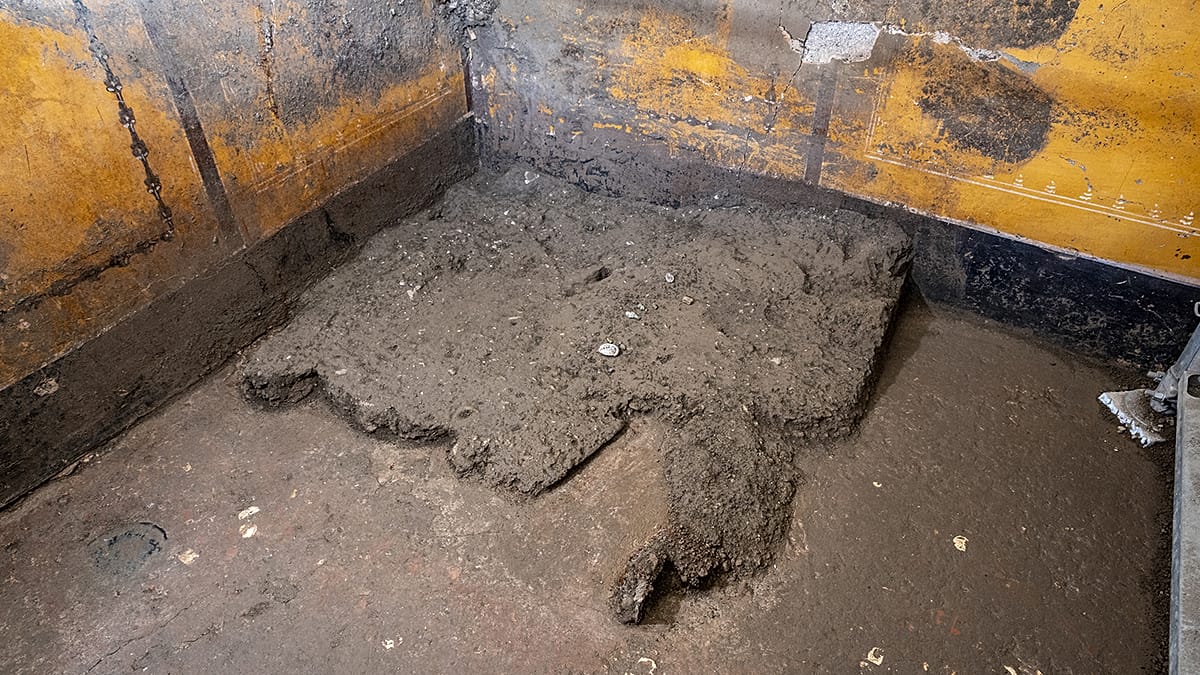
Archaeologists working in the central area of Pompeii have brought to light the contents of a wooden wardrobe that once belonged to a woman in the ancient city. The discovery, made in the House of Cornelius Maximus (IX 11, 7), offers an unusually intimate view of daily life before the catastrophic eruption of Mount Vesuvius in AD 79.
The cabinet, which had been sealed by volcanic ash for nearly two millennia, contained a remarkable array of personal items: bronze tweezers and a spatula for mixing pigments, a glass balsamarium (a small jar for perfumes), a perfume burner, and a bronze lamp. Alongside these were lead weights, likely used for commercial purposes, stored in a small wooden box of which only faint traces remain.
A glimpse into a Pompeian woman's world
The collection also included vases and pots in bronze, glass, and ceramic—everyday household objects that may have carried sentimental value. Among them was an elegant little jug decorated with pine-scale motifs. Perhaps most striking is a necklace composed of at least twenty-four miniature objects in faience, bone, glass paste, and rock crystal, all pierced for suspension. The pendants represent deities such as Bes and Mercury, as well as feet, hands, pine cones, and bunches of grapes.
Experts believe such necklaces were sometimes regarded as magical amulets used in spells and potions. In reality, they are what the Romans called crepundia—rattles or amulet necklaces given to children for protection and so that they could be heard when they moved. It was not unusual for adults to keep these keepsakes, often in small boxes or cloth bags inside wardrobes, as reminders of a childhood that otherwise left little trace. The Roman world was highly mobile, with people moving across the empire for trade, military service, or as slaves, so many found themselves far from their original homes and families.
A hidden treasure
The wardrobe also concealed a small hoard of 38 bronze coins, preserved in a cistella, a container made of plant material using basketry techniques. The presence of these coins suggests that the owner or owners did not have time to retrieve their valuables—whether economic or emotional—before fleeing the eruption. If they escaped, they never returned to dig through the ruins, unlike others whose efforts have left traces in recent excavations. But perhaps they perished, among those who, as the historian Tacitus recalls, died without heirs and whose property would have been used for the refounding of Pompeii, which never took place. These are questions that remain open.
Gabriel Zuchtriegel, director of the Archaeological Park of Pompeii, emphasized the human dimension of the find: "Pompeii is not just a place of great works of art; it is also somewhere where the most ordinary objects restore the human dimension of the past. The value of this discovery lies in the possibility of reading together the different traces of a life: personal habits, work, memories." He added, "We cannot reconstruct with certainty the identity of the person who lived in the house, but these fragments bring us closer to their everyday life."
The House of Cornelius Maximus
The excavation has also clarified aspects of the house itself. The facade, tentatively attributed to Cornelius Maximus based on inscriptions no longer visible, was first excavated in 1912. Only now have the rooms behind it been investigated, as part of a major restoration and accessibility project for the adjacent Insula dei Casti Amanti. The room where the wardrobe was found features refined Fourth Style wall paintings, likely from the workshop on Via di Castricio, indicating a certain standard of living, consistent with the house's prime location overlooking one of the main arteries of the ancient city.
However, at the time of the eruption, various works were in progress that would have affected liveability. The discovery of at least two mouse skeletons, found inside an amphora on a mezzanine, adds a curious detail. According to analyses in the park's laboratory, they likely belonged to the species Apodemus sylvaticus, also known as the wood mouse.
This find is part of a broader series of recent discoveries at Pompeii that continue to enrich our understanding of Roman life. For those interested in similar stories, the restoration of another grand Pompeian house and the recent heritage days events offer further insights. The site remains a testament to the fragility of human existence and the enduring power of everyday objects to connect us with the past.