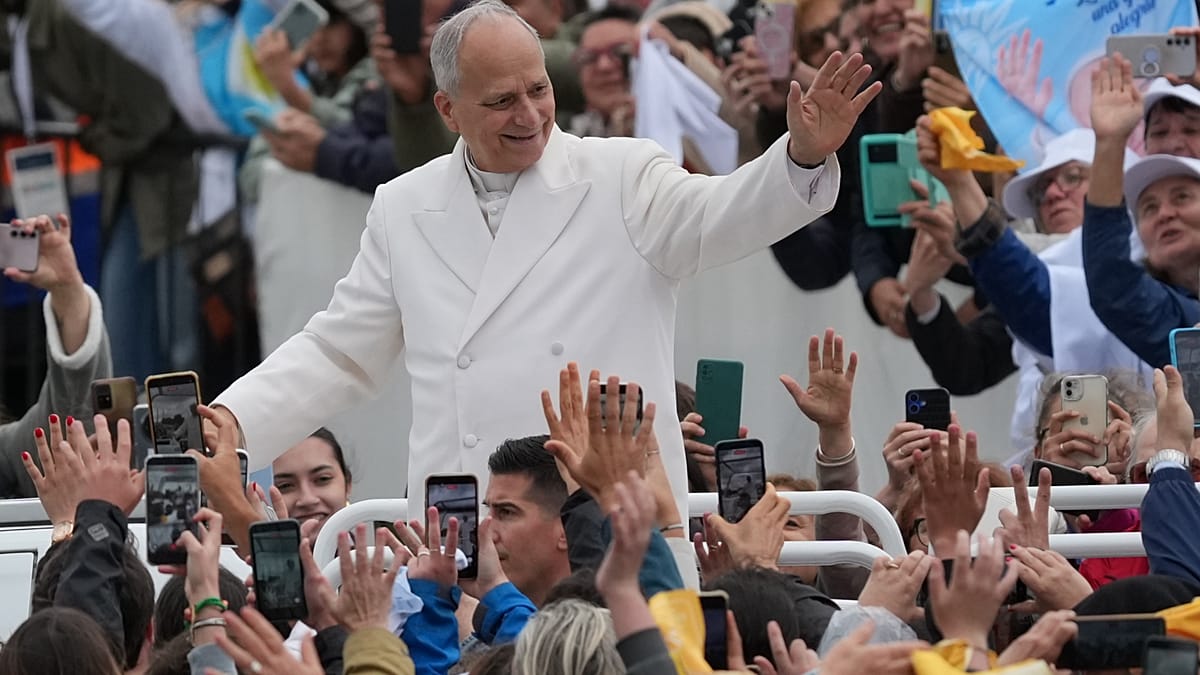
Pope Leo XIV brought his message of peace and community to Uruguay on Saturday, celebrating Mass in the city of Paysandú before a crowd of more than 40,000 people. The service, held in the Parque París Londres, was the centrepiece of the first full day of his sixth apostolic journey, which began with a visit to the South American nation.
The Pontiff arrived from the "Brigadier General Aviator Tydeo Larre Borges" International Airport in the popemobile, making his way through the cheering faithful and blessing those who had gathered. At the altar, placed beside an image of Blessed Jacinto Vera, he delivered a homily focused on the themes of unity and community.
"Peace is possible and we are called to build it," the Pope declared during the liturgy. He then offered the congregation three symbols drawn from Uruguayan soil, each meant to illustrate how the Christian faith can be nurtured and spread in today's world.
The first symbol was the "General Artigas" bridge, which he used as a metaphor for the importance of forging strong bonds and engaging in dialogue with others. The second was the local palm trees, which grow together in groves and remind the faithful of the communal nature of the Church. Finally, he pointed to mate, the traditional drink shared at gatherings, calling it "an element deeply significant to your culture, around which friends or relatives gather to share."
At the end of the service, after the bishop of Salto, Arturo Eduardo Fajardo Bustamante, offered official thanks, the Pope presented a chalice to the local diocese.
A packed schedule in Montevideo
The day's programme continued with a visit to the Basilica of Our Lady of the Rosary in Paysandú, where the Pope unveiled a commemorative plaque and greeted the faithful outside. He then travelled to the capital, Montevideo, for the second part of his agenda.
In the late afternoon, the Pope was scheduled to meet the social community of Casavalle at the Parish of Our Lady of Guadalupe, followed by an engagement with the academic and education sector at the Catholic University of Uruguay. These meetings are intended to foster direct dialogue with the country's educational and care institutions.
The day is set to conclude at Montevideo's Centenario Stadium, where the Pope will preside over a prayer vigil with thousands of young people and faithful who have come from across the country. The event is expected to be a highlight of the visit, offering a moment of collective reflection.
On Sunday, the Pope is expected to travel to Florida, about 90 kilometres from the capital, a town considered the "cradle" of the nation because it was there that Uruguay's Declaration of Independence was signed in 1825. Florida is also an important religious centre, home to the National Shrine of the Virgen de los Treinta y Tres, in front of which the Pope will celebrate Sunday Mass.
This journey comes less than a month after the Pope underwent surgery for lung adenocarcinoma at Rome's Gemelli Hospital, a fact that has drawn attention to his stamina and determination. His visit to Uruguay is part of a broader tour of South America, and his words on peace resonate beyond the continent, echoing Europe's own struggles to find a unified voice on peace talks.
The Pope's emphasis on dialogue and community also touches on themes familiar to European audiences, where debates about social cohesion and the role of faith in public life remain pertinent. His use of local symbols to convey universal messages is a hallmark of his pastoral style, and his call to "build peace" is a reminder that such efforts require active participation, not just passive hope.
As the visit continues, observers will be watching for any further statements on global affairs, particularly given the Pope's history of speaking out on issues such as migration and conflict. His presence in Uruguay, a country known for its secular traditions, also highlights the Church's ongoing engagement with societies where religious practice is not always the norm.