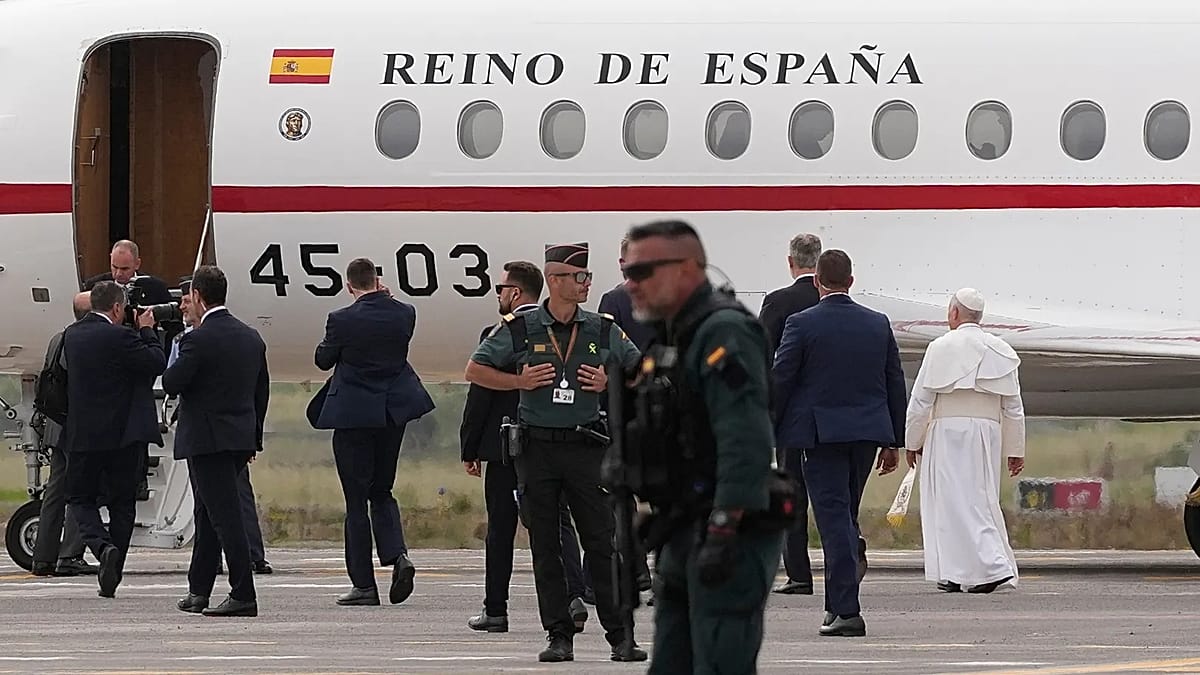
Pope Leo XIV returned to Rome on Friday aboard a Falcon jet provided by King Felipe VI of Spain, after the original papal aircraft suffered a technical glitch on the runway in Tenerife. The incident, described by veteran Vatican reporters as the first time in decades a papal flight required a plane change, brought an unusual end to an otherwise smooth week-long visit to Spain.
The pontiff’s departure from Tenerife Norte–Los Rodeos International Airport was initially delayed by about half an hour. According to an AFP reporter at the scene, the pope had already boarded the Iberia-operated charter when the pilot announced a “startup failure of the engine,” likely caused by wind conditions. The pilot told passengers that maintenance crews would attempt to tow the aircraft into a more favorable position for a new engine start. When that effort failed, the pope and the king, who had come to bid farewell, disembarked and returned to the terminal.
King Felipe VI then offered his own Falcon jet, a Spanish military aircraft, to transport the pope and his delegation. The flight departed just after 6:00 pm local time and was expected to land in Rome around 11:00 pm. Approximately 80 journalists, along with Vatican officials and clergy, remained on the original Iberia plane while the pope switched aircraft.
A Rare Disruption in Papal Travel
Veteran Vatican journalists recalled only a handful of similar incidents during the pontificate of St. John Paul II. In 1986, his plane was forced to land in Naples due to a snowstorm in Rome, and the pope and passengers completed the journey by train. In 1988, en route to Lesotho, bad weather diverted his flight to South Africa—a country he had deliberately excluded from his African itinerary because of apartheid—and he was later driven into the kingdom.
Typically, papal trips follow a pattern: the Italian national carrier ITA Airways flies the pope to the destination, and the host country’s airline brings him home. For longer or more remote journeys, ITA may handle the round trip. This time, Iberia had proudly released video earlier in the trip showing Pope Leo XIV seated in the cockpit, smiling as the plane carried him from Madrid to Barcelona and then to the Canary Islands. Spanish military aircraft provided an airborne escort on both legs, a standard gesture of respect for visiting dignitaries.
The pope’s visit to Spain included stops in Madrid, Barcelona, and the Canary Islands. He used the trip to press his message on migration, a theme that resonates across the continent as EU member states grapple with the implementation of the EU Migration Pact. In Barcelona, he inaugurated the new tower of the Sagrada Família basilica, a landmark moment for the city and for Catalan culture.
The technical glitch, while disruptive, did not overshadow the broader significance of the visit. Pope Leo XIV has made migration a central plank of his papacy, and his Spanish itinerary underscored the importance of the Mediterranean route. The incident also highlighted the close ties between the Vatican and the Spanish monarchy, with King Felipe VI’s swift offer of his own aircraft ensuring the pope’s return to Rome without further delay.