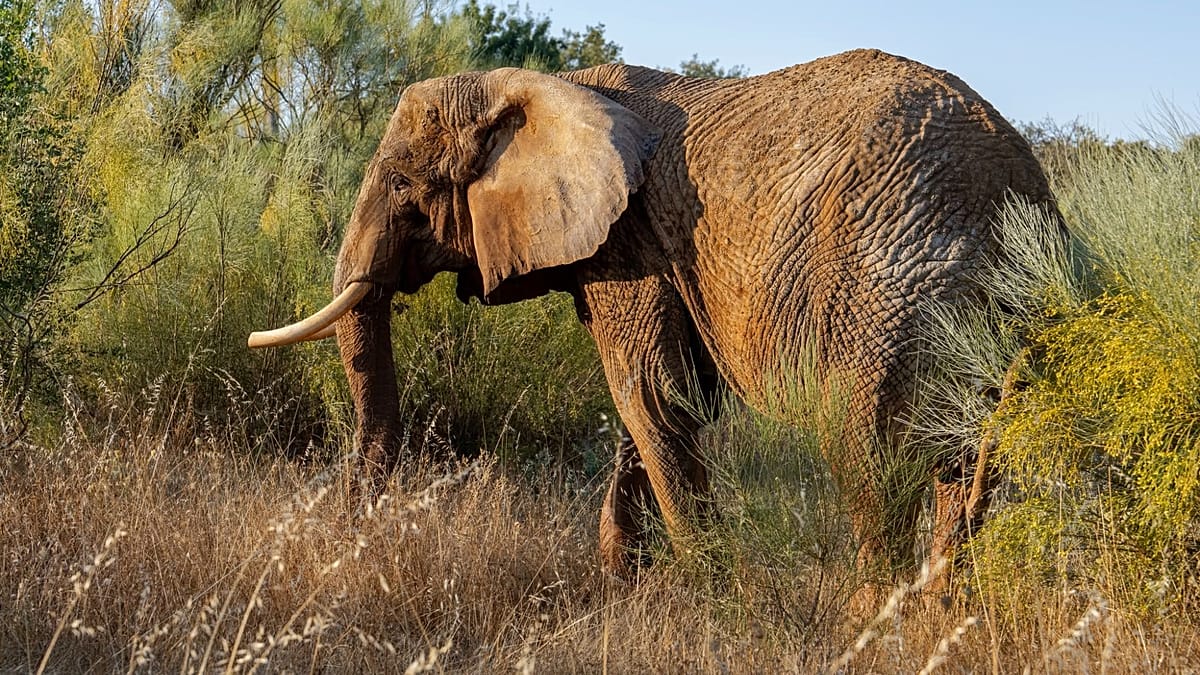
Nearly four months after leaving the circus ring for good, Julie—Portugal's last performing elephant—has found a new rhythm in the rolling plains of the Alentejo. The 400-hectare estate, run by the Pangea Sanctuary, is the first large-scale elephant refuge in Europe, and Julie is its inaugural resident.
When she arrived in June, Julie was cautious and withdrawn, according to elephant keeper Johnny Nascimento. "She was shy, like anyone who comes to a new place, who does not know anyone and does not know the surroundings," he said. "Slowly, about a week later, she began to trust and to decide what she wanted to do outside. There are many trails, so she has been tidying up the house and, in this case, making it her own home."
The move came after a voluntary agreement with the Victor Hugo Cardinali circus, following Portugal's 2018 ban on wild animals in circuses, which only took full effect in 2024 to give circuses time to adapt. Julie, captured in Africa around four decades ago, had been with the Cardinali troupe since 1988.
A new life, at her own pace
Julie now has unrestricted access to the sanctuary's varied terrain, and the change has been tangible. "She has been with us for just over three months and has already gained about 100 kilos in that time, which is perfectly normal," explained Ryan Hockley, the sanctuary's manager. "Where she was before, she did not really have the opportunity to exercise, she was just in a shed most of the time. Whereas now she has free access 24 hours a day, she can be in the shelter, she can be in any habitat, she literally owns everything, she makes her own choices."
One of her favourite pastimes is wallowing in the mud pools scattered across the estate—a simple pleasure that was impossible in her former life.
The sanctuary's mission extends beyond Julie. With an estimated 600 elephants still in captivity across Europe, many living in substandard conditions, Pangea aims to provide a model for ethical retirement. "I think it is extremely important that someone has done what we are doing, that someone has created an elephant sanctuary," Hockley said. "There are more than 600 elephants in Europe, Asian and African, and a proportion of those elephants are not in ideal conditions."
The choice of the Alentejo was deliberate. Its warm, dry climate echoes the savannahs of East Africa, offering a semblance of home. "If we were to choose anywhere in Europe, I think Portugal is the ideal choice, the climate gives me that feeling of being in Africa," Hockley said, drawing parallels with Tanzania or Kenya.
Pangea's long-term goal is to expand its capacity to house between 20 and 30 elephants. "We are certainly the first large-scale elephant sanctuary in Europe, there is a sanctuary in France, but the enclosure they have is not as big as the one we have here, we have an incredible piece of land," Hockley added.
Julie will soon have company. Kariba, another African female elephant from a circus in Belgium, is expected to arrive as early as November. Her transfer was delayed by a series of infections, but once she is fully recovered, she will make the journey to Portugal.
For now, Julie continues to explore her new domain, her days filled with mud baths and quiet wanderings—a far cry from the confines of a circus shed. Her story is a testament to what can happen when animals are given the space to simply be themselves.