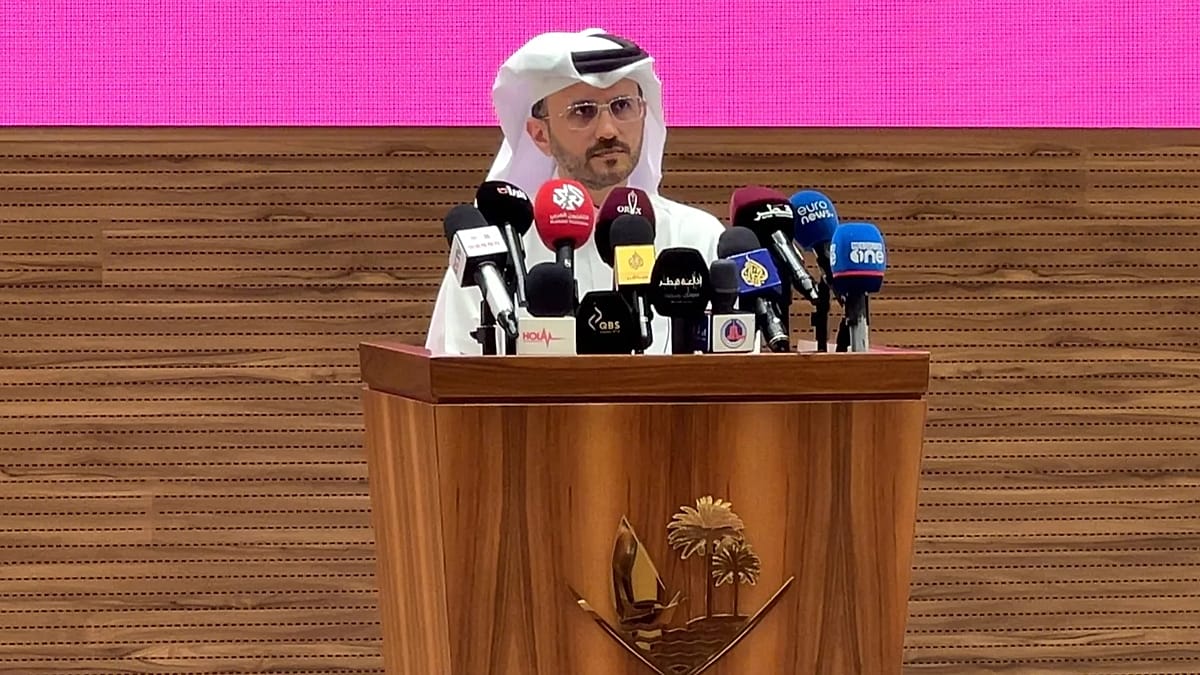
Qatar has issued a sharp warning to Iran, declaring that it will not tolerate being used as a "political punching bag" in the escalating crisis over the Strait of Hormuz. Speaking in Doha on Tuesday, Dr. Majed Al-Ansari, spokesperson for Qatar's Ministry of Foreign Affairs, made clear that any attack on Qatari sovereignty is unacceptable and that Doha has taken all necessary precautions to protect itself.
"We will not be used as political punching bags in this war," Al-Ansari told reporters. "Any attack on our sovereignty cannot be justified by any means, and we have taken all the necessary precautions to make sure that we are safe from this aggression."
The remarks come as Gulf leaders convened in Saudi Arabia for the first time since the Iran conflict began, aiming to address the blockade of the Strait of Hormuz—a critical maritime chokepoint through which about a fifth of the world's oil passes. The meeting underscores growing regional unease over Tehran's use of the strait as a political lever.
Qatar's Balancing Act
Al-Ansari stressed that Doha does not see a general push within the Gulf Cooperation Council (GCC) for further escalation with Iran. He recalled that before the war, there had been a rapprochement with Tehran, and Qatar had consistently advocated for diplomatic engagement. "I think if you go back to before this war has started, there was actually a rapprochement with Iran, we were attempting to find a diplomatic resolution through engagement with Iran," he said. "I think this is a position that Qatar has always held."
However, the tone shifted sharply when addressing the current crisis. Al-Ansari insisted that the Strait of Hormuz "should have never been closed and it should be opened immediately regardless of other considerations going on in the region." He described the use of the waterway as a bargaining chip as unacceptable.
Qatar's stance reflects a delicate balancing act: maintaining ties with Iran while protecting its own sovereignty and aligning with broader Gulf and European interests. Doha is also coordinating mediation efforts with Pakistan, with Al-Ansari noting that the current circle of negotiations is sufficient and does not need to be expanded.
European Role Welcomed
In a nod to European diplomacy, Al-Ansari praised the efforts of the United Kingdom and France to secure safe navigation in the Strait of Hormuz. "We applaud our partners in Europe for taking the lead on this," he said, adding that Qatar is continuing to engage with them. He expressed support for all international efforts leading to a diplomatic solution and the reopening of the strait.
This endorsement comes as the EU has been increasingly active in the region, with the World Bank warning that the conflict could trigger the sharpest energy price spike since 2022, a concern that resonates deeply in European capitals dependent on stable energy supplies.
Al-Ansari acknowledged that the war has fundamentally altered threat perceptions across the region. "The main concern right now in the region is the security of the region. The threat perception in the region has changed as a result of this war," he said. "The stability has been put into question, and what we need right now are security guarantees that would make sure that we would not return to the situation a couple of months down the road."
Call for a Comprehensive Deal
Looking beyond the immediate crisis, Qatar is advocating for a broader political settlement that includes Iran. "We want a comprehensive deal that would address the interest of all the people in the region, including the Iranians, our people, and the concerns of the international community regarding Iran," Al-Ansari said. He acknowledged that progress would likely be incremental, stating, "Peace is incremental, and we are not against any deal that would maintain the ceasefire, which is a positive trajectory for us."
Qatar's position aligns with its longstanding role as a mediator in regional conflicts, a role that has gained prominence amid the current tensions. The country's energy sector, meanwhile, continues to advance its North Field expansion, a project that underscores Doha's strategic importance in global liquefied natural gas markets.
Al-Ansari reiterated that Qatar's position has been consistent from the start: "Any conflict in the region should be solved on the negotiation table. And we believed in the negotiation process and we were supportive of the negotiation process and we will remain supportive of a diplomatic resolution."
As the crisis unfolds, Qatar's warning to Iran serves as a reminder that even regional powers with close ties to Tehran have limits. The coming weeks will test whether diplomatic channels—bolstered by European mediation—can prevent further escalation in one of the world's most strategically vital waterways.