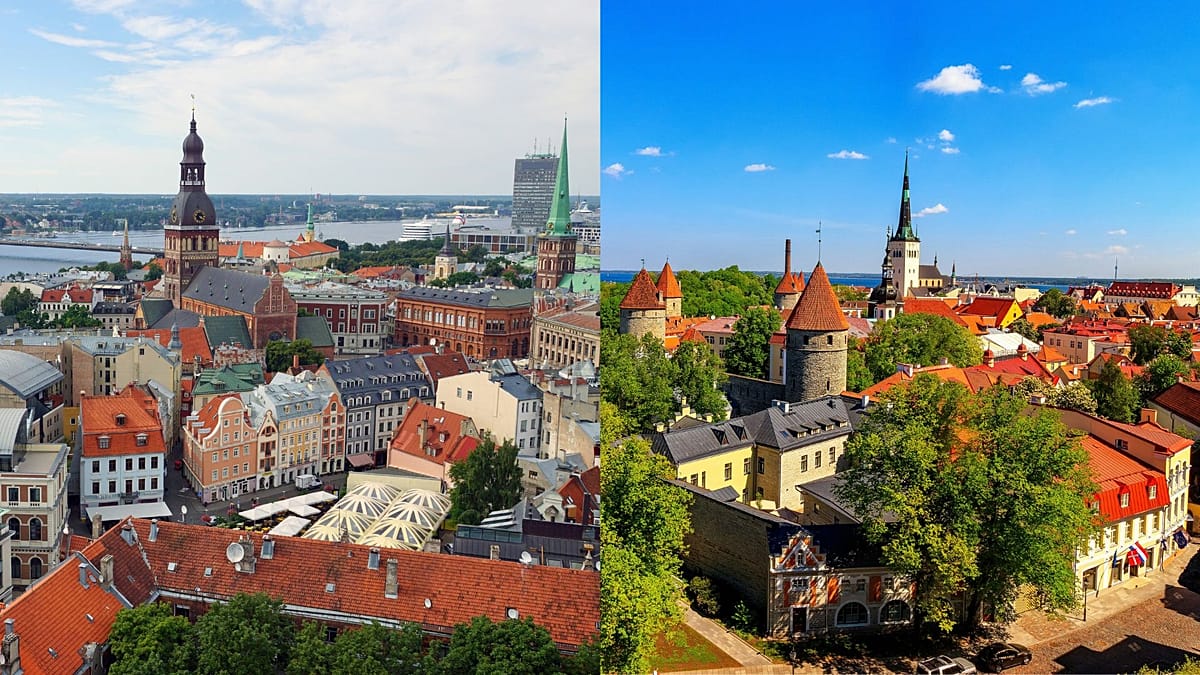
As heatwaves become a summer staple across southern Europe, the 'coolcation' has moved from trend to necessity. While Scandinavia has long been the default refuge, the Baltic capitals have emerged as savvy alternatives—more affordable, less crowded, and just as culturally rich. For a long weekend, both Riga and Tallinn deliver, but they do so with distinct personalities.
Geographically, the comparison is fair: Riga sits on the Gulf of Riga, Tallinn on the Gulf of Finland. Vilnius, the third Baltic capital, lies inland, making it a different kind of trip. Having visited both coastal cities in the summer of 2025, I found that while they share a Hanseatic heritage and UNESCO-listed Old Towns, the experience diverges in subtle but meaningful ways.
Riga: A feast for architecture lovers
Riga’s centre is a living textbook of European architecture. At the Three Brothers, you can see the city’s oldest medieval dwellings—one from the 15th century, two from the 17th—now housing the Latvian Museum of Architecture. But the real star is Art Nouveau: roughly a third of the buildings in the centre are in this style, including the National Romantic variant unique to Latvia. The Quiet Centre district is the best place to admire it, and the Art Nouveau Museum on Alberta iela offers a glimpse into the original interiors.
For a contemporary counterpoint, the National Library of Latvia, designed by the renowned architect Gunārs Birkerts, is a must. A guided tour in English reveals the building’s symbolic details, or you can explore via the library’s self-guided audio option.
The skyline is punctuated by church spires, with St. Peter’s Church offering the best panoramic views—climb to the top for a perspective that takes in the Daugava river and the city’s rooftops. The rooster, a symbol of Riga, adorns many churches; the one on St. Peter’s has been there since 1491, though the current version dates to 2009. You’ll find the motif on countless souvenirs, but the traditional sugar rooster is a tastier takeaway.
Food is a highlight. The Riga Central Market, one of Europe’s largest, operates from five former military airship hangars, selling everything from fresh produce to local meats. For a more intimate experience, Āgenskalns Market—a historic hall from 1898, renovated in 2022—offers ground-floor vendors and an upstairs food court with Latvian dishes. And for beer enthusiasts, Latvia’s craft scene is booming, with one brewery per 25,000 people; try Nurme or Labietis in Riga.
While Riga’s metropolitan area reaches the Gulf, the city centre is inland, so don’t expect beaches. Instead, take a cruise along the Riga Canal and the Daugava—a more charming alternative to the standard hop-on-hop-off buses.
Tallinn: Medieval charm with a tech edge
Tallinn’s Old Town, also UNESCO-listed, is smaller and denser, which can make it feel more touristy—especially when cruise ship day-trippers flood the cobblestone streets. But that compactness also means everything is within easy walking distance, and the city’s modern side is never far away.
Estonia’s digital prowess is well known, and Tallinn reflects that: it feels more contemporary than Riga, with a thriving tech scene and a general air of efficiency. The contrast is stark when you step into the medieval heart, where you can explore Toompea Castle (free pre-booked tours Monday to Friday), the Kiek in de Kök fortifications museum, or the Great Guild Hall, now the Estonian History Museum.
For views, the Tallinn Town Hall’s 64-metre tower is worth the extra fee, but the two free viewing platforms on Toompea Hill—Kohtuotsa and Patkuli—are equally rewarding, provided you go early or late to avoid the crowds.
Culturally, Estonia’s ties to Finland are evident in its Uralic language and traditions. The Song and Dance Celebration, held every five years, is a powerful expression of national identity; even between festivals, the grounds are worth a visit to appreciate the scale.
Which one to choose?
If you’re an architecture buff or a foodie who loves sprawling markets, Riga will captivate you. If you prefer a more compact, fairy-tale Old Town with a modern, digital twist, Tallinn is your pick. Both cities are walkable, safe, and offer a genuine taste of Baltic culture—and both are increasingly on the radar of travellers seeking a cooler summer escape. As the coolcation trend grows, these capitals are proving that the Baltics are more than a stopover—they’re destinations in their own right.
For those watching regional security dynamics, the Baltic states remain a focal point of European geopolitics, with recent discussions about a Baltic security coordinator underscoring their strategic importance. But for the traveller, the only pressing question is whether you prefer Riga’s grandeur or Tallinn’s intimacy—either way, you’re in for a memorable weekend.