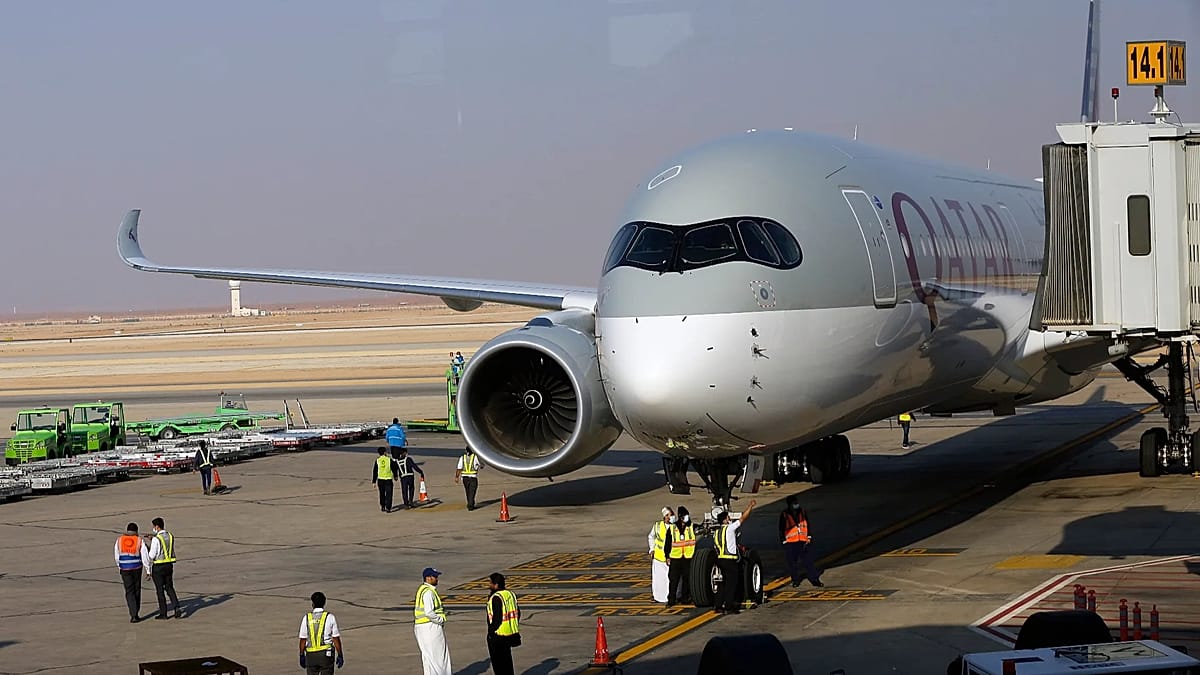
Residents of the Saudi capital reported seeing flames and thick black smoke rising from King Khalid International Airport on Saturday, just hours after local authorities had issued an overnight air raid alert. Video clips circulating on social media appeared to show a towering column of smoke above the airport, while flight tracking service Flightradar24 noted that the facility was experiencing “major problems.”
A journalist from the AFP news agency on the scene also observed firefighters working to extinguish a burning fuel truck near the airport perimeter. The Saudi Civil Defense had earlier sent alerts to residents in several parts of the country, warning of potential danger and advising people to remain indoors and away from windows. The agency later gave the all clear.
“I heard the alarm, then my windows shook,” a 27-year-old Riyadh resident living in the north of the city told AFP. “It was definitely scary. I was not expecting this,” they added.
Houthi escalation and regional tensions
The incident comes against a backdrop of intensified attacks by Yemen’s Houthi rebels, who declared a naval blockade of Saudi Arabia in July. The Houthis, designated as a Foreign Terrorist Organisation by the United States, have since stepped up strikes on Saudi cities and shipping lanes, further inflaming an already volatile Middle East. The region is still reeling from the effects of the Iran war and ongoing tensions around the Strait of Hormuz.
Saudi Arabia has responded with its own military operations against the Houthis, who have seized vast swathes of territory in Yemen this month in a lightning offensive. Despite these counterstrikes, the group’s advance has not been halted.
“Developments around the Bab al-Mandab Strait underline the urgent need to prevent Yemen’s conflict from further threatening the security of the Red Sea and this vital international maritime route,” said Khaled Khiari, the UN assistant secretary-general for the Middle East, Europe, the Americas, Asia and the Pacific, earlier this week.
The Red Sea and the Bab al-Mandab are critical arteries for global trade, including for European economies that rely on the Suez Canal for shipments of oil, gas, and consumer goods. Any disruption to these routes has immediate knock-on effects on shipping costs and energy prices across the continent.
European governments are watching the situation closely. The EU has repeatedly called for de-escalation and has imposed sanctions on Houthi leaders, while also supporting UN-led peace efforts. The bloc’s naval mission, Operation Aspides, has been patrolling the Red Sea to protect commercial vessels from attacks, a reminder of how far-reaching the consequences of the Yemen conflict have become.
For now, the immediate cause of the fire at King Khalid airport remains unclear. Saudi authorities have not yet issued an official statement on the incident, and it is not known whether the blaze was linked to the earlier air raid alert or to a separate accident. The airport, one of the busiest in the Gulf, has continued to operate, though passengers have reported delays and diversions.
The episode underscores the fragile security environment in the region, where a single incident can disrupt air travel and send ripples through global markets. For European travelers and businesses, the situation is a reminder of the interconnectedness of security and commerce, and the importance of stability in the Gulf for the wider world.