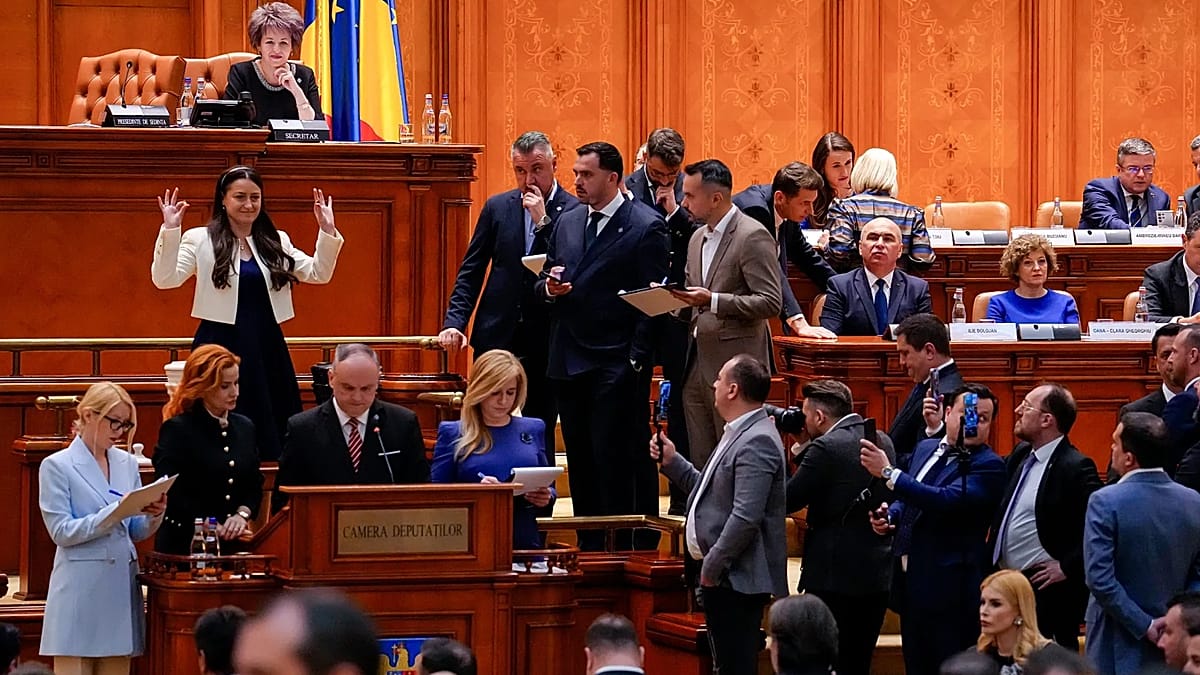
Romania's fragile pro-European coalition government collapsed on Tuesday after lawmakers voted overwhelmingly in favour of a no-confidence motion against Prime Minister Ilie Bolojan. The vote, which passed 281 to 4, plunges the country into a fresh period of political uncertainty less than a year after the coalition took office.
The motion was jointly submitted last week by the leftist Social Democratic Party (PSD), which had withdrawn from the governing coalition in late April, and the hard-right opposition Alliance for the Unity of Romanians (AUR). Lawmakers from Bolojan's centre-right National Liberal Party (PNL) and its coalition partners — the Save Romania Union party and the ethnic Hungarian UDMR — abstained from voting.
Bolojan, who had led the government for ten months, described the motion as “cynical and artificial,” arguing that it was drafted by people who had not been part of the daily decision-making process. “It is cynical, because it does not take into account the context in which we find ourselves,” he said during the parliamentary debate in Bucharest.
“I assumed the position of prime minister, being aware that it comes with enormous pressure and that I would not receive applause from the citizens. But I chose to do what was urgent and necessary for our country,” Bolojan added.
Economic Turmoil and Austerity Measures
Romania has been grappling with one of the highest budget deficits in the European Union, rampant inflation, and a technical recession. The country's political instability was compounded by the annulment of a presidential election in December 2024. When the coalition was formed in June, it pledged to prioritise deficit reduction. Bolojan's government introduced austerity measures including tax hikes, public sector wage and pension freezes, and cuts to public spending and administrative jobs.
The PSD frequently clashed with Bolojan over these measures. The party accused him of having “failed to implement any genuine reform” during his tenure and argued that Romania needs a leader “capable of collaboration.” Bolojan countered that his tough fiscal policies had “regained the trust of the markets in the Romanian government.”
George Simion, leader of the AUR, celebrated the vote, saying that voters had “supported and wanted water, food, energy,” but had “received taxes, war and poverty.” He declared that his party would “assume the future of this country, a future government and restore the hope of the Romanians.”
Simion also called for a return to the ballot box, a reference to the annulled presidential election that had initially favoured a far-right candidate.
Stalemate Ahead
The collapse of the coalition leaves Romania without a clear path forward. The PSD, which would be essential to forming any pro-European parliamentary majority, has previously ruled out entering a government with the AUR. President Klaus Iohannis is now expected to consult with party leaders in an effort to identify a candidate capable of forming a new government.
Cristian Andrei, a Bucharest-based political consultant, said the crisis will likely lead to a stalemate. “No one has a majority, or a coalition, and it will take the president weeks to find such a majority and name a new prime minister, prolonging the indecision,” he said.
Andrei outlined two tentative options: a reshuffled coalition without Bolojan in the same formation, or a minority cabinet led by the PSD with support from populist parties such as the AUR or other small groups. “A PSD-AUR official Cabinet is not a possibility today because the president will not endorse it,” he added.
The political turmoil in Bucharest comes as the European Union faces broader challenges, including trade tensions with the United States and internal debates over migration policy. The EU Commissioner for Transport, Adina Vălean, a Romanian, has previously defended Romania's pro-European trajectory amid the rise of populist forces.
For now, Romania's immediate future hinges on whether the country's political class can overcome its divisions and form a stable government capable of addressing the deep economic and social challenges ahead.