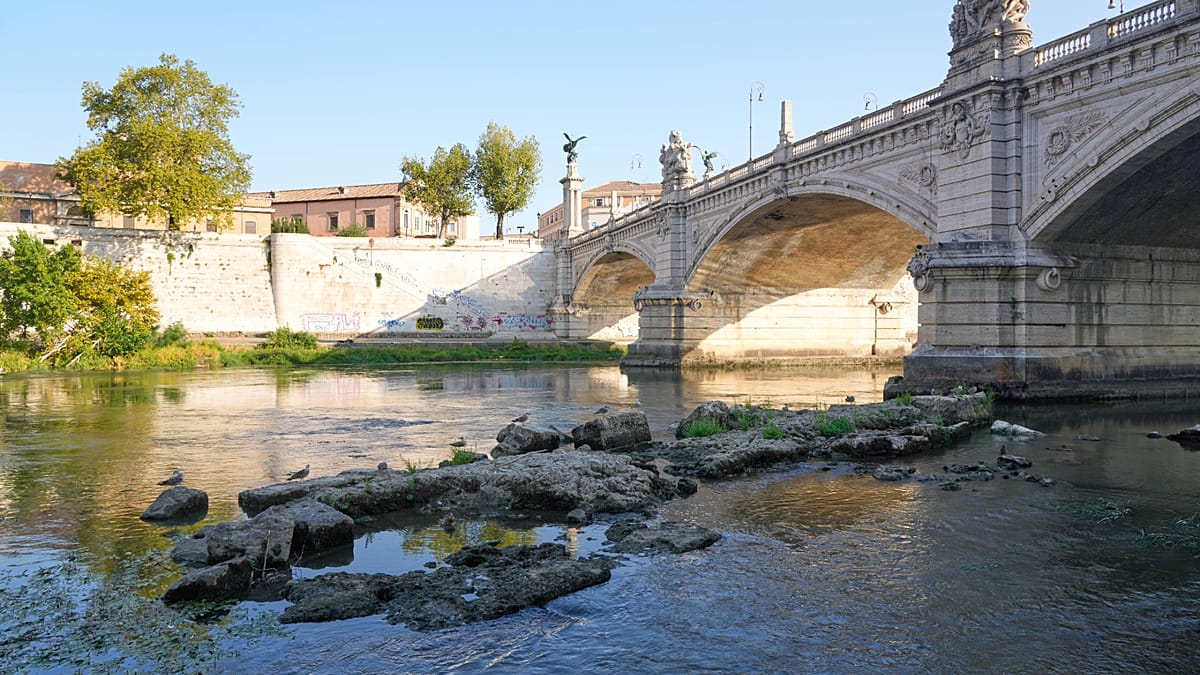
Rome's Tiber river has fallen to levels not seen in decades, and the receding waters have brought an unexpected archaeological treasure back into view: the stone piers of a bridge commissioned by Emperor Nero in the first century AD. The structure, known as the Pons Neronianus, once carried the Via Trionfale across the river toward the Vatican hill, a route used by triumphant generals and later by pilgrims.
The remains are now clearly visible just downstream from Castel Sant'Angelo, the towering cylindrical mausoleum built for Emperor Hadrian. For most of the year, the ancient foundations lie submerged beneath the muddy current, but this summer's prolonged drought across Western Europe has reduced the Tiber to a trickle in places, exposing the weathered blocks that have not seen daylight in decades.
A bridge with imperial connections
According to the Italian news agency Ansa, the bridge linked the Campus Martius, the bustling field of war and politics in ancient Rome, with the Ager Vaticanus, the floodplain on the opposite bank. That area, now the heart of the Vatican City, was then home to the gardens and villas of the imperial family, including the property of Nero's mother Agrippina, as well as the circus of Caligula and the Via Cornelia, which ran in front of what is now Castel Sant'Angelo.
The bridge was built between AD 54 and 68, during Nero's reign, and was a vital artery for the movement of troops and goods. It fell into disrepair after the fall of the empire, and by the Middle Ages it was largely forgotten, its stones scavenged for other construction projects. The piers that remain today are a rare surviving testament to the engineering prowess of the era.
For centuries, the exposed pillars served a more practical purpose: they were used to moor floating mills that harnessed the Tiber's current to grind grain. These watermills, a common sight in medieval Rome, were eventually demolished in the late 19th century as the city modernized its riverbanks.
A climate warning in stone
The reappearance of the bridge is not entirely unprecedented—during particularly dry summers, the piers have occasionally emerged from the shallows. But this year's sighting is especially striking because of the severity of the drought, which has affected not only Italy but much of southern Europe. The Po river, Italy's longest, has also suffered record lows, and several regions have imposed water rationing.
For the thousands of tourists currently thronging Rome's historic center, the sight is a rare bonus. Many have stopped on the modern Vittorio Emanuele II bridge to photograph the ancient stones, which now sit in the middle of a narrow channel of water, surrounded by sun-baked mudflats.
Archaeologists and historians are urging caution, noting that the exposed remains are fragile and should not be disturbed. The bridge's reappearance, they say, is a poignant reminder of the region's vulnerability to climate change, a theme that resonates across the continent. As Europe grapples with more frequent and intense heatwaves, the Tiber's ancient stones offer a tangible link to a past that is increasingly at risk.
While the bridge is a fascinating glimpse into Rome's imperial past, it also serves as a warning. The same drought that has revealed these relics is threatening crops, wildlife, and water supplies across the continent. In Portugal, for instance, ancient olive trees are being studied for their resilience to such conditions, as reported in a recent story on the continent's oldest olive groves.
As the summer wears on, the question remains whether the Tiber will recover its usual flow, or whether the Neronian bridge will become a more permanent fixture in the Roman landscape. For now, it stands as a silent witness to the changing climate, and a reminder that even the mightiest empires must adapt to the forces of nature.