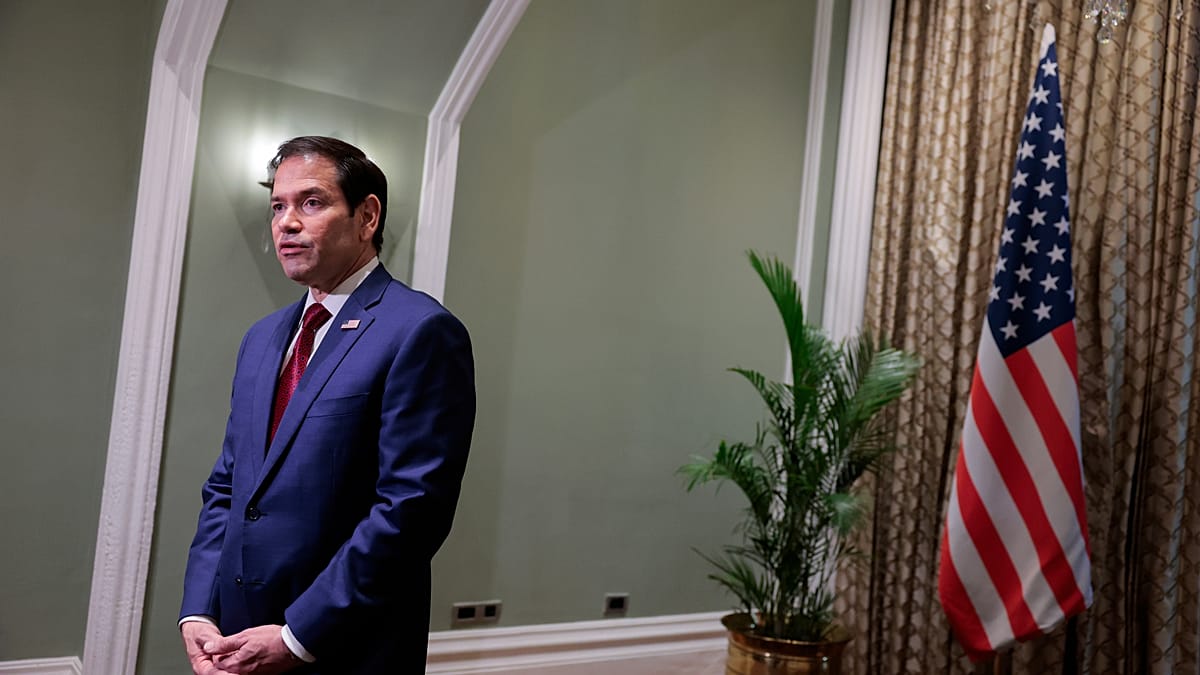
US Secretary of State Marco Rubio has called on Cubans who want political change to collaborate quietly with the Central Intelligence Agency (CIA), the United States' foreign intelligence service. In a social media post, Rubio wrote that "now is the time" for those seeking to "create positive change" in Cuba to act, adding: "The disappointment of failed promises, corruption, and the privileged lives of only a few; seize this opportunity to create the change you desire through a discrete partnership with the CIA."
The appeal marks the latest escalation in the Trump administration's campaign against the Cuban government. President Donald Trump has repeatedly stated that his goal is to bring about a change in Havana's leadership, and has claimed the country is "ready to fall." In January, Washington intensified pressure by announcing an oil blockade on the island, following a US military operation that captured former Venezuelan leader Nicolás Maduro.
Trump explained the move on his Truth Social platform, writing: "Cuba lived, for many years, on large amounts of oil and money from Venezuela. There will be no more oil or money going to Cuba - zero!" He added: "I strongly suggest they make a deal, before it is too late."
Speaking to reporters in September, Trump expressed confidence that a negotiated outcome was possible without military intervention. "I would say that Cuba and us will make a deal," he said. "I don't think we'll need the military."
The CIA has published operational guidance for Cubans interested in cooperating, advising them to avoid using any device or internet connection linked to their identity or workplace, and to "remove all software, apps and programmes from the device you are using to contact us."
European implications
The move has drawn attention across Europe, where many governments maintain diplomatic and economic ties with Cuba. The European Union has consistently opposed extraterritorial US sanctions, and the bloc's foreign policy chief has previously criticised the re-imposition of the embargo. European capitals, including Madrid and Paris, are watching closely as Washington's rhetoric intensifies, given the potential impact on European companies operating on the island.
Rubio's call for a "discrete partnership" with the CIA echoes Cold War-era tactics and has raised concerns among European diplomats about the stability of the Caribbean region. Some analysts in Brussels note that such overt appeals could complicate EU efforts to engage with Cuba through political dialogue and development cooperation.
The timing is also sensitive: the Trump administration's broader foreign policy has already unsettled European allies, particularly over its approach to Russia and Ukraine. As Trump's embrace of Putin alarms Kyiv and European capitals, the Cuba gambit adds another layer of unpredictability to transatlantic relations.
European officials have not publicly commented on Rubio's post, but the issue is likely to be raised in upcoming EU foreign affairs meetings. The bloc's stance on Cuba has historically been one of "constructive engagement," a policy that contrasts sharply with Washington's current approach.
For now, the CIA's public outreach to Cuban citizens marks a notable shift in US intelligence practice, which typically avoids such overt recruitment appeals. The agency's advice, published online, is a clear signal that Washington is seeking to encourage internal dissent, even as it tightens economic pressure.
Whether this strategy will succeed remains uncertain. Cuba's government has weathered decades of US sanctions, and its alliances with Russia and China provide some economic and political cushion. European observers note that the island's leadership has shown resilience in the face of external pressure, and that calls for regime change may not resonate as strongly as Washington hopes.
As the situation evolves, European policymakers will be balancing their own interests in Cuba—ranging from tourism and trade to human rights advocacy—against the risk of being drawn into a new confrontation between Washington and Havana. The coming months will reveal whether Rubio's appeal gains traction, or whether it becomes another chapter in the long and fraught history of US-Cuba relations.