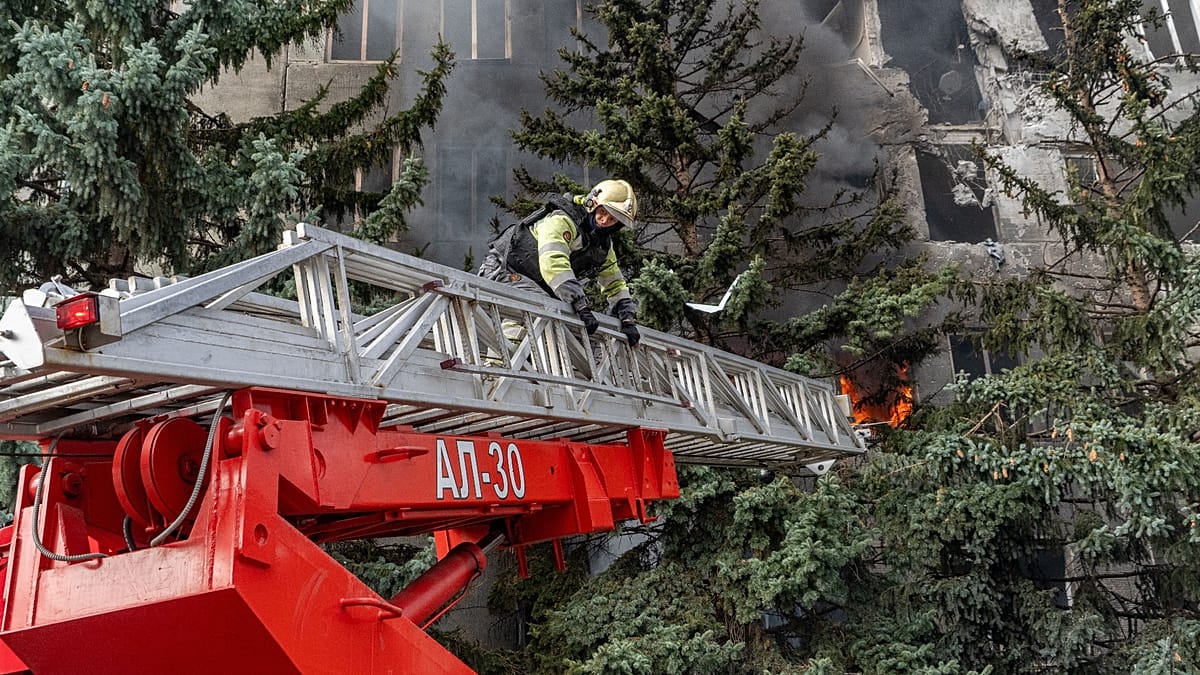
Russian forces struck two residential buildings in Sloviansk, in the Donetsk region, on the morning of 11 October, injuring at least four people. Mayor Vadym Liakh said the wounded were receiving medical care, and President Volodymyr Zelensky warned that others may still be trapped beneath the debris.
In the Kyiv region, an overnight Russian attack set storage facilities ablaze at an industrial site in the Bucha district. Firefighters were still working to contain the flames on Sunday morning. Separately, in the Sumy region, a Russian drone hit an ambulance, injuring a paramedic and a driver. According to Oleh Hryhorov, head of the regional military administration, the medical workers managed to exit the damaged vehicle on their own.
Ukraine's national energy company, Ukrenergo, announced emergency power cuts across several regions on Sunday, citing the strain on the grid caused by sustained Russian shelling. The previously published schedules for hourly outages have been suspended, and the emergency measures will remain in place until the system stabilises.
Ukrainian drones strike third Yandex data centre
Overnight into Sunday, Ukrainian drones attacked a Yandex data centre in Vladimir, east of Moscow. The company said the facility's infrastructure was damaged and operations were completely halted. No casualties have been reported. Yandex added that it is still assessing the damage and cannot yet estimate how long repairs will take. This marks the third Yandex data centre hit in October, following strikes on facilities in Kaluga on 9 October and near Ryazan on 8 October.
Aleksandr Avdeyev, the regional governor, confirmed the drone attack and the resulting fire, saying residential areas were spared. Residents of homes closest to the site have been evacuated. Two substations supplying electricity to 5,000 people in Vladimir were switched off; an hour later, the governor said 80% of power had been restored and heating and water supplies were back to normal. Preliminary reports suggest a supercomputer housed at the Vladimir facility was damaged. An identical machine is located at the Yandex data centre in Ryazan that was also targeted.
The attack disrupted Yandex's services across Russia and beyond. Users in Moscow, St. Petersburg, Perm, Krasnoyarsk, Vladivostok, Ulan-Ude, Yekaterinburg and other cities were unable to order taxis. Similar problems were reported in Serbia, Kazakhstan, Belarus and Armenia. Drivers could not log into the app or faced navigation failures, while passengers saw no available cars. Outages also affected many of the company's other services.
The strikes on Yandex infrastructure follow a pattern of Ukrainian targeting of Russian technological and logistical assets. In early October, Russia repeatedly struck key bridges in Kyiv. According to The Telegraph, against the backdrop of military setbacks, Vladimir Putin decided to switch to attacks on Ukraine's critical infrastructure and the bridges in Kyiv. The recent Ukrainian operations appear aimed at disrupting Russian military logistics and the digital economy that supports them.
Ukrainian monitoring channels reported strikes on Sunday on a movable railway bridge in Rostov-on-Don, near the Black Sea. Regional authorities have not yet commented. In the Krasnodar region, the crisis centre said "fragments of drones" fell on the grounds of Sochi airport, causing a fire in an administrative building. No casualties were reported. Debris also fell in a residential area.
The exchange of strikes underscores the escalating nature of the conflict, with both sides targeting infrastructure far from the front lines. As winter approaches, Ukraine's energy grid remains vulnerable, while Russia's tech sector faces mounting disruptions. European officials are watching closely, given the implications for regional stability and the continent's digital economy.