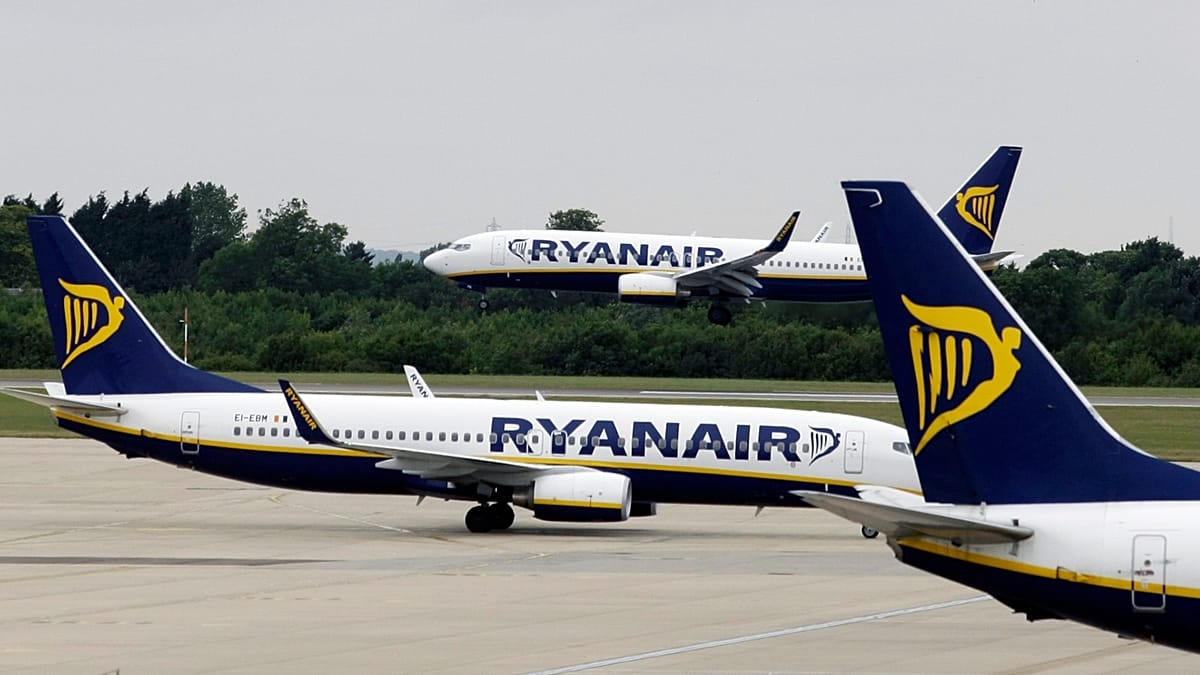
Flying on Ryanair's Boeing 737s may come with an unexpected hazard just outside the cabin door: the aircraft's retractable onboard stairs. A study by Italy's National Agency for Flight Safety (ANSV) has found that passengers using these integrated stairs face a significantly higher risk of falling than those using airport-provided stairways.
The study, published in August 2026, analyzed falls reported during boarding and disembarkation in Italy between 2023 and 2025. Of 104 incidents, 85 involved passengers using the forward integrated stairs of Boeing 737s—a striking 82 percent of cases, as reported by Corriere della Sera.
The disparity becomes even more pronounced when adjusted for passenger numbers. Over the same period, Ryanair carried roughly 27 percent of all passengers in Italy, yet accounted for the vast majority of falls. Other carriers, representing the remaining 73 percent of passengers, recorded just 19 falls.
The trend extends beyond Italy. Since 2021, Ryanair has registered 489 falls on stairs across its network, with 360 (73 percent) occurring on the Boeing 737's integrated stairway. According to ANSV, that is three times the number of falls recorded on airport stairways.
Why are the integrated stairs riskier?
Ryanair's Boeing 737s are equipped with an integrated stair system that can be deployed while parked, allowing passengers to disembark without the need for airport ground handlers. This cuts turnaround times and reduces ground-service costs. However, the design has drawn scrutiny.
The integrated stairway has 12 steps, each about 61 centimeters wide and 20 centimeters high, with a tread depth of 25 centimeters and an inclination of 35 degrees. ANSV's investigation notes that these dimensions "are at the limits for step height and steepness" compared with airport-operated stairs, which typically have lower steps, a less pronounced incline, and larger platforms and treads.
The agency also highlights that "the first step" of the stairway is "asymmetrical" for passengers descending, due to the shape of the fuselage relative to the step. This asymmetry can catch passengers off guard.
According to Ireland's air accident investigation unit (AAIU), EU regulations do not impose specific requirements on the size of integrated stairs because they are not deemed critical to flight operations. This regulatory gap has allowed the design to persist.
Incidents and response
The ANSV study was prompted by three serious incidents in Genoa, Venice, and Bologna, in which passengers suffered "serious injuries." In Genoa on 22 March 2025, a passenger was taken to hospital by ambulance after a fall that ANSV attributed "most likely due to the inattention of the passenger." Two days later in Venice, another passenger was seriously injured after falling while carrying two suitcases and not holding the handrail. In Bologna, a passenger fell while carrying two bags.
Following these incidents, Ryanair updated its disembarkation protocol. Since 23 July, cabin crew have been repeating warnings to use the handrail, now also in the language of the country of origin and destination.
The issue had already been flagged by aviation safety agencies in Ireland and Spain. After falls in Dublin in 2021 and Alicante in 2024, Spain's CIAIAC urged Boeing to redesign the stairway, reducing its steepness and increasing step surface area. The agency also called on Ryanair to abandon the integrated system altogether and rely solely on airport-provided stairs.
No investigation has concluded that the system is defective. ANSV has endorsed the Spanish recommendations to Boeing and Ryanair, while attributing the falls primarily to human factors such as inattention and failure to use the handrail.
The findings add to a broader conversation about aviation safety and passenger behavior. As European travel continues to rebound, the debate over cost-saving measures versus passenger safety is likely to intensify. For now, passengers on Ryanair's 737s are advised to hold the handrail and watch their step.