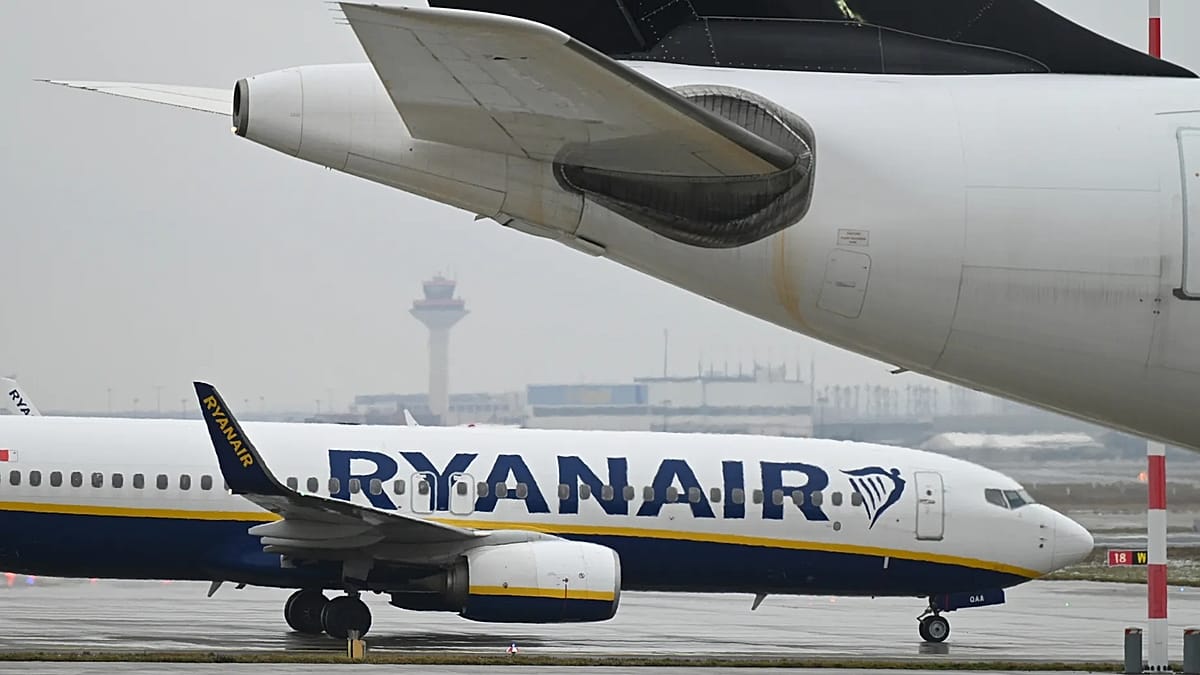
A preliminary report into last month's Ryanair incident in Greece has revealed that debris from a broken engine fan smashed a window on the aircraft, causing a passenger to be partially sucked out of the cabin. The flight, bound from Thessaloniki to Memmingen in Germany, experienced a failure in its right engine during climb-out, according to the US National Transportation Safety Board (NTSB), which is leading the investigation on behalf of Greek authorities.
The NTSB report states that engine fragments breached the fuselage, leading to a rapid decompression of the cabin. The crew immediately turned the aircraft back to Thessaloniki's Makedonia Airport (SKG), where it landed without further incident. On board were two pilots, four flight attendants, and 149 passengers. One passenger sustained serious injuries, the report confirms.
The incident has raised fresh concerns about aviation safety and engine maintenance, particularly given that the fan blades had undergone ultrasonic inspections as recently as May, with no issues detected. The same engine had been the subject of four suspected bird strike reports in the 12 months preceding the failure, though subsequent checks found no damage. In two of those cases, bird remains were reportedly discovered.
Passenger's ordeal
Serbian national Ljubisa Karović was seated near the shattered window when the decompression occurred. He was nearly pulled head-first through the opening, but other passengers, including his wife, managed to hold onto him until the aircraft stabilized. His wife, Svetlana Grković, described the terrifying moments to Serbian outlet Nova: "The pressure pulled Ljubiša out; luckily he was strapped in, but half his body was sticking out of the plane."
She added: "I reacted immediately and grabbed his legs. I thought, 'If we're going to die, we're going to die together'. It was awful." The couple's quick thinking and the assistance of fellow passengers likely prevented a far worse outcome.
Ryanair initially downplayed the event, stating that the flight returned to Thessaloniki after a "passenger window dislodged inflight." The airline emphasized that the aircraft landed normally and that passengers were bussed to the terminal before a replacement service was arranged. However, the NTSB's findings paint a more serious picture, with the engine failure and subsequent debris penetration posing a significant threat to those on board.
The NTSB was delegated the investigation "in full" by Greek authorities a week after the incident, underscoring the complexity of the case. The investigation is ongoing, and further findings are expected as experts analyze the engine components and maintenance records.
This incident comes amid broader concerns about aviation safety in Europe, including drone-related disruptions at airports and other operational challenges. While bird strikes are a known hazard, the fact that multiple strikes were reported on the same engine without significant findings raises questions about inspection protocols.
For the passengers, the memory of that flight will not fade quickly. The psychological impact of such an ordeal is profound, and the physical injuries sustained by Karović serve as a stark reminder of the forces at play at 30,000 feet. As the investigation continues, the aviation industry will be watching closely to see what lessons are drawn from this harrowing event.