From the earliest human attempts to decipher the heavens, the sun and moon have anchored faith, agriculture, timekeeping, and art. This summer, London's Saatchi Gallery presents The Sun and the Moon, an ambitious survey that gathers over 170 artists and artefacts across two floors, tracing humanity's enduring celestial fascination.
The show is the second in the gallery's series on nature's influence on creativity, following last year's popular FLOWERS - Flora in Contemporary Art and Culture. Curator Katherine Benson describes it as 'a whole 24-hour journey through the eyes of artists and creators,' exploring how these 'celestial constants' have inspired across epochs.
A Day in Nine Rooms
The exhibition is structured as a complete diurnal cycle, moving visitors from dawn through noon, sunset, and into the night. It opens with works by Patrick Caulfield, Barbara Hepworth, and Sinta Tantra, then enters Dawn, which examines early cultures' cosmic interpretations. Artefacts include a 1st-century BC Sol Invictus Celtic bust, a replica of the Nebra Sky Disc, and a 17th-century Indian textile depicting the sun, displayed alongside contemporary pieces like Royal Opera costumes.
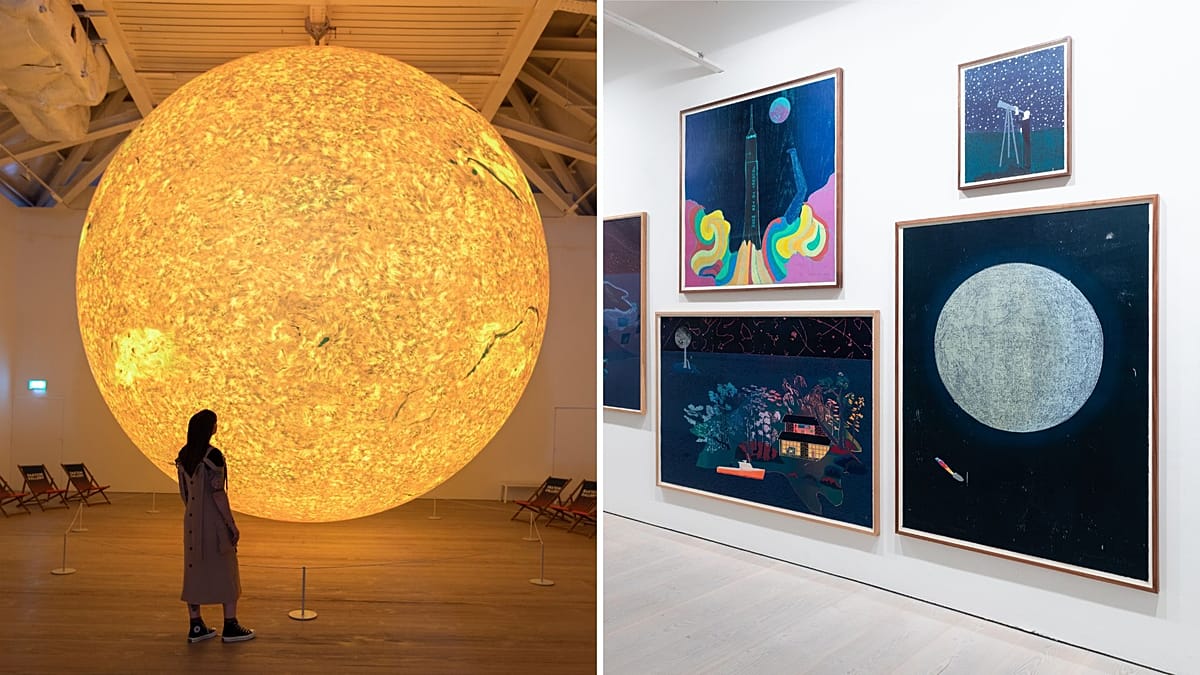
Subsequent rooms explore the sun's role in timekeeping and agriculture, summer rituals, and the emotional weight of sunset. At the exhibition's midpoint is Luke Jerram's Helios, a six-metre illuminated sphere built from 400,000 NASA photographs. Visitors can lounge in deckchairs beneath it, listening to a specially composed ambient soundtrack by Duncan Speakman and Sarah Anderson. Jerram hopes the work 'inspires awe and wonder' and prompts reflection on the sun's importance for light, warmth, and energy.
The second half turns to the moon, beginning with its phases and historical observation. The gallery Walking on the Moon focuses on the Apollo missions' cultural legacy, highlighting lesser-known contributors. Its centrepiece is Moon Landing, a collaboration between textile artist Margot Selby and composer Helen Caddick. The work honours Navajo women who wove integrated circuits and Raytheon workers who wired Apollo 11's memory cores—contributions long overlooked.
Caddick's score uses binary code logic, scored for two harps, two cellos, and two violins. 'When the first harp is resting, the second is playing,' she explains. The textile, woven by Selby and six studio members over four months, contains over 30,000 threads and responds to the music section by section. Selby says colour choices are instinctive, but rhythms and patterns directly follow the composition.
British-Zambian artist Kay Gasei offers a more intimate reflection with Moonlight Series Number Four: Boy by the Pool, part family portrait and part mythological tale drawn from childhood night adventures. 'It's about mischievousness, playing at night,' Gasei says. 'I ran away as a kid more than once.'
The show broadens beyond Western narratives. Sakha designer Aina Petrova presents URSUUNA, contemporary interpretations of traditional Arctic snow goggles—among the earliest eye protection, carved from wood and bone to prevent snow blindness. Petrova reimagines them as symbols of survival and cultural identity.
The Sun and the Moon runs at Saatchi Gallery through summer 2025. For those seeking further cultural exploration, the Musée d'Orsay recently opened a gallery addressing Nazi-looted art, a reminder of how institutions reckon with history. Meanwhile, as summer temperatures rise across Europe, the WMO warns of widespread above-average temperatures—a timely context for an exhibition celebrating the sun's power.