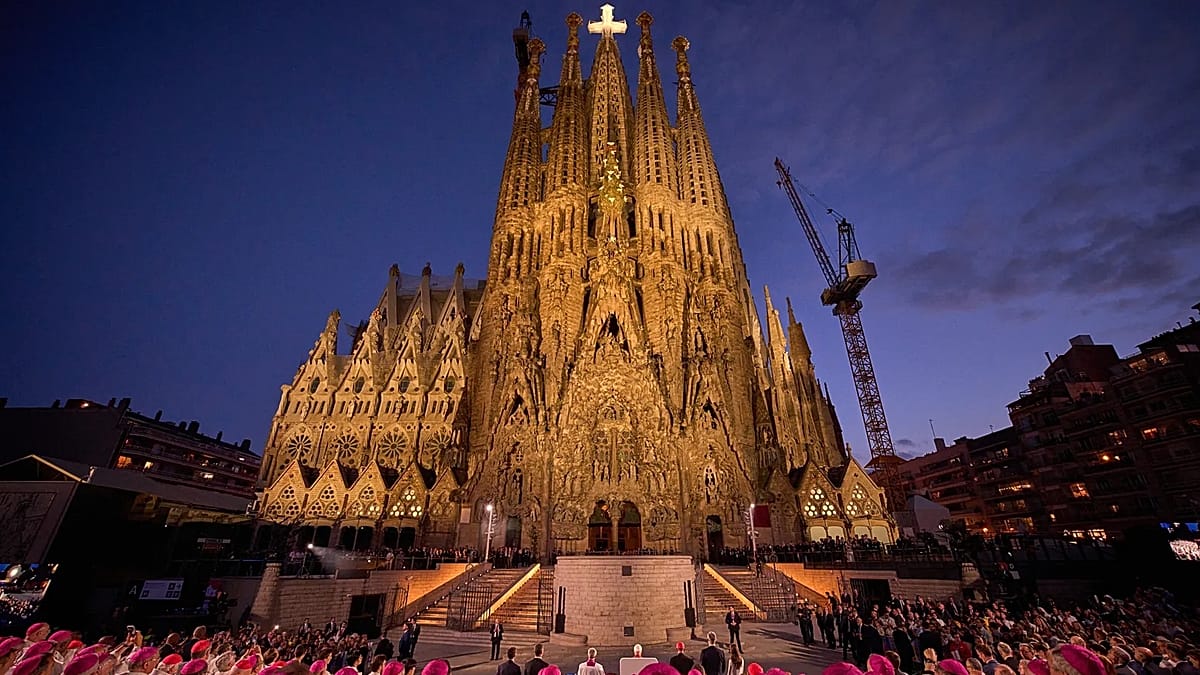
Some architectural projects seem to mock the passage of time. The Sagrada Família in Barcelona, Antoni Gaudí's unfinished masterpiece, has been rising from the ground for over 140 years. The architect, famously unhurried, once remarked that his client—God—was in no rush. But this year, after a century of setbacks, accidents, and even a pandemic, the basilica is finally shedding its scaffolding.
Two milestones converge in 2026: the centenary of Gaudí's death (he was struck by a tram in 1926) and the completion of the Tower of Jesus Christ, which at 172.5 metres makes the Sagrada Família the tallest church in the world, surpassing Germany's Ulm Minster. The achievement is a testament to a remarkable fusion: Gaudí's 19th-century geometric genius with 21st-century materials science and engineering. The architect, who always knew others would finish his work, would surely have been fascinated.
A Bible in stone
The Sagrada Família is not merely a building to be seen; it is a narrative to be deciphered. Gaudí, a devout Catholic whose beatification process is underway, designed a church that functions as a stone catechism. Its 12 towers represent the apostles, its floor plan evokes the body of Christ, and each façade tells a different chapter of Jesus's life, from the Nativity to the Passion. On the Passion Façade, a sculpted face of Gaudí himself is immortalised, and the crucified Christ is depicted in an unconventional way—naked, with an open book for a head, symbolising the word of God.
Gaudí used real people as models for his sculptures and devoted his final 12 years entirely to the project, funding it through private donations rather than public money. The temple's organic, forest-like interior, with coloured light streaming through stained glass, has even influenced popular culture. Guides tell visitors that George Lucas found inspiration for his Stormtrooper helmets in a Roman soldier on the façade, and a figure of Saint George stands beneath a swirling white structure representing the dragon.
Engineering the impossible
The latest milestone, however, is the tower that now dominates Barcelona's skyline. Last week, Pope Leo XIV visited the city to bless the Tower of Jesus Christ, the central and tallest of the basilica's spires. Inside, a glass lamb by Italian artist Andrea Mastrovito filters Mediterranean light, and from 2027 the tower will open to the public with a walkable viewing platform at the highest point in the Catalan capital.
But the real secret behind the rapid progress lies in an innovative modular construction system and 24 tonnes of structural adhesive. The final towers are built from prefabricated stone panels, precision-cut off-site and then bonded with high-strength adhesives, a technique that dramatically accelerates assembly compared to traditional masonry. This 21st-century approach allows the complex geometry of Gaudí's design to be realised with unprecedented speed and accuracy.
The combination of stone, steel, and invisible chemistry is a fitting tribute to an architect who left detailed models and instructions for future generations. As the Sagrada Família nears completion, it stands as a symbol of persistence and innovation—a project that has outlived its creator and adapted to the technologies of each era. For Europe, it is a reminder that even the most ambitious visions can be achieved with patience and ingenuity.
For more on how Europe is balancing heritage with modernity, see Barcelona's coastal redesign and EU budget talks.