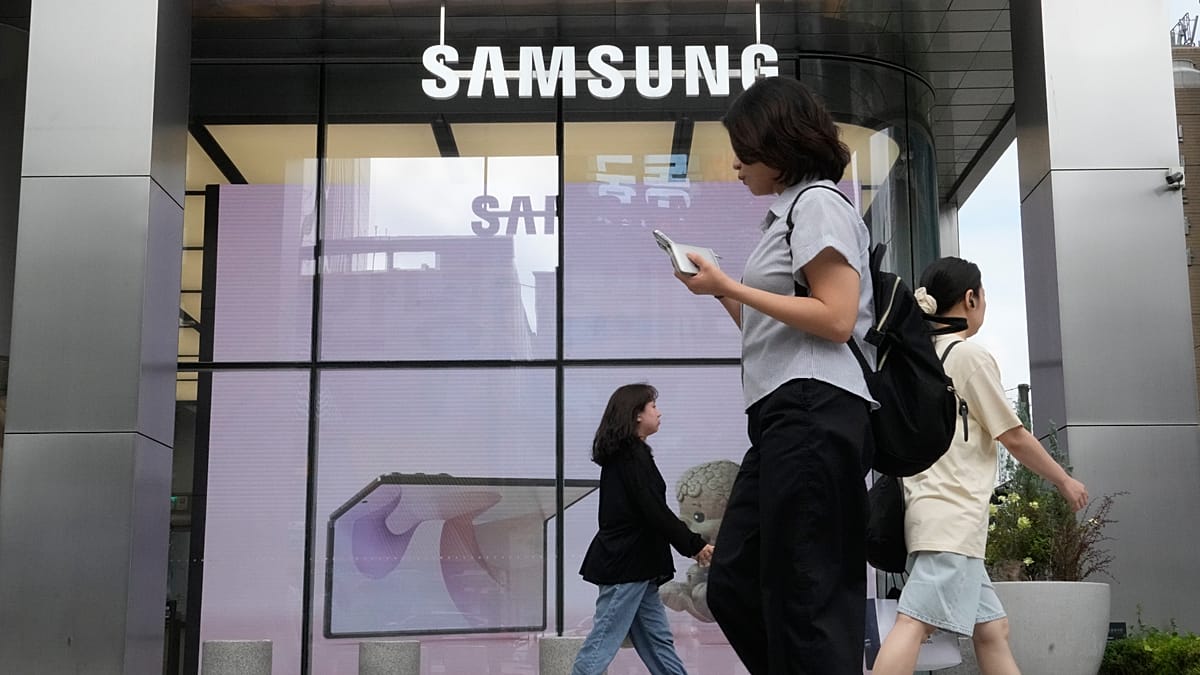
South Korea's Samsung Electronics posted a record operating profit of ₩89.5 trillion (€54 billion) for the April-to-June period, a 1,814% jump from a year earlier, as the global artificial intelligence boom continues to drive demand for advanced memory chips. The company's semiconductor division alone saw operating profit soar to ₩89.2 trillion (€53.8 billion), 223 times the level recorded in the same quarter last year.
Revenue rose 28% quarter-on-quarter and 130% year-on-year to ₩171.5 trillion (€103.5 billion), an all-time high. The results, announced on Thursday, come a day after rival SK Hynix also reported record quarterly revenue and operating profit, underscoring the dominance of South Korea's two largest memory chipmakers in the AI-driven semiconductor market.
AI demand fuels chip boom, but supply constraints persist
The surge in profitability was driven by rising chip prices and increased shipments of high-bandwidth memory (HBM) chips, which are essential for powering AI applications in data centres. Samsung said demand for its memory products is expected to remain strong in the second half of 2025, fueled by the continued expansion of AI infrastructure and the broader adoption of agentic AI. Server chip demand is likely to accelerate further, keeping the market undersupplied.
However, the company warned that the gap between chip supply and demand could widen further in 2027 and persist into 2028. Kim Jaejune, an executive vice-president of Samsung's memory chip division, said on a conference call: "Despite our efforts to increase production, demand growth is outpacing our efforts." He added that Samsung has secured long-term chip supply contracts with the world's five largest data centre companies and is close to agreements with five other major businesses, though he did not name them. The Associated Press has reported that the five could include Amazon Web Services, Google, Meta, Oracle and Microsoft.
Samsung and SK Hynix together produce about two-thirds of the world's memory chips. Both companies have embarked on major investments in semiconductor manufacturing facilities and data centres as South Korea expands its AI ambitions. Samsung's first fabrication plant in Taylor, Texas, is on track to begin operations this year, and the company plans to break ground on a second factory that could start mass production in 2030.
Despite the soaring profits, shares of both Samsung and SK Hynix have fallen sharply this week in South Korea's volatile stock market, where retail investors often drive sharp swings. Concerns are growing over the companies' plans to spend heavily on expanding manufacturing capacity and the prospect of intensifying competition from Chinese chipmakers.
The chiefs of Samsung, SK, and South Korean carmaker Hyundai joined President Lee Jae Myung on a trip to San Francisco last week, where they announced hundreds of billions of dollars in planned cooperation with major US technology companies, including AI firms OpenAI and Anthropic, and chip designers Nvidia and Broadcom. The agreements span chip technologies, data centres, and other AI infrastructure.
Kim Yong-beom, Lee's chief policy adviser, said the initiatives reflect how global technology companies are rushing to secure long-term partnerships with South Korean chipmakers as they seek reliable supplies of memory chips for AI. The developments have significant implications for European tech firms and data centre operators, which rely heavily on these chips for their own AI infrastructure. European companies such as Porsche and Mercedes-Benz have also faced challenges from global supply chain dynamics, though in different sectors.
Analysts warn that the massive spending on new fabrication plants and data centres may not generate sufficient returns if demand growth slows or if geopolitical tensions disrupt supply chains. The European Union, which has been pushing to boost its own semiconductor production through the European Chips Act, is watching these developments closely as it seeks to reduce dependence on Asian suppliers.