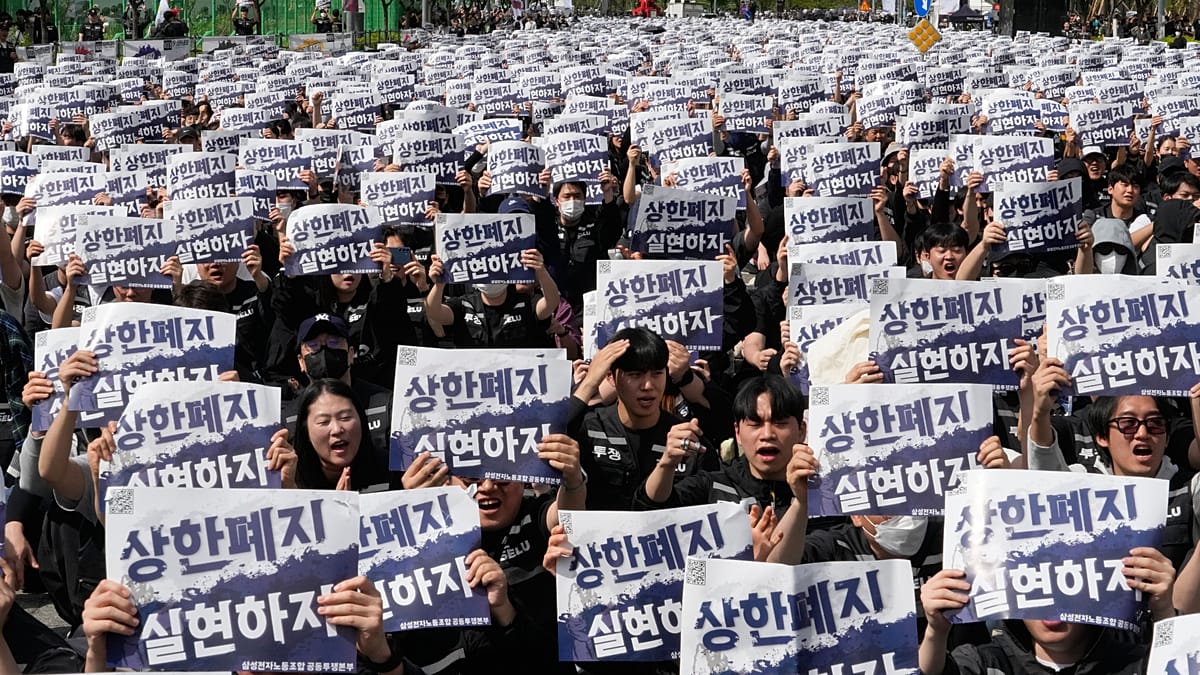
Thousands of Samsung Electronics workers gathered on Thursday at the company's semiconductor complex in Pyeongtaek, South Korea, to demand higher bonuses and threaten a strike. The protest highlights growing tensions between labor and management at a time when the company is reaping record profits from the artificial intelligence boom.
Union representatives estimated attendance at around 40,000 members, though police did not provide an official count. Workers held signs and waved banners, shouting slogans such as “make compensation transparent and remove maximum limits on bonuses!” The demonstration took place under a heavy police presence.
Record Profits, Unhappy Workers
Samsung Electronics, which together with SK Hynix produces about two-thirds of the world's memory chips, forecast earlier this month that its first-quarter operating profit would reach a record 57.2 trillion won (€33 billion). This surge is largely attributed to soaring global investment in data centers and AI infrastructure, which has driven up demand for high-bandwidth memory chips.
On the same day as the protest, SK Hynix reported its best-ever quarterly results, with record revenue and operating profit for the first three months of the year. The company credited the AI boom for the strong performance.
Despite Samsung's financial success, the union—which represents about 74,000 workers—argues that the company has failed to offer adequate compensation. The union has rejected management's proposal for bonuses in the form of restricted stock and is calling for the removal of caps on bonuses.
“We won’t stop this fight until our fair demands are met,” Choi Seung-ho, a union leader, said through a loudspeaker from atop a crane-mounted structure during the protest.
Strike Threat Looms
If talks with management break down, the union has threatened an 18-day strike beginning May 21. Union leaders estimate that such a strike would cost the company over 1 trillion won (€578 million) per day. The threat underscores the high stakes for Samsung, which is already navigating a complex global environment.
South Korea's semiconductor makers have benefited from the AI boom, but the war in the Middle East has clouded the future outlook. The conflict has disrupted supplies of key materials such as helium, which is crucial to chipmaking, and has pushed up energy costs. These challenges add pressure on Samsung to resolve the labor dispute quickly.
The protest in Pyeongtaek is part of a broader wave of labor activism in South Korea's tech sector, as workers seek a greater share of the profits generated by the AI revolution. For European readers, the situation offers a glimpse into the global dynamics of the semiconductor industry, which is central to Europe's digital ambitions and supply chain resilience. The outcome of this dispute could have ripple effects on chip prices and availability, affecting European tech companies and consumers alike.