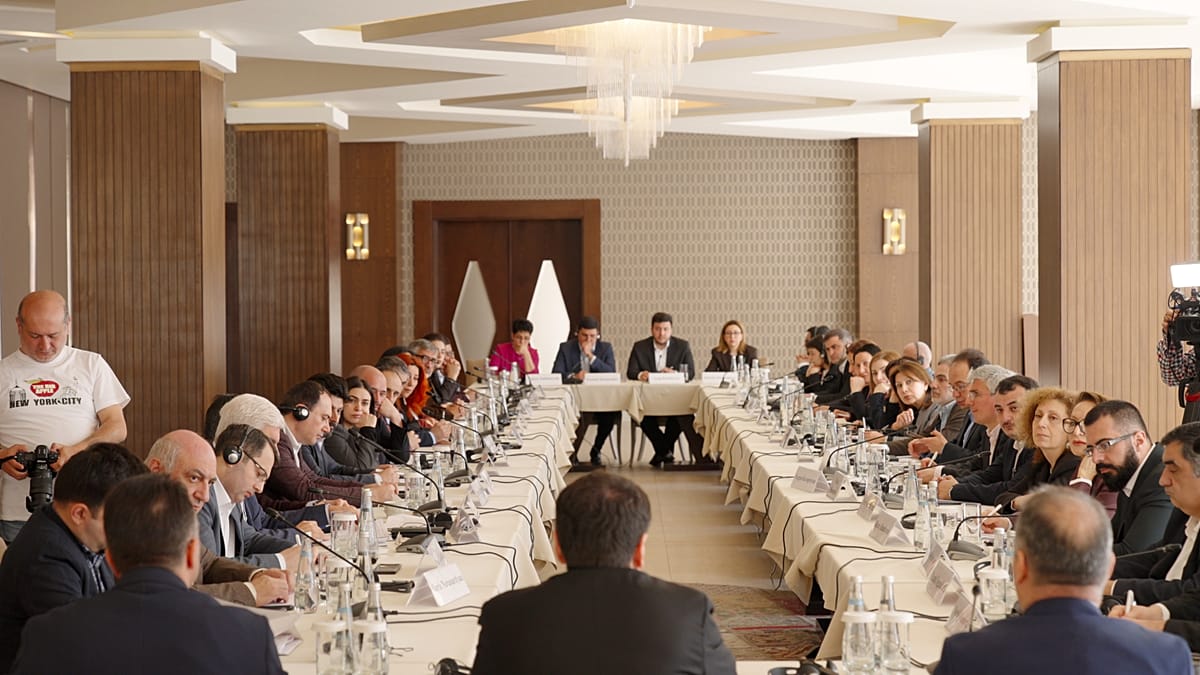
As war in Ukraine and geopolitical instability continue to strain traditional energy supply routes, governments and energy companies are increasingly looking to the Caspian region as a vital corridor for maintaining Eurasian energy flows. The urgency to invest in and reshape transit routes was a central theme at the second Caspian and Central Asia Oil Trading and Logistics Forum in Baku, where senior executives, traders, and policymakers gathered to discuss the future of energy across Eurasia.
The Middle Corridor: A Strategic Alternative
The so-called Middle Corridor currently links China and Central Asia to Europe through the Caspian Sea, the South Caucasus, and Turkey, offering an alternative route for energy and trade between Asian and Western markets. As traditional supply chains face disruption, governments and companies are looking to diversify transport routes and reduce geopolitical risk. The corridor's key pipelines—including the Caspian Pipeline Consortium (CPC), Baku-Tbilisi-Ceyhan (BTC), and Baku-Supsa—are being assessed for capacity upgrades, with expected logistical changes following the potential opening of the Zangezur corridor.
Anar Habib, senior middle distillates trader at SOCAR, emphasized that investment must flow into infrastructure in this part of the world to secure a more stable future. "Azerbaijan is a real gateway for movement between East and West, and investment into this part of the world is crucial, particularly in highlighting the geopolitical situation here, where hurdles are now being removed," he said.
Central Asia's Gas Security Challenges
Askar Ismayilov, adviser on Central Asia at the Global Gas Centre, stressed that Central Asia will need to develop new routes to stabilize gas supplies to Europe and, ultimately, a new pipeline to connect five Central Asian countries. "We see that demand for gas in Uzbekistan has reached up to 20 billion cubic metres annually. We are in close talks with the government of Turkmenistan to secure commitments for the supply of gas," he said. Ismayilov noted that beyond supply stability, the gas ring would also boost regional economies. He underlined that "we see more potential in Azerbaijan, going through Armenia and into Turkey, and I think Turkmenistan's gas and potential gas from Kazakhstan would also go to Europe."
Assylbek Jakiyev, chairman of Petro Council Kazakhstan, pointed to the Russia-Ukraine war as one of the biggest challenges facing his country. "80% of oil goes via the CPC pipeline—that's why the Middle Corridor is very important and Kazakhstan is definitely seeking alternative routes and investors who can support this route. Kazakhstan is working hard with SOCAR to promote diversification," he said. Still, he acknowledged that "Kazakhstan has been highly dependent on the Russian transportation system, but we are doing a big job to diversify our portfolio."
Infrastructure and Logistical Hurdles
Efforts to reduce transit times on land are focused on digitalisation, customs harmonisation, vessel and wagon upgrades, and rail modernisation. Port capacities at Alyat and Dübəndi in Azerbaijan, Aktau and Kuryk in Kazakhstan, and Kulevi in Georgia are being scrutinised ahead of growing cargo volumes. Colin Nesbeth, founder and chief executive of Central Asia Marketing, acknowledged the scale of the challenge. "It's all very well [to say] 'Ah, we must look at diversifying routes, oh Russia,' but at the end of the day, the pipeline still goes through Russia." He noted that Russia's announcement that it "is not putting any more crude through the Druzhba pipeline, which goes to Germany via Kazakhstan... [means] the situation is not getting any better." Nesbeth stressed the value of closer engagement with Azerbaijan: "Work with the governments, the Azerbaijani government. It would help all round and would be a hedge against these volatile and significant costs for individual companies—it would be much better for them."
Azerbaijan's Central Role
Azerbaijan sits at the centre of the corridor, connecting oil and refined products from Central Asia and the Caspian basin to global markets through pipelines, ports, and rail networks. Industry leaders say demand for alternative logistics routes has accelerated since the war in Ukraine and the reshaping of global energy markets. Instability in Iran and repeated disruption to traffic through the Strait of Hormuz have further restricted the movement of energy and goods. Attendees agreed that the Caspian region could play a bigger role in global energy markets in the coming decade, not only for oil and gas but as a key transit route for new trade and energy partnerships.
Shehryar Omar, chief executive of the Petroleum Institute of Pakistan, told Euronews that Central Asia and the South Caucasus should also look further south. "Pakistan is a gas-dependent country—about 35% of our energy is gas. As a result of declining domestic reserves, we went into LNG contracts years ago, and now, because LNG stopped flowing over the last two months, we have had power outages and related problems," he said. "Central Asian countries need to look at Pakistan specifically and South Asia in general in terms of investing in infrastructure to bring their gas south."
John Patterson, chairperson of the British Chamber of Commerce in Azerbaijan, who has lived in the country for nearly 30 years, highlighted the interconnectedness of energy infrastructure. "We now have a pipeline that runs from Sangachal, following the route of the BTC into Turkey, then continuing via TANAP into Europe and ending in Italy," he said. "We now have 11 countries, I believe, linked via that pipeline. They have a shared interest in it, and so the security of that pipeline is the security of those 11 countries."
The push for diversification comes as Europe faces ongoing energy supply disruptions. The EU has been actively seeking alternatives to Russian gas, and the Caspian corridor offers a promising avenue. As the US and Azerbaijan launch TRIPP Corridor talks, boosting Europe's energy diversification, the strategic importance of the region is clear. However, as EU Energy Chief warns of years-long recovery from Middle East conflict-driven cost increases, the need for reliable transit routes becomes even more pressing.