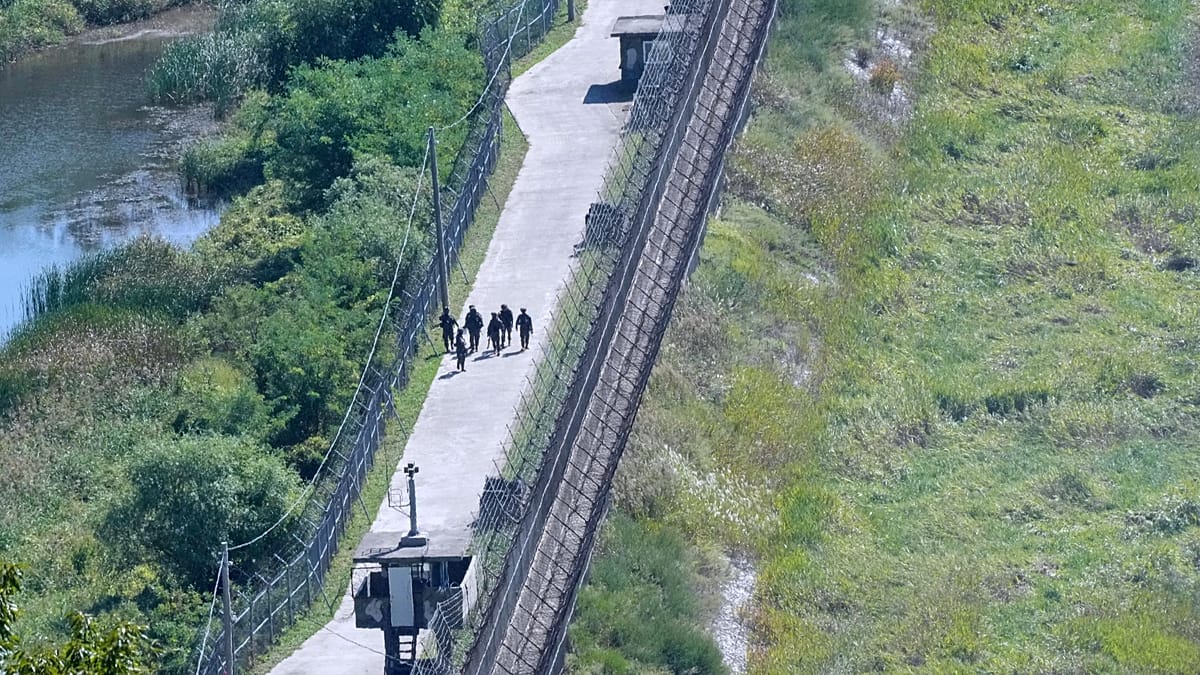
South Korea's defence minister has confirmed that landmines which wounded three soldiers in the Demilitarised Zone (DMZ) last week were of North Korean origin, describing the incident as a clear breach of the 1953 armistice that ended the Korean War.
Speaking at a parliamentary hearing on Tuesday, Defence Minister Kang Shin-chul said the explosions, which occurred during a routine clearance operation, were caused by North Korean mines. One soldier lost a foot in the blasts, which took place on the southern side of the heavily fortified buffer zone.
"This is a clear violation of the armistice agreement, and since North Korea bears responsibility, we will take corresponding measures," Kang told lawmakers, without specifying the nature of those measures.
Investigation points to Pyongyang
The defence ministry had earlier said North Korean mines were "highly suspected" of causing the two explosions on 21 September. A site investigation on Tuesday uncovered an unexploded North Korean plastic anti-personnel mine, according to Yang Jin-hyeok of the Joint Chiefs of Staff.
Kang explained that the soldiers were in the DMZ to clear vegetation and assess terrain changes caused by North Korean forces south of the Military Demarcation Line, the effective border between the two Koreas. The operation was being conducted in coordination with the UN Command.
He noted that the mine detectors used were the latest models, but dense vegetation hampered detection efforts. "Clearing all the vegetation as they advanced was difficult," he said, adding that the mines may have gone undetected because the detectors were held too far above the ground.
The minister said the military "has a range of necessary measures at our disposal, and we will implement them in stages," declining to elaborate on the options under consideration.
Escalating border tensions
The incident comes amid heightened friction along the border. Since North Korean leader Kim Jong-un designated South Korea as his country's "principal enemy" in 2024, Pyongyang has laid mines and built anti-tank barriers along the frontier, aiming to permanently seal it off.
This is not the first time landmines have caused casualties. In 2015, two South Korean soldiers were seriously wounded in a similar blast, with one losing both legs. Seoul then accused North Korean troops of crossing the Military Demarcation Line to plant the mines, a charge Pyongyang denied.
The two Koreas remain technically at war, as the Korean conflict ended with an armistice rather than a peace treaty. The DMZ, which stretches about 250 kilometres across the peninsula, is one of the world's most heavily fortified borders.
Tuesday's confirmation follows a series of recent provocations, including ballistic missile tests and reported deployments of North Korean workers to Russia, according to UN data. The incident also comes as Seoul navigates a delicate diplomatic landscape, with South Korea's president urging the US to keep dialogue with the North open.
Analysts note that the landmine blasts could complicate efforts to reduce tensions, though the South Korean military has so far stopped short of naming specific retaliatory steps. The UN Command, which oversees the armistice, has been informed of the findings.
For now, the focus remains on the three wounded soldiers, who are receiving medical treatment. The defence ministry has pledged a thorough investigation and said it will continue to monitor North Korean activities along the border.