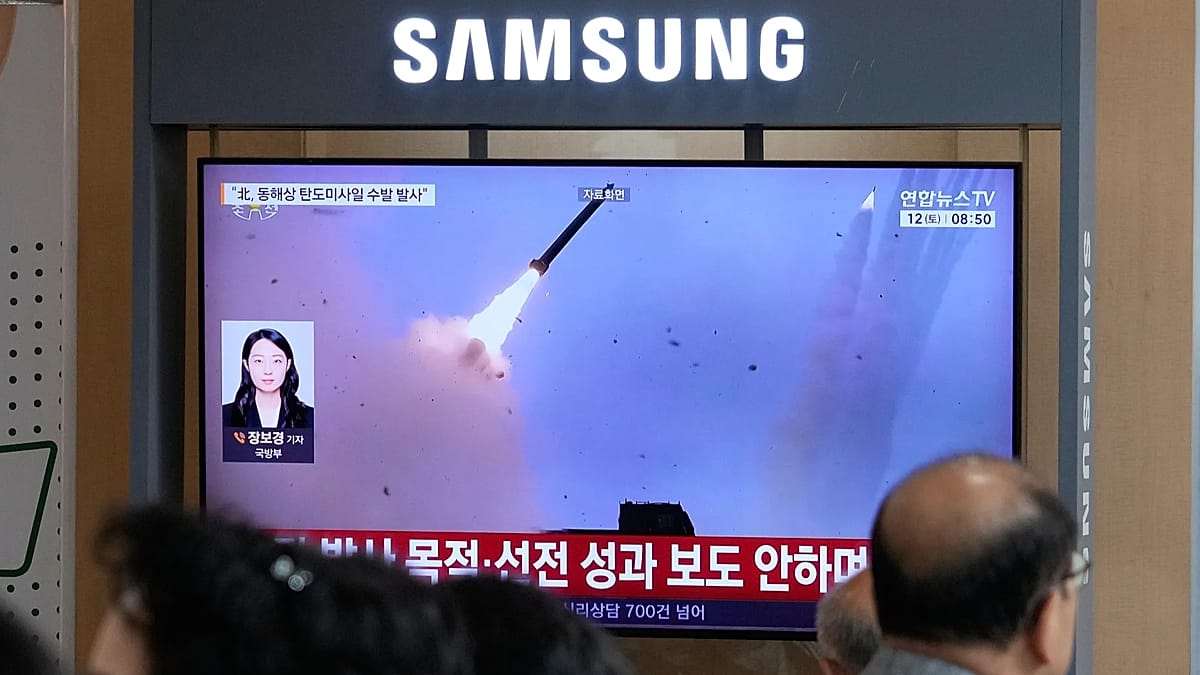
North Korea conducted a launch of a suspected ballistic missile on Sunday, according to the Japanese Prime Minister's office, while South Korea's military reported an unidentified projectile fired into the East Sea. The launch adds to a series of provocations that have kept the region on edge.
The move comes days after Pyongyang dismissed a resolution by the International Atomic Energy Agency (IAEA) condemning its nuclear programme. A spokesperson for the North Korean Foreign Ministry said the resolution had "no effect on the DPRK's position as a nuclear weapons state," underscoring the regime's defiance of international pressure.
Trump's nuclear claims and renewed diplomacy
In August, former US President Donald Trump told reporters that North Korean leader Kim Jong-un had "57 very powerful nuclear weapons," while again touting their personal relationship. "You know what, the fact that I get along with him, that's a good thing not a bad thing," Trump said, adding that Pyongyang's arsenal should "never" have been allowed to develop.
Trump also announced his intention to meet Kim later this year, which would be their first encounter since his first term in the White House. However, no concrete details were provided, and the prospect of such a summit remains uncertain.
On Friday, South Korean President Lee Jae Myung urged Trump to maintain dialogue with Pyongyang, stating that Seoul was working to facilitate talks between the North and the United States. "I cannot say for certain how likely it is, but it is also clear that we must make every possible effort to turn that possibility into reality," Lee said, reflecting cautious optimism in Seoul.
Regional tensions and military exercises
Hopes for an imminent meeting may have been dampened after Kim Yo Jong, the powerful sister of Kim Jong-un, criticised recent military drills in the Western Pacific, which she labelled a "US-led war rehearsal." The US, South Korea and Japan concluded Exercise Freedom Edge 26 on 11 September, which US Pacific Command said advanced "trilateral readiness across the Indo-Pacific."
The latest missile launch is a stark reminder of the volatile security environment in Northeast Asia, with implications for European allies who monitor the region's stability. The European Union has consistently called for denuclearisation and peaceful dialogue, and any escalation could affect global security dynamics.
As the situation evolves, European observers will be watching closely, particularly given the broader context of US sanctions on Russia and shifting transatlantic ties. The EU's own strategic interests in the Indo-Pacific, as outlined in its recent strategy, make developments on the Korean Peninsula a matter of direct concern.
For now, the international community awaits further details on the missile's trajectory and specifications, while diplomatic channels remain open. The coming weeks will test whether the promised personal diplomacy can overcome the deep mistrust that has defined the region for decades.