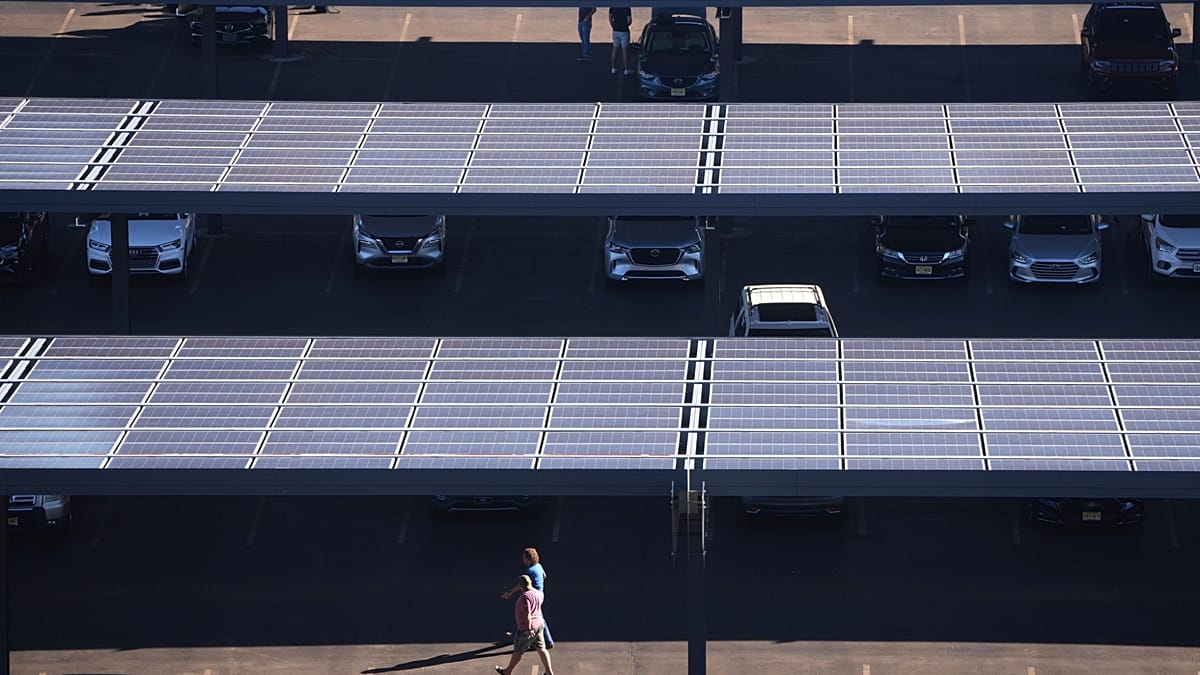
Across Europe, the humble car park is being reimagined as a source of clean energy. By covering parking lots with solar panels, businesses and municipalities could generate electricity, reduce bills, and support decarbonisation goals. Yet despite the clear benefits, uptake varies dramatically from country to country.
Solar power has become one of the most cost-effective energy sources in the EU. According to the International Renewable Energy Agency (IRENA), in 2024 solar panels were on average 41 per cent cheaper than the cheapest fossil fuel alternatives. This price advantage has spurred innovation beyond traditional rooftop and ground-mounted installations, from solar fences to experimental solar railways in Switzerland and Italy.
Car parks offer a particularly attractive opportunity. They occupy vast areas of urban land, often in sunny locations, and can host solar panels without requiring additional land. Rob Stait, a director at Alight, a leading European solar developer, explains: “Car parks can generate electricity without taking up additional land, which is an important consideration given the planning challenges that ground-mounted solar can encounter.”
Solar carports also pair naturally with electric vehicle (EV) charging infrastructure. By generating power on-site, they can reduce the cost of charging and make it easier to install charge points where they are needed. Stait adds that they provide sheltered parking, which helps keep vehicles cooler during Europe’s increasingly hot summers.
France and Germany lead the way
France has been the most ambitious. In 2022, it passed a law requiring all new and existing car parks with at least 80 spaces to be covered by solar panels. Operators of larger sites—those with more than 400 spaces—had to comply by 2025, covering at least half of their area. The government estimated this could add 11 gigawatts to the grid, enough to power around 12 million homes. Non-compliance could result in fines of up to €40,000 a year.
Last year, France eased the mandate slightly, allowing outdoor lots over 1,500 square metres to meet the requirement with a mix of solar panels and shade-providing trees. Still, the policy remains a benchmark for the rest of Europe.
Slovenia has similar rules for reconstructed and new parking lots over 1,000 square metres. In Germany, several states—including Baden-Württemberg, North Rhine-Westphalia, Schleswig-Holstein, Rhineland-Palatinate, and Lower Saxony—have introduced solar mandates for new car parks, depending on the number of spaces.
UK shelves its solar car park plans
In contrast, the United Kingdom has stepped back. Last year, the government launched a call for evidence on how to “harness the untapped potential” of solar in car parks. Initial estimates suggested that an 80-space car park could save around £28,000 (approximately €32,000) per year in electricity bills by installing solar carports and using all the generated power. Companies could also sell excess energy back to the grid.
Former Energy Secretary Ed Miliband said at the time: “Right now, the sun is shining on hundreds of thousands of car parking spaces across the country which could be used to power our homes and businesses.” He pointed to the UK’s first solar park-and-ride in Leeds, which generates an estimated 852,000 kWh per year, offsetting 471 tonnes of carbon annually—equivalent to removing 203 cars from the road.
However, after the consultation, the Department for Energy Security and Net Zero (DESNZ) concluded that the policy “will not be taken any further at this point.” A spokesperson said the decision came after “careful consideration and close engagement with industry,” and that solar remains “central” to the UK’s clean power mission, with support for solar on new buildings through the Future Buildings Standard.
Rob Stait called the decision a “huge missed opportunity.” He argues that relying on market forces alone rarely works without policy support. “The type of debates that typically slow solar deployment—visual impact, biodiversity, land use—largely disappear when you’re building on existing infrastructure like car parks,” he said.
The contrast between France and the UK highlights a broader European divide. While some countries are embracing solar car parks as a practical solution, others remain hesitant, often due to concerns about aesthetics, grid capacity, or upfront costs. Yet as electricity prices remain volatile and climate targets tighten, the case for turning parking lots into power stations grows stronger.
For Europe to fully capitalise on this opportunity, more governments may need to follow France’s lead. The technology is proven, the economics are favourable, and the benefits extend beyond energy savings to include EV charging and urban heat reduction. As inflationary pressures continue to strain household budgets, such measures could offer tangible relief.
With longer heatwaves becoming more common, shaded parking is an added bonus. And as wildfire seasons intensify, the need for resilient, decentralised energy sources becomes ever more apparent.