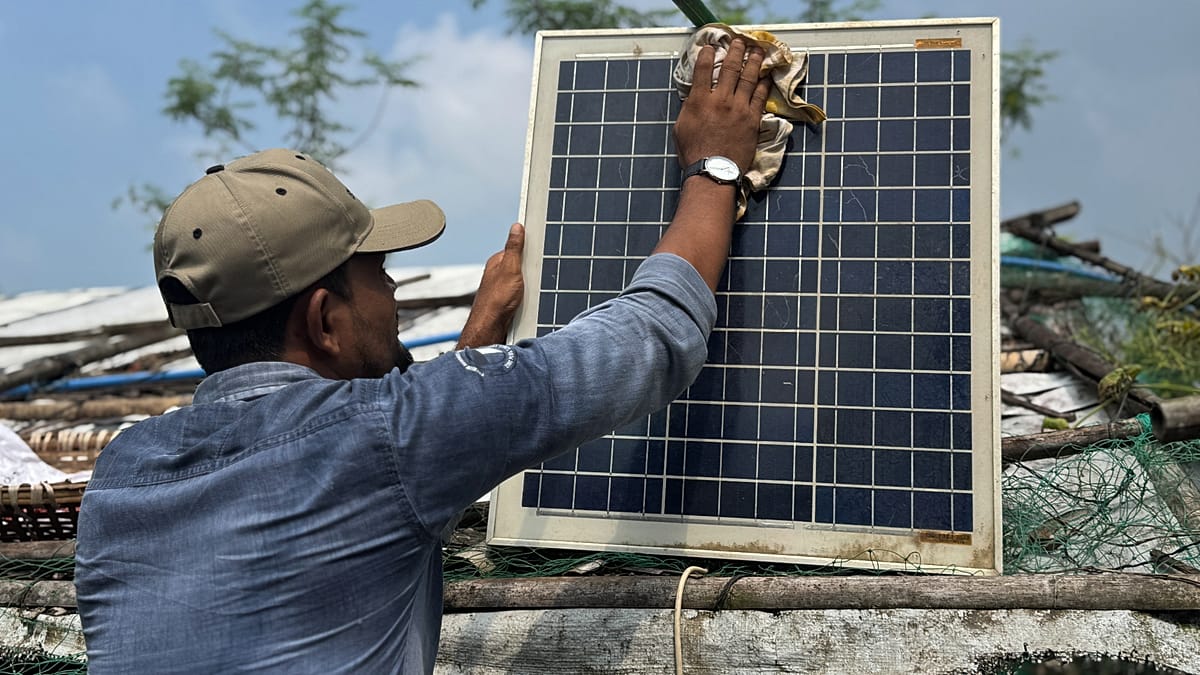
In the sprawling refugee camp at Teknaf, Bangladesh, Mohammed Saber places a single rectangular solar panel on the roof of his bamboo-and-tarpaulin shelter each morning. It is a routine he has followed for six years, ever since the panel was handed to him as part of a humanitarian aid package. For Saber and his family, who fled the Myanmar military's crackdown on the Rohingya in 2017, this small device has become their primary source of electricity.
“We can now charge our phones, cook with light, children can study at night and use fans during the hot season,” says the 35-year-old. His story is echoed across the globe, from the flood-ravaged plains of Nepal to refugee camps in Africa, where solar energy is increasingly becoming a cornerstone of disaster relief.
A quiet revolution in emergency power
Humanitarian organisations are recognising that access to electricity is a fundamental need, not a luxury. As technology improves and costs fall, portable solar kits are emerging as a practical, immediate solution. Sarah Rosenberg-Jansen, a research fellow at the Stockholm Environment Institute, explains that these kits are all-in-one, compact units that operate independently of utility grids. “In emergency situations, solar kits can be deployed immediately,” she says, highlighting their value in rapidly evolving crises—whether floodwaters are rising, front lines are shifting, or roads are impassable.
The kits range from simple solar lanterns to more robust home systems, torches, heating pads, and even electric cook stoves. Their portability and ease of use are key advantages, especially for vulnerable populations. Yuriy Boyechko, CEO of Hope For Ukraine, a US-based nonprofit, notes that even elderly recipients manage with ease. “We have grandmas and grandpas who are around 75-80 years old... receiving kits. It’s just a matter of plug and play,” he says.
From luxury to lifeline
Only a few decades ago, solar energy was a costly luxury. But mass manufacturing and technological advancements have driven prices down dramatically. Unlike fossil fuels, solar panels are not subject to the same price shocks, and they can be transported to disaster zones without the logistical and financial burdens of fuel supply chains. This shift is visible in real-world applications: a tuberculosis clinic in Karachi, Pakistan, runs on solar power; in South Sudan's Renk county, the UN migration agency has installed solar-powered water filtration systems for families displaced by the conflict in Sudan; and after Nepal's catastrophic floods in August, which killed over 1,400 people, solar kits were distributed by groups like Australia's SolarBuddy.
In Europe, the trend is also taking root. A Greek island has cut power costs by embracing renewables, and Europeans are increasingly turning to solar for energy independence. The same principles are now being applied in humanitarian contexts, offering a glimmer of stability in turbulent times.
Obstacles remain
Despite the promise, integrating solar into humanitarian operations is not without challenges. Mark Gibson from the Global Platform for Action (GPA) points out that aid agencies have long-standing systems, often reliant on diesel generators, with established leases and supply chains. Switching to solar requires trust in new technologies and building new distribution networks, sometimes in high-risk environments. Furthermore, recent cuts in international donor funding have undermined progress. Aimee Jenks, a programme leader at GPA, warns, “Much of the technical expertise in the humanitarian sector on energy has been cut. That’s now retracting a lot of progress.”
Cost remains a barrier for many, even as prices fall. Boyechko notes that Hope For Ukraine will have distributed over 3,200 kits by the end of 2026, but “it took us two years to get to that number, because of funding needs.” The need is immense, and the pace of distribution is often limited by financial constraints rather than technological ones.
For families like Mohammed Saber's, the impact is profound. The solar panel has not only provided light and power but also a sense of dignity and control over their daily lives. As climate change intensifies extreme weather and conflicts persist, the role of solar in humanitarian response is set to grow, offering a sustainable path forward in the most challenging circumstances.