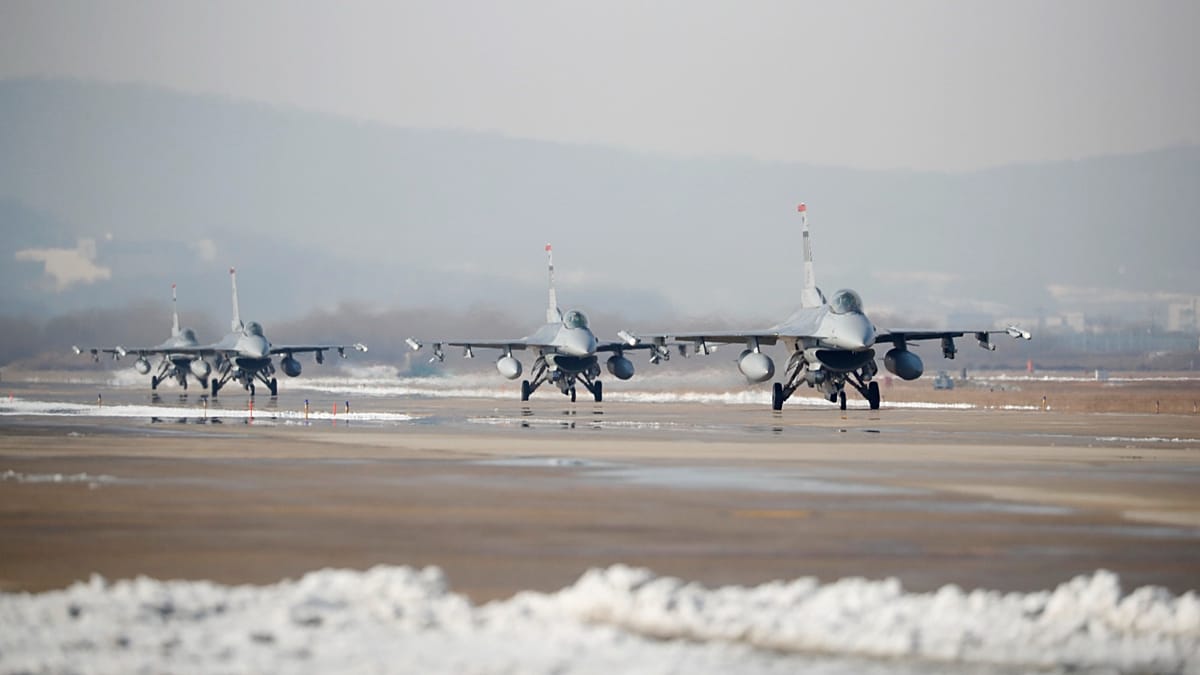
Eight South Korean student activists were taken into custody on Tuesday after attempting to breach the perimeter of Osan Air Base, a key US Air Force installation about 50 kilometres south of Seoul. The group, affiliated with the Korean Progressive University Student Union, had gathered at the main gate to voice opposition to the American military footprint in the country, according to police and US military statements.
The protest was tied to a contentious plan to build a massive semiconductor manufacturing cluster in the southern city of Gwangju. The students argue that the presence of the US military at the Gwangju Air Base, which is partly used by American forces, could complicate the project's development. The proposed hub, valued at 800 trillion won (€485 billion), is intended to house facilities for SK hynix and Samsung Electronics, two of the world's leading chipmakers.
Detention and investigation
The US military confirmed that the eight individuals "attempted to unlawfully enter Osan Air Base through the installation's main gate" and were subsequently handed over to the Korean National Police. A spokesperson for the US Forces Korea said the students are now in police custody and undergoing standard investigative procedures. South Korean police told AFP that the detainees have refused to answer questions during interrogation.
The student union, in a statement posted on Facebook, condemned what it called the "interruption" of the chip cluster project by the US military. The group has long been critical of the American presence in South Korea, which it views as a symbol of neo-colonial influence and a barrier to peaceful reunification with the North.
The Gwangju airbase has been a point of contention for years. Local residents and activists have campaigned for its relocation, citing noise pollution and safety concerns. Last month, the presidential office in Seoul announced that consultations with Washington had begun on moving the airport, a move that could free up land for the semiconductor project. However, the timeline remains uncertain, and the US military has not publicly committed to a withdrawal.
The incident comes at a time when South Korea is reaping enormous economic benefits from the global artificial intelligence boom, which has driven record profits for its chipmakers. The proposed Gwangju cluster is seen as a strategic investment to maintain the country's competitive edge in advanced semiconductors. Yet the presence of a US air base in the city has become a flashpoint for anti-American sentiment, which has simmered for decades.
Anti-American protests in South Korea are not new. In 2019, nearly 20 students linked to a pro-Pyongyang group broke into the US ambassador's residence in Seoul, highlighting the deep-seated grievances among some segments of the population. Issues such as the treatment of Korean women in camp towns near US bases have long fuelled resentment.
The US maintains approximately 28,500 troops in South Korea as part of a mutual defence treaty aimed at deterring aggression from North Korea. The alliance is a cornerstone of regional security, but it has always had its critics, who argue that the military presence undermines Korean sovereignty and perpetuates a Cold War mindset.
For now, the eight students remain in detention, and the investigation is ongoing. The incident is unlikely to derail the broader US-South Korea alliance, but it underscores the delicate balance between security cooperation and local sensitivities. As the chip project moves forward, the fate of the Gwangju airbase will remain a key test of how Seoul and Washington manage their partnership in an era of technological rivalry and shifting geopolitical priorities.