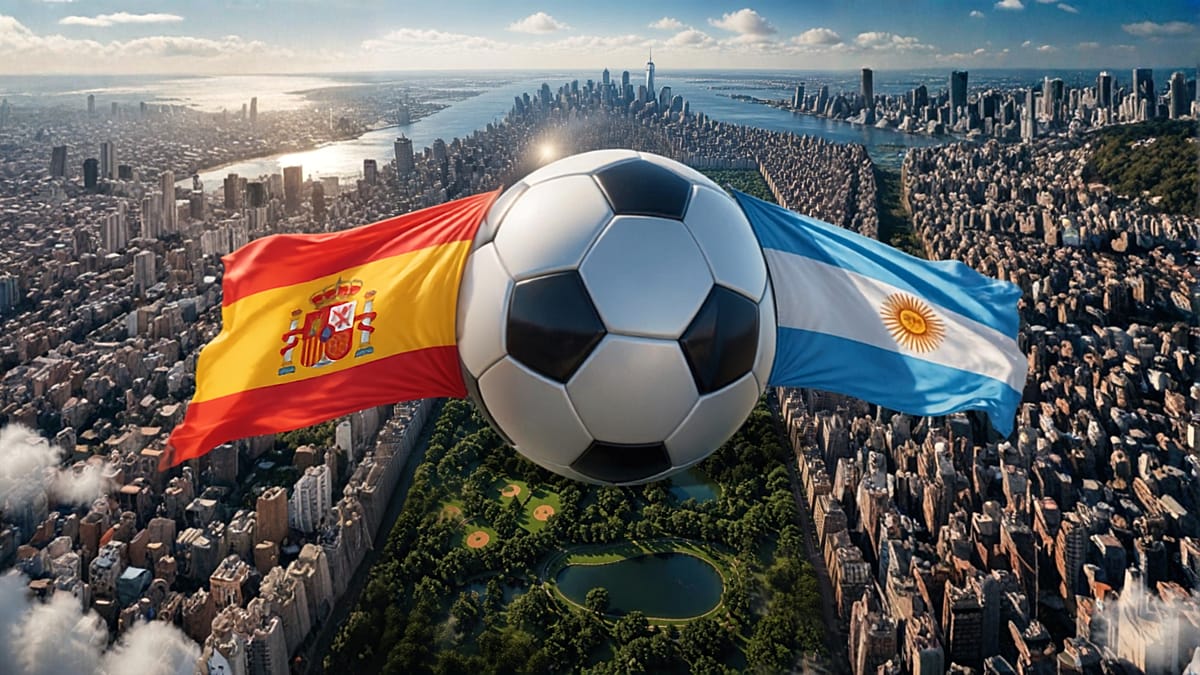
New York's MetLife Stadium will host a historic World Cup final on Sunday, 19 July, as Spain and Argentina meet for the first time with the global crown at stake. The match, scheduled for 5 p.m. local time (9 p.m. in Madrid, 4 p.m. in Buenos Aires), pits the reigning European champions against the Copa América holders and defending world champions.
Both teams have reached the final through contrasting styles. Spain, under Luis de la Fuente, has relied on disciplined possession and defensive solidity, conceding only one goal in the tournament. Their semi-final against France ended 2-0, with goals from Mikel Oyarzabal and Pedro Porro early in the second half. Argentina, led by Lionel Scaloni, has thrived on improvisation and late drama, scoring 19 goals — the most of any team — including a stoppage-time winner against England in the semi-final, set up by Lionel Messi and finished by Lautaro Martínez.
A Clash of Footballing Philosophies
The final represents a duel between two distinct footballing traditions. Argentina's attack, built around Messi's creativity and Julián Álvarez's movement, relies on sudden bursts and individual brilliance. Spain's approach, anchored by Rodri in midfield, emphasizes control and rhythm, with the team rarely losing its shape. As one Spanish journalist put it, "Por la mañana café, por la tarde, gol" — a nod to the team's methodical buildup.
For Spain, victory would secure a second World Cup title, 16 years after their triumph in South Africa. For Argentina, a win would make them the first team to retain the trophy since Brazil in the 1950s, and Messi would appear in his third World Cup final, a feat matched only by Brazil's Cafu.
Spain's lineup is expected to feature Unai Simón in goal; a back four of Porro, Pau Cubarsí, Aymeric Laporte, and Marc Cucurella; a midfield of Rodri and Fabián Ruiz; and an attacking trio of Dani Olmo, Álex Baena, and Lamine Yamal supporting Oyarzabal. However, Yamal missed the final training session with a bandage on his left thigh after a knock in the semi-final, raising fitness concerns. The Spanish camp has downplayed the issue, calling it precautionary.
Argentina's likely starting XI includes Dibu Martínez in goal; a defense of Nahuel Molina (or Gonzalo Montiel), Cristian Romero, Lisandro Martínez, and Nicolás Tagliafico; a midfield of Rodrigo De Paul, Leandro Paredes, Enzo Fernández, and Alexis Mac Allister; and a strike partnership of Messi and Julián Álvarez.
The match will be officiated by Slovenian referee Slavko Vincic, who took charge of the 2024 Champions League final and the 2022 Europa League final. His appointment has drawn attention, particularly in Argentina, where he refereed the shock 2-1 loss to Saudi Arabia in Qatar 2022 — a match in which VAR disallowed two goals for Lautaro Martínez and one for Messi. Spanish fans recall his decision to send off Eduardo Camavinga in a Champions League quarter-final between Real Madrid and Bayern Munich.
Air quality concerns have also emerged, with wildfire smoke threatening the final in New Jersey. Spanish Prime Minister Pedro Sánchez is expected to attend the match before flying to Algeria, as reported by European Pulse.
This final is more than a football match; it is a meeting of two cultures, two languages, and two ways of understanding the game. As the saying goes, "Por la mañana café, por la tarde, gol" — and in New York, the world will watch which rhythm prevails.