Spain experienced its first nationwide general strike in 14 years on Wednesday, as hundreds of thousands of workers and activists took to the streets to demand action on the housing crisis and stagnant wages. The 24-hour stoppage, which began at midnight, was called by the country's two largest unions, Comisiones Obreras (CCOO) and the General Union of Workers (UGT), with support from the smaller CGT and CNT. It was the first such mobilisation since 2012, when Mariano Rajoy's conservative government pushed through labour reforms, and the eighth general strike since Spain's return to democracy in the late 1970s.
Despite heavy rain in Madrid, protesters gathered in large numbers, chanting, dancing, and holding keys aloft as a symbol of their frustration over housing costs. The slogan "Wages, housing and prices" encapsulated the core grievances: rents have risen by roughly 80% over the past decade, while wages have failed to keep pace. Young people, in particular, have been hit hard, with many forced to live with parents or share overcrowded flats.
The strike was directed at all levels of government, from local councils to the central administration in Madrid, which protesters accuse of failing to tackle the crisis. Valeria Racu, a spokesperson for the Tenants' Union (Sindicato de Inquilinas), was blunt in her criticism: "This is a strike against rentierism, against landlords, against employers and against all governments," she said. "That includes the central government, this progressive government that has been very disappointing and whose housing policy has been disastrous and has brought us to this point, just as the policies of the Partido Popular did before."
Turnout estimates varied sharply between organisers and authorities. In Madrid, the Tenants' Union claimed more than half a million participants, while the central government's office counted 120,000. In Barcelona, organisers said 400,000 people marched, compared with 55,000 according to city police. In Bilbao, municipal police recorded around 50,000 attendees. The discrepancies reflect the deep divisions over the strike's impact.
Clashes and arrests
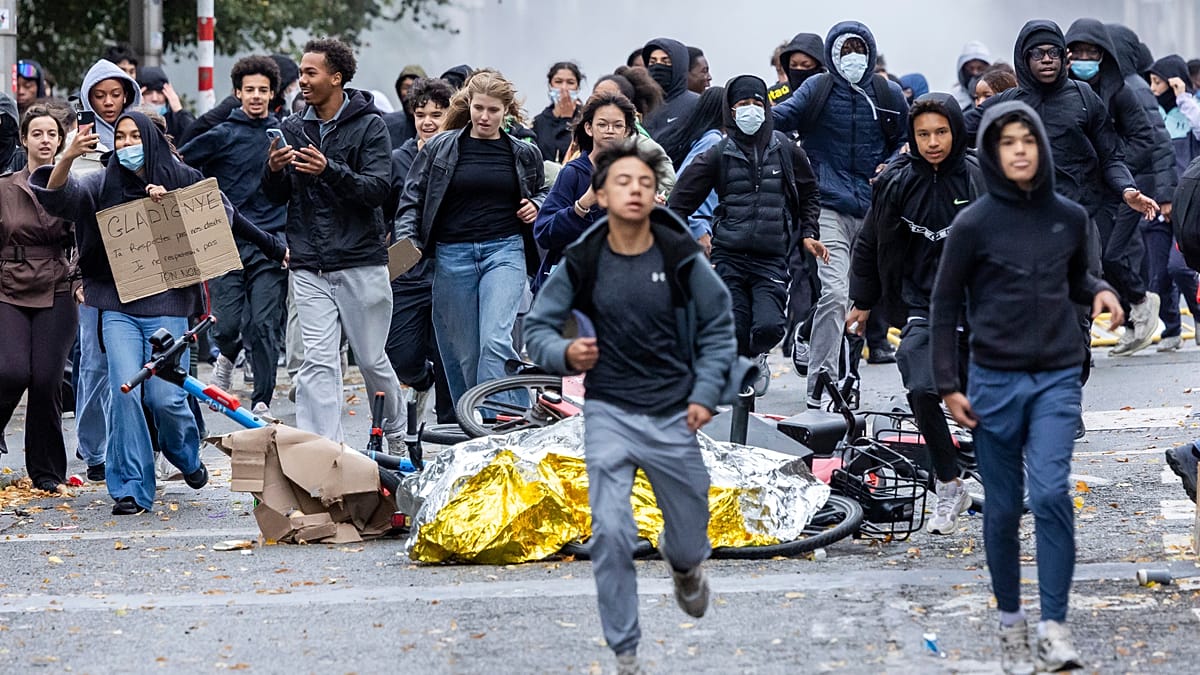
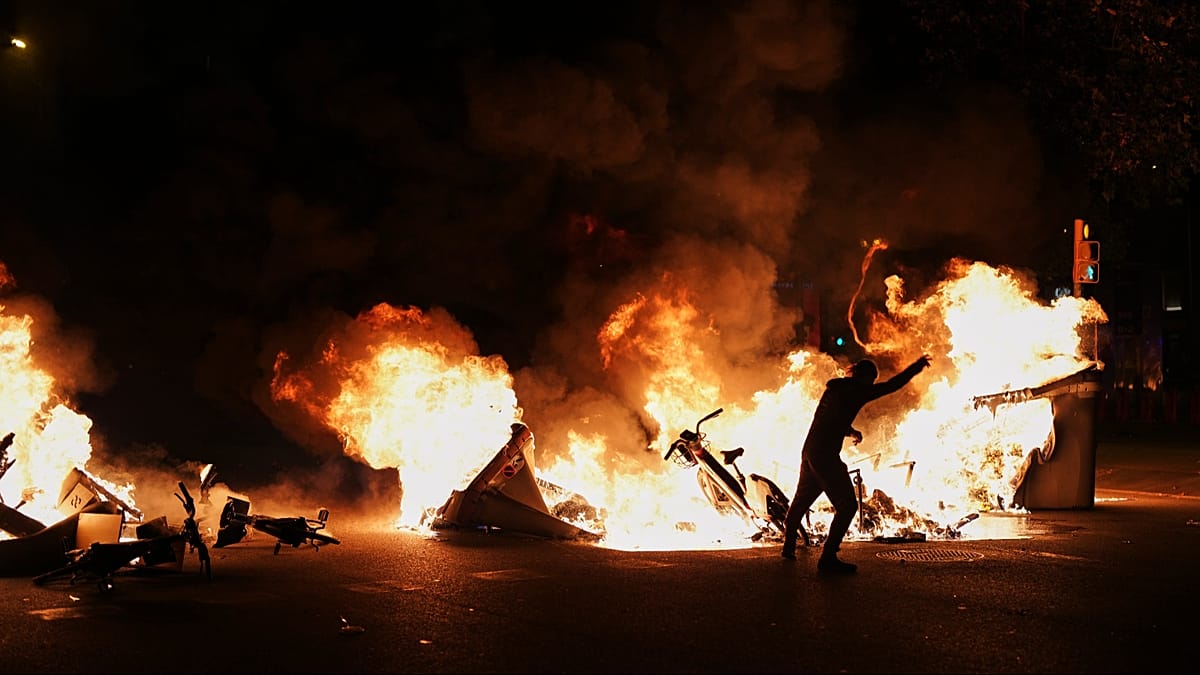
The most tense moments occurred in Madrid and Barcelona, where riot police charged groups of masked protesters who had thrown fireworks and flares at officers. Nationwide, more than 70 people were arrested, and police reported 1,500 incidents. Early in the morning in Madrid, at least eight people were injured when police charged a picket outside the city's bus depots. The UGT's general secretary, Pepe Álvarez, accused police on X of obstructing a constitutional right by surrounding an information picket at Mercamadrid, the city's main wholesale food market.
Afternoon marches were scheduled in Barcelona from the Jardinets de Gràcia and in Madrid from Atocha station to Plaza de España, but the clashes had already set a confrontational tone. The strike also disrupted public transport, with the Madrid metro running a minimum service and recording 21% fewer passengers at 7:00.
Divergent assessments
Unions and employers offered starkly different verdicts on the strike's success. According to CCOO and UGT, participation reached 90% in the ports, especially Valencia and Algeciras, and in the car industry, with complete stoppages at Volkswagen's plant in Navarre and at Seat. Participation stood at 85% in the meat industry and 82% in waste collection. Industrial electricity demand fell by 25.6%, a figure unions cited as evidence of the stoppage's reach.
Employers, however, dismissed the strike as a failure, pointing to lower participation in many sectors and the relatively limited impact on overall economic activity. The conflicting narratives are typical of general strikes, but the underlying issues remain unresolved. As Spain's economy continues to grow, the gap between housing costs and wages has become a political flashpoint, with tenant unions and left-wing parties pushing for rent controls and more social housing.
The strike comes amid broader European debates about housing affordability and labour rights. In which European economy bleeds most when workers strike, analysts have noted that Spain's strike culture is less disruptive than in France or Greece, but the social tensions are comparable. The Spanish government, led by Prime Minister Pedro Sánchez, has promised measures to address the housing crisis, but protesters remain sceptical.
Wednesday's events also echo past protests, such as the train crash victims honoured at Toledo Cathedral, which highlighted the country's capacity for collective mourning and mobilisation. More recently, Spain cleared the Ceuta port camp as hundreds of migrants returned to Morocco, a reminder of the pressures on the country's borders and social services.
As the strike drew to a close, union leaders vowed to continue their campaign if the government does not respond to their demands. "This is only the beginning," said a CCOO spokesperson. "We will not accept a country where working people cannot afford a home." The coming weeks will show whether the government is willing to negotiate or faces further unrest.