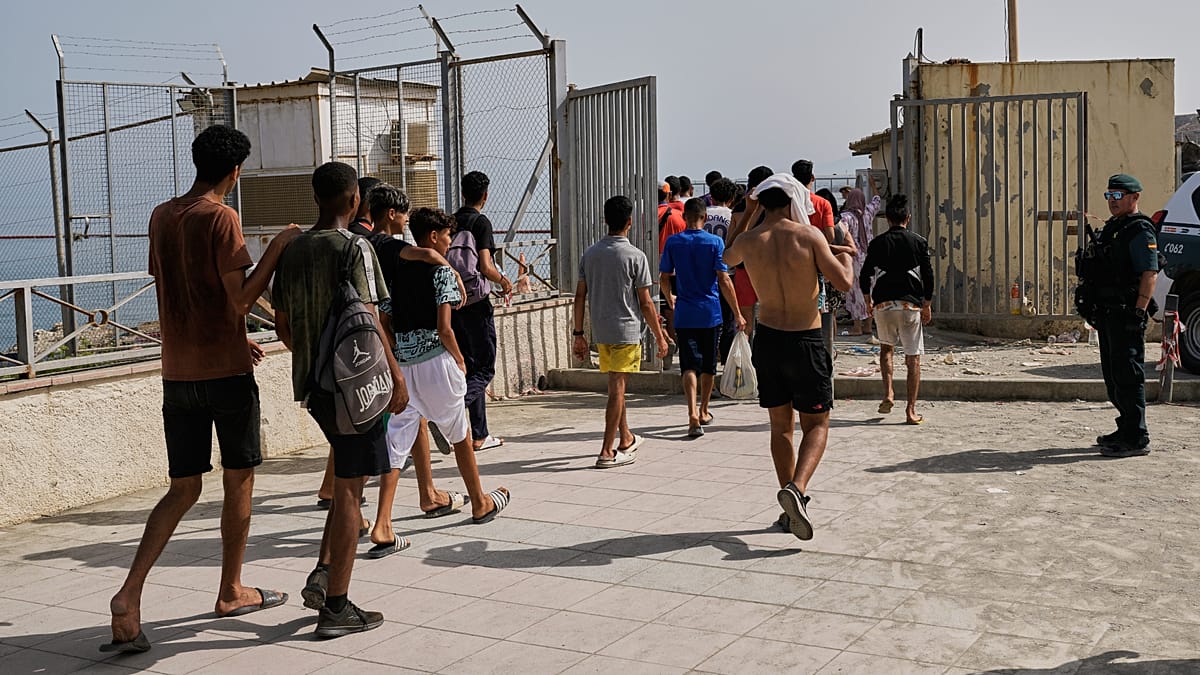
Spain's Civil Guard has drawn up a six-page assessment of the risk of another mass migrant crossing into the North African enclave of Ceuta on 15 August, following a surge in late July that overwhelmed local authorities. The document, obtained by the Spanish outlet Mañaneros, is based entirely on open-source intelligence—social media posts and media coverage—and was commissioned to gauge whether an online call to attempt the crossing is genuine, how far it has spread, and the level of coordination behind it.
The report stops short of predicting a repeat of the late-July events. As cited by RTVE, it states that there is no reliable basis for estimating how many people might take part, nor for assuming that the 15 August date will trigger a mass movement. Its central conclusion is that an active online campaign exists with the potential to mobilise people, but whether it will translate into a real-world crossing, the numbers involved, and the identity of those behind it all remain unknown.
The Civil Guard notes that much will depend on preventive measures taken by Moroccan authorities on roads, at transport hubs, in the border town of Fnideq, and along the coast, as well as on Spain's own security deployment. The report was compiled after monitoring that continued until 4 August.
What triggered the investigation?
According to the Civil Guard, the first calls for a new collective attempt to reach Ceuta began circulating in late July and early August, when young Moroccans started sharing messages urging another push around 15 August. The report compares coverage from both Spanish and Moroccan media, observing that the issue has moved beyond Spanish-language social media. Investigators examined Facebook, WhatsApp, and Instagram groups with memberships ranging from roughly 400,000 to over 422,000 people, though the report itself cautions against reading too much into those figures.
More significant, investigators say, are the recurring patterns: repeated references to the 15 August date, the same geographical locations, detailed discussions about how to organise the crossing, and the persistence of these messages over several days. The report also found a substantial amount of misinformation circulating online, including claims that the border would be opened, that migrants would receive asylum or financial assistance, or that anyone reaching Ceuta could not legally be returned.
Who is behind the campaign?
The report describes the online drive as decentralised. Rather than identifying a single organiser, investigators found that the proposed date appeared to spread organically from one online group to another. Based on the open-source material reviewed, the Civil Guard said it had been unable to identify those responsible for promoting the campaign. It also said it had found no evidence linking it to the Moroccan government, Moroccan security services, or any specific migrant-smuggling network.
However, the report dismisses the idea that the campaign was entirely spontaneous. It concludes that there appears to be “some degree of digital facilitation”—in other words, some level of coordination behind the online activity—even though its source and extent remain unclear. This echoes concerns raised in earlier coverage of disinformation around the Ceuta crossings.
Brussels keeps watch
The European Commission said it is closely monitoring social media ahead of 15 August. “We remain fully vigilant before, during, and after 15 August,” spokesperson Guillaume Mercier told reporters. However, Brussels urged caution, stressing that many of the reports circulating online “have not been verified” and that the overall picture remains “unclear.” The Commission said it is in close contact with both Spanish and Moroccan authorities.
The Commission also noted that it had detected Russian-linked channels that began rapidly amplifying the migration issue from 30 July onwards. This adds a geopolitical dimension to the situation, as the EU has previously accused Moscow of using migration as a tool to destabilise member states. The Commission pointed out that the EU can use legislation such as the Digital Services Act (DSA) to tackle online disinformation, which requires major digital platforms to assess and mitigate systemic risks to public security. Spain has not, however, activated the DSA's crisis mechanism, which would allow for enhanced coordination with the platforms.
The situation in Ceuta remains tense, with the city's mayor having previously urged the EU to deport migrants after the border surge. The EU is also weighing new aid for the enclave, while questions mount over Madrid's handling of the crisis. As the 15 August date approaches, the uncertainty over whether the online calls will translate into a physical crossing underscores the fragile nature of the border and the broader challenges facing the EU's external frontiers.