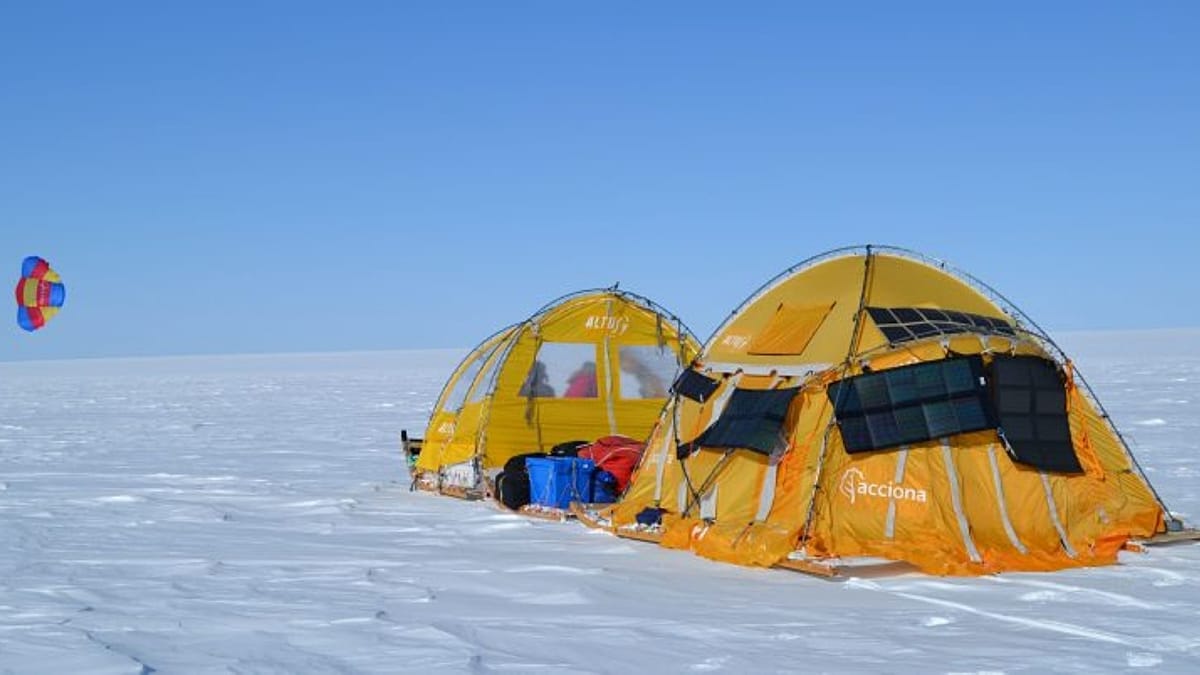
Spanish polar explorer Ramón Larramendi is preparing to lead a scientific expedition across the Antarctic interior that will cover roughly 3,400 kilometres in about 80 days, without burning a single drop of fossil fuel for transport. The Wind Sled Antarctica 2026-2027 project will carry instruments for 16 research projects in some of the most inaccessible terrain on the planet, aiming to expand knowledge about ice dynamics, climate change, and polar ecosystems.
“The wind sled is, in a way, completely unique in the world,” Larramendi told European Pulse in an interview in Madrid's Plaza de España. The explorer believes his design is an exceptional blend of traditional techniques and advanced technology, conceived to travel long distances without combustion engines or aerial resupply.
The expedition departs Spain on 18 October and is scheduled to return in early February. The route begins near Russia's Novolazarevskaya base in Queen Maud Land and ends at the French-Italian Concordia station on Dome C, after crossing the Pole of Inaccessibility and passing near the Pole of Cold.
A wind-powered vehicle for zero-emission polar travel
The Wind Sled is a polar exploration platform that uses kites to harness wind power and solar energy to run scientific equipment. Its design, inspired by Inuit culture, is the result of about 25 years of development and testing, during which Larramendi has travelled more than 28,000 kilometres over ice on various expeditions.
“This sled combines Inuit techniques, which may look old-fashioned and a bit strange compared with modern technology. That makes it a very, very unusual mix, but tremendously efficient,” says the explorer, who sees sustainability as a core pillar of the project.
The vehicle consists of four modules and is 15 metres long. It can carry up to 2,100 kilograms of cargo, though on this trip it will initially transport around 250 kilograms of scientific instruments. The crew will have 20 kites, with surface areas ranging from five to 150 square metres, deployed according to weather conditions. In favourable winds, the sled can reach speeds of up to 80 kilometres per hour, with an average cruising speed of about 25 kilometres per hour.
The absence of fossil fuels reduces both environmental impact and logistical needs. For comparison, the Transantarctic Scientific Expedition of 2011-2012 covered a similar distance using tracked trucks, snowmobiles, and sleds, consuming around 170,000 litres of fuel in two months.
Larramendi hopes this campaign will demonstrate the vehicle's potential as a scientific platform for future crossings. “Other systems powered by renewable energy may emerge to cross Antarctica, but none will be more sustainable or have a smaller footprint than the Wind Sled,” he argues.
Sixteen projects to study ice, pollutants, and microbial life
The expedition will carry out 16 scientific projects selected through a call coordinated by the Spanish Polar Committee. The research involves centres from CSIC, CIEMAT, INTA, six Spanish universities, and international organisations, providing direct measurements in areas where data are scarce, complementing satellite and permanent station observations.
Among the studies is a project from NASA's Ames Research Center, led by Spaniard Alfonso Dávila, which will examine whether conditions favourable to microbial life can arise inside salt rocks exposed to Antarctica's extreme cold. Sensors will measure temperature, relative humidity, and electrical conductivity to determine whether liquid water could form inside them despite low temperatures and aridity.
Another project, called Dinglac and led by glaciologist Francisco Navarro of the Polytechnic University of Madrid, will use ground-penetrating radar to analyse the first ten metres of snow. The measurements will help understand how snow layers accumulate and move, improving estimates of how the Antarctic ice mass is evolving in the context of climate change.
The campaign will also investigate microplastics, persistent pollutants, and possible microorganisms and viruses, as well as studying Earth's magnetism and the performance of Europe's Galileo navigation systems. Some experiments will use equipment linked to space exploration.
For Larramendi, the value of this work also lies in the fact that it will take place in territory that is virtually unknown from a scientific point of view. “It takes place in an area for which there are practically no data,” he explains. The system makes it possible to venture into regions where conventional operations are difficult and costly.
Four people isolated for 85 days: an experiment for future space missions
The expedition team will consist of four Antarctic veterans: Larramendi himself; Hilo Moreno, polar guide and mountain technician; Mariusz Potocki, a researcher at the University of Maine in the United States; and Javier Selva, photographer, documentary maker, and head of technical image direction. Selva already accompanied Larramendi on an Antarctic expedition between 2011 and 2012.
In addition to fieldwork, the four explorers will themselves be the subject of study, providing data on human physiology and psychology during prolonged isolation, which could inform future space missions. The expedition's innovative approach to sustainable travel also resonates with broader European efforts to reduce carbon footprints in scientific research, as seen in other initiatives across the continent.