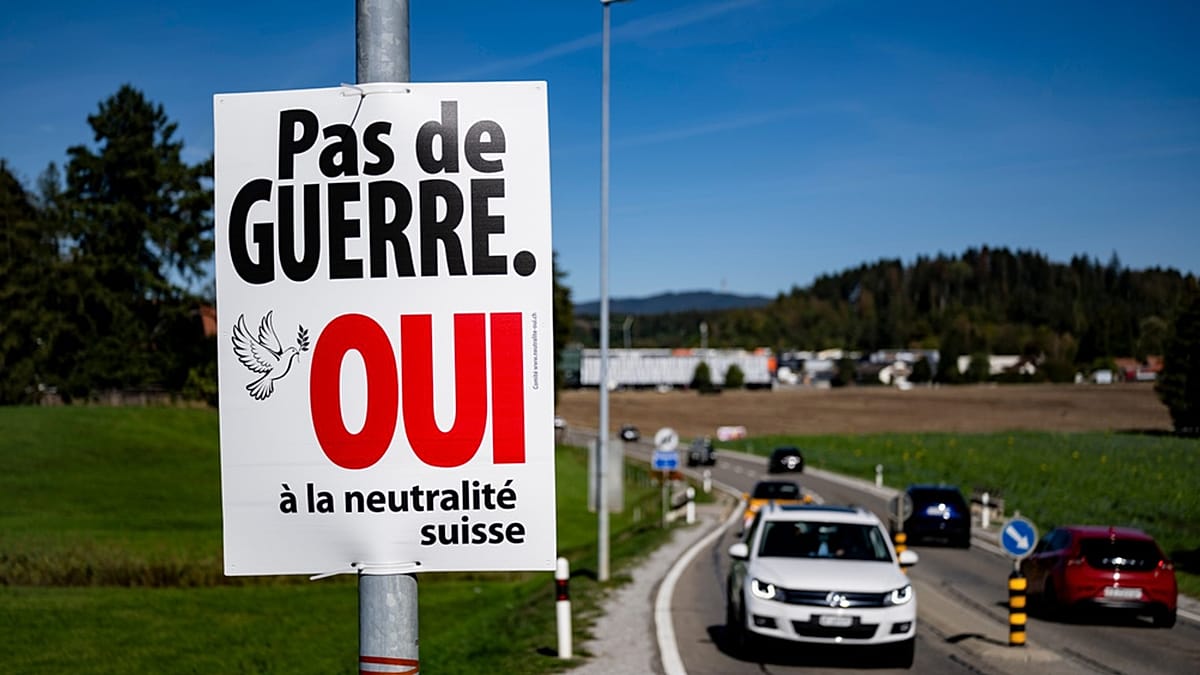
Swiss voters delivered a resounding rejection of a proposal to harden the country's neutrality, with roughly 70% voting against the measure in a nationwide referendum on Sunday. Final results published by the government showed the initiative was defeated in all 26 cantons, a rare clean sweep that underscored the breadth of opposition.
The proposal, championed by the right-wing Swiss People's Party (SVP), would have written "perpetual and armed neutrality" into the constitution. Crucially, it would have barred Bern from imposing sanctions on other states unless those measures had first been approved by the United Nations — a provision that would have effectively handed Moscow a veto over Swiss sanctions policy, since Russia holds a permanent seat on the UN Security Council.
A verdict on cooperative neutrality
Supporters, led by SVP veteran Christoph Blocher, argued that Switzerland had drifted too close to the European Union and NATO, particularly since Russia's full-scale invasion of Ukraine. Campaign posters carried the slogan "No to war". But the defeat had been widely anticipated: Swiss media reported that the foreign ministry in Bern had privately forecast the outcome weeks before the vote.
Foreign Minister Ignazio Cassis sought to frame the result as a reaffirmation rather than a rupture. "This result is not a vote against neutrality," he told a press conference in Bern. "Switzerland was neutral yesterday, it will be neutral today and it will remain neutral."
The government's current doctrine is what it calls "cooperative neutrality": Switzerland remains militarily non-aligned and outside any alliance, but retains the right to impose sanctions when it judges them necessary to uphold international law. Defence Minister Martin Pfister has separately called for closer cooperation with NATO.
Blocher's costly gamble
The initiative was the personal project of Blocher, the 85-year-old billionaire and long-time SVP eminence grise. According to the Berner Zeitung, he spent 3.8 million Swiss francs of his own money on the campaign — reportedly the largest sum ever contributed by a single individual to a Swiss referendum.
Opponents argued that codifying neutrality in rigid terms would have paralysed Swiss foreign policy. "The initiative would have set neutrality in stone and would no longer have allowed an adequate response to a given situation," said Susanne Vincenz-Stauffacher, a member of the National Council, referring to Russia's war against Ukraine. She warned that such a definition could prevent Switzerland from sanctioning an aggressor: "At the end of the day you are not neutral but on the aggressor's side."
Marianne Binder, a Centre Party member of the Council of States representing Aargau, was blunter: "Blocher has completely lost his way here."
The result will be read closely in Brussels, where Switzerland's relationship with the EU remains unsettled, and in NATO capitals that have watched Bern edge toward closer security cooperation. It also follows a pattern seen elsewhere in Europe, where voters have weighed proposals to redefine neutrality against the demands of a changed security environment.
Yet the vote should not be mistaken for a shift in Swiss public opinion on neutrality itself. According to the latest survey cited during the campaign, 82% of respondents continue to support the principle. What a clear majority rejected was not neutrality as such, but a particular, restrictive interpretation of it — one that would have constrained Bern's room for manoeuvre at a moment when much of Europe is rethinking its own.
The referendum formed part of a broader round of national and local votes held across the country on Sunday.