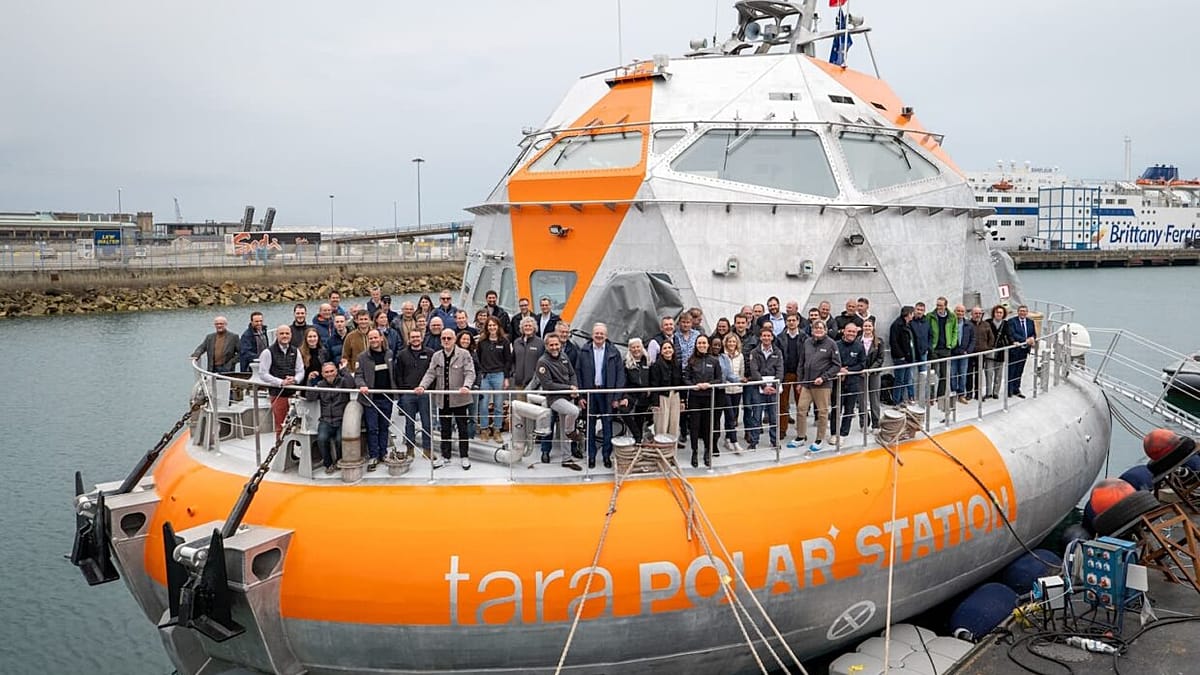
On Sunday afternoon, the Tara Polar Station departed the port of Lorient in Brittany, setting course for the North Pole on its inaugural scientific expedition. Several hundred onlookers lined the quays to witness the departure, joined by France's Minister for the Sea, Catherine Chabaud.
The vessel, a floating laboratory shaped like an igloo atop a massive buoy, is designed to withstand the crushing pressure of sea ice and temperatures as low as −52 °C. Its mission: to drift passively with the pack ice for 350 to 500 days, gathering unprecedented data on Arctic Ocean biodiversity and the accelerating effects of global warming in a region heating three to four times faster than the global average.
A multinational effort in extreme conditions
Twelve countries are contributing to the mission, including Germany, Canada, the United States, Spain, Switzerland, and Japan. The crew will comprise twelve people during the polar winter—six of them scientists—and eighteen during the summer months. All members underwent rigorous medical and psychological screening and participated in team-building exercises to prepare for the isolation and hazards of the Arctic.
From mid-August, the station will sail along the Russian coast, escorted by an icebreaker, before deliberately allowing itself to be trapped in the pack ice at the beginning of September. Once frozen in, it will drift at an average speed of about ten kilometres per day toward the Fram Strait, between Greenland and Svalbard, where it is expected to emerge at the end of 2027.
The overwintering crew will face five months of polar night, average temperatures of −25 °C, and the constant threat of polar bears. All personnel have been trained in the use of firearms for protection during ice excursions. A Lapponian herder dog will accompany the mission to detect approaching animals.
Scientific goals: understanding a rapidly changing Arctic
At the heart of the station, a moon pool and state-of-the-art instruments will allow researchers to collect more than 10,000 samples from the water column down to 2,000 metres depth, as well as from the atmosphere and cavities within the sea ice. The aim is to document Arctic biodiversity—still largely unknown—before the region is profoundly transformed by climate change.
Several research programmes will focus on improving climate models, including studies on how bacteria influence the reflectivity of clouds. The data collected could help refine predictions of future warming and sea-ice loss. This work builds on earlier European efforts, such as the Arctic seabed expedition that revealed fragile ecosystems at risk from Norway's mining plans.
The cost of this first mission is estimated at €6 million. It marks the beginning of a broader programme: ten expeditions scheduled between 2026 and 2045, with one mission every two years. The Tara Polar Station represents a significant European investment in polar science, with implications for understanding global climate dynamics and the future of the Arctic region.