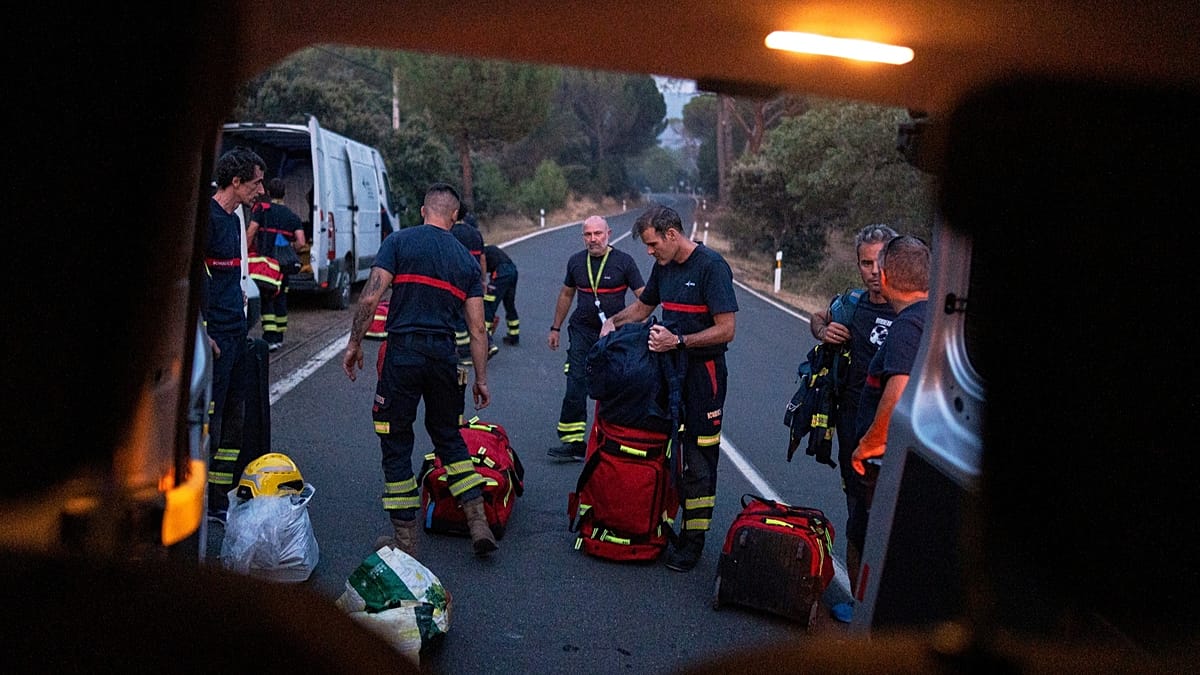
Firefighting crews in southwestern Spain faced a grueling battle on Monday as three major wildfires continued to burn out of control, forcing the evacuation of around 800 residents. The largest blaze, which ignited last week in the Andalusian province of Huelva, has been particularly stubborn due to shifting winds and rugged terrain, according to regional emergency officials.
Antonio Sanz, the region's minister for emergencies, described the situation as "extremely difficult, complex and dangerous," noting that weather conditions offered no respite. "It is a long-distance race full of obstacles," he said, adding that there was no immediate prospect of containment. "We have to be realistic: there is no forecast that the fire will be brought under control any time soon. There are still hours and probably days of intense work ahead."
More than 600 firefighters, supported by 26 water-dropping aircraft, worked through the night conducting controlled burns and carving out mechanized firebreaks. Yet authorities acknowledged that the combination of steep slopes, dry vegetation, and erratic winds had slowed progress significantly.
Evacuations and scale of the fires
On Monday, officials ordered the evacuation of El Madroño, a municipality of roughly 300 people, bringing the total number of evacuees to about 800. The fire perimeter currently encloses more than 20,000 hectares, though authorities stressed that this figure represents the area within the fire line, not necessarily land that has been completely burned.
Separate blazes are also raging in Castellón and Segovia, both rated at level two severity. Spain has endured a punishing summer, with around three dozen wildfires forcing tens of thousands of people from their homes, particularly in the central regions. A July fire in Ávila, near Madrid, was considered the largest in recent Spanish history, devastating some 50,000 hectares. Earlier in the month, another blaze in Almería province claimed 14 lives.
The current fires are part of a broader pattern across Europe, which has experienced successive heatwaves and droughts this year. Scientists attribute the intensification of these events to human-induced climate change. As record heat and wildfires continue to strain resources from the Balkans to the Iberian Peninsula, the need for coordinated European responses becomes ever more urgent.
In Huelva, the fire has already destroyed homes and livelihoods, with images showing charred structures and blackened landscapes. Local authorities have set up temporary shelters for evacuees and are working to protect vulnerable communities. The Andalusian government has requested additional support from the national government, including more aircraft and specialized ground crews.
Firefighters remain cautiously optimistic despite the challenges. "We are making progress in some areas, but the fire is unpredictable," said a spokesperson for the regional fire service. "Our priority is the safety of residents and firefighters." The coming days will be critical, with forecasts indicating continued high temperatures and low humidity.
As Spain battles these blazes, the wider European context remains troubling. The heatwave has strained rivers and energy supplies across the continent, while other countries, including Albania, have also faced severe fire outbreaks. The European Union has activated its civil protection mechanism to assist affected member states, but the scale of the crisis is testing the limits of national and regional capacities.
For now, the immediate focus is on containing the flames and ensuring the safety of those displaced. But the longer-term questions about climate adaptation and fire prevention are becoming impossible to ignore. As one local official put it, "We are fighting a new kind of fire, one that demands new strategies and greater solidarity."