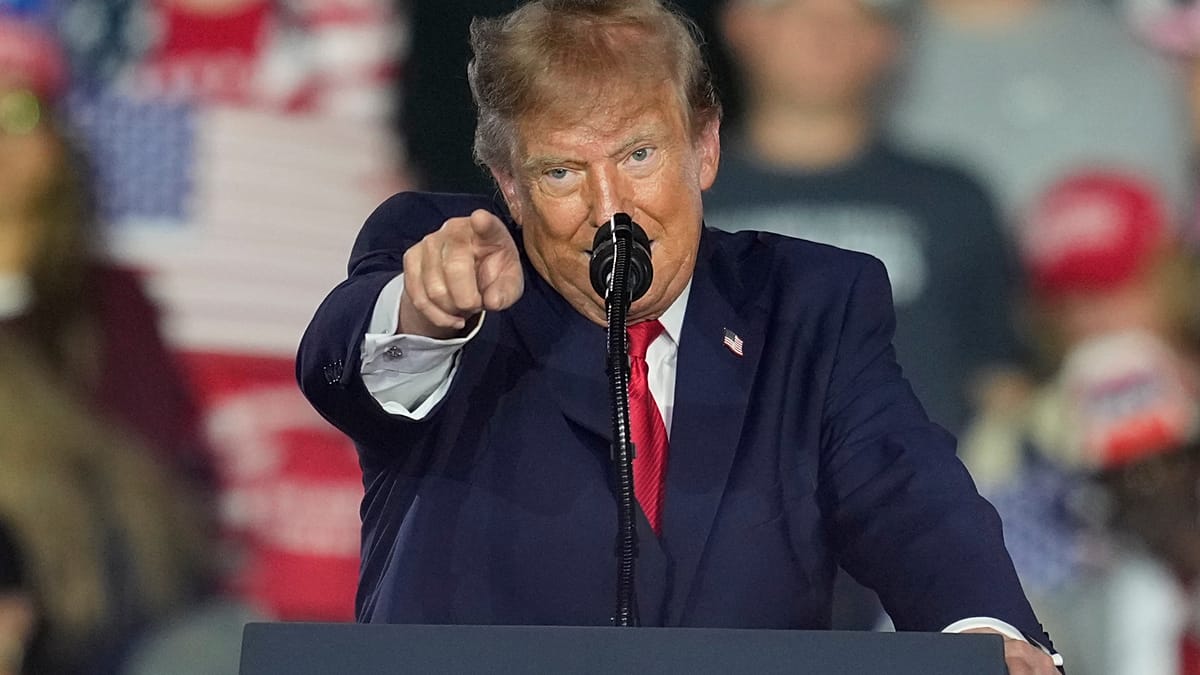
US President Donald Trump concluded his midterm campaign on Sunday with rallies in Salina, Kansas, and Dubuque, Iowa, as the Republican Party braces for a challenging election day. The president's final push comes amid signs of internal Democratic strife in Michigan that could complicate the party's bid to flip the Senate.
In Iowa, Trump addressed a crowd for two hours, telling supporters that Republicans are on the verge of sweeping victories. “We're going to elect ‘America first’ Republicans up and down the line,” he declared early in his speech. Later, in Kansas, Air Force One flew over an enthusiastic crowd before landing at Salina airport for an outdoor rally. Trump spoke for nearly 90 minutes, though hundreds of attendees left before he finished.
“This is our last stop. We’re closing it down tonight,” Trump said, capping a campaign that has included more than two dozen rallies across 19 states since the start of October. With over 54 million ballots already cast, Tuesday's elections are widely seen as a referendum on Trump's second term, which has been marked by declining approval ratings, sweeping tariffs, and the decision to launch a war in Iran.
This year's campaign strategy marks a shift from 2024, when Republicans focused on flipping states that had voted for Joe Biden. Now, Trump has concentrated his efforts on states he has previously dominated, such as Iowa and Kansas, where Democratic challengers are nonetheless running competitive races.
All 435 House seats and 35 Senate seats are on the ballot. Republicans currently hold a narrow 219-214 majority in the House and a 53-47 edge in the Senate. Polls suggest Democrats are well positioned to regain control of the House and have a viable path to a Senate majority. A Democratic House would give the party control of the federal budget, the power to block legislation, and greater authority to investigate the Trump administration.
Michigan's Democratic rift
In Michigan, a public split has emerged within the Democratic Party. Congresswoman Haley Stevens, who lost the Democratic Senate primary to progressive Abdul El-Sayed, announced she would endorse Republican Mike Rogers in the Senate race. Stevens told reporters, “This is a very close election, we all know that, but Abdul made very clear that I was not welcome in his campaign.”
Trump praised Stevens for her endorsement and welcomed her to join the Republican Party. “I don’t know Haley, I’ve never met Haley, but Haley said what few people are willing to say,” he said. At his rallies, Trump continued to attack El-Sayed, using Islamophobic rhetoric and branding him a “jihadist.” “Can you imagine, we’ll have to put him through metal detectors...,” Trump said.
El-Sayed, whose national profile has been rising, has been a vocal critic of the US alliance with Israel and has called for an end to US arms sales to the country. His candidacy has energized progressives but has also exposed divisions within the party, which could prove costly in a tight race.
The Michigan contest is one of several that will determine control of the Senate. Democrats need to net at least two seats to take the majority, assuming they hold the vice presidency's tie-breaking vote. With polls showing a close race, the endorsement by Stevens could sway undecided voters.
As the campaign draws to a close, both parties are making their final appeals. Trump's rallies have been marked by lengthy speeches and attacks on opponents, while Democrats have focused on economic concerns and the administration's record. The outcome on Tuesday will shape the remainder of Trump's term, including his ability to implement his agenda and the future of US foreign policy, particularly regarding delays in military aid to Ukraine that have worried NATO allies.
European observers are watching the midterms closely, as the results could affect transatlantic relations, trade policy, and security commitments. Trump's tariffs have already strained ties with the EU, and a Democratic Congress could push back on his trade agenda. The president's recent remarks about Norway have also raised eyebrows in Europe, adding to the diplomatic friction.
With early voting already surpassing 54 million, turnout is expected to be high. Both parties are mobilizing their bases, and the final rallies in Iowa and Kansas underscore the importance of these battleground states. The results will be closely watched not only in the United States but also in European capitals, where the stability of the transatlantic alliance is at stake.